
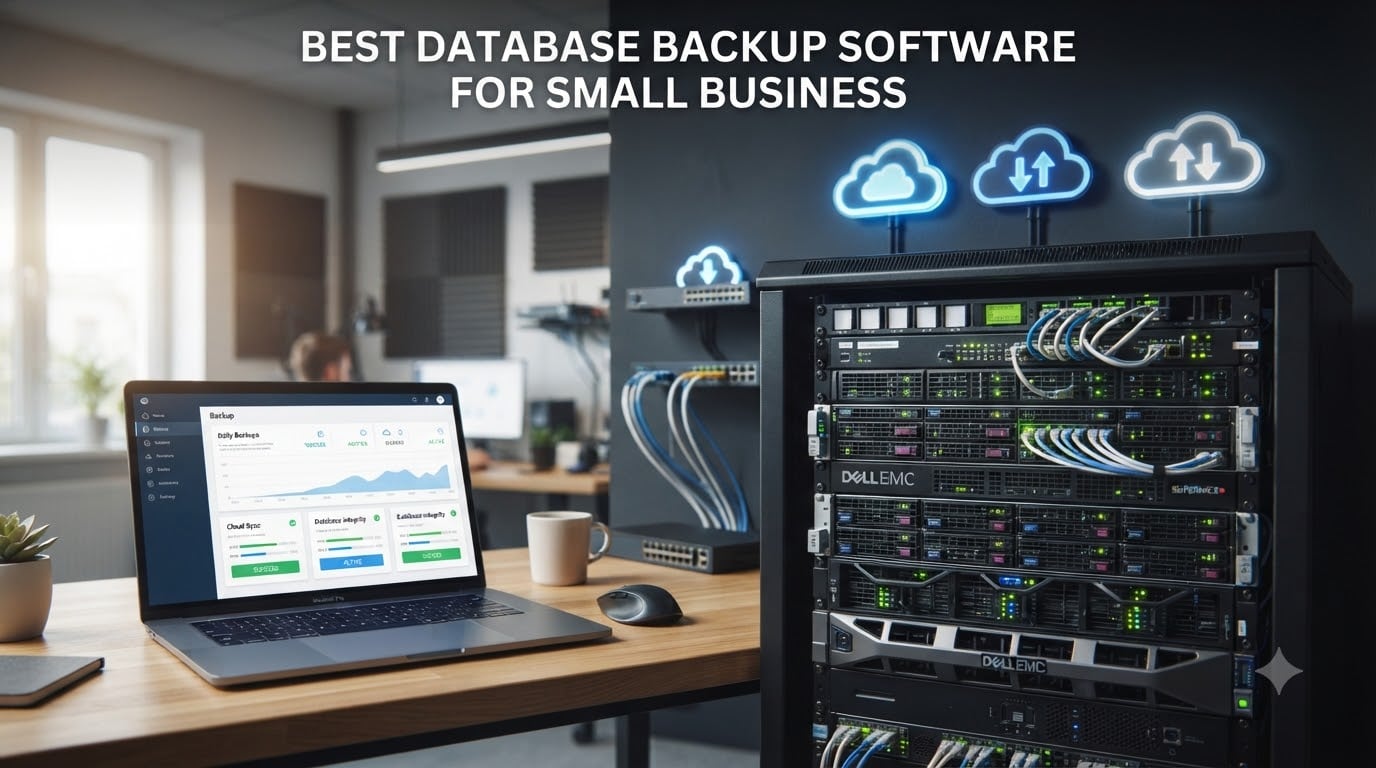
If you run a small business and depend on a database to store customer records, orders, or inventory, losing that data can cripple operations overnight. This guide covers the best database backup software for small business and shows you exactly what to look for when evaluating solutions. We’ll walk through backup strategies, must-have features, and common mistakes so you can protect your data without overspending.
Table of Contents
What Is Database Backup Software?
Database backup software automates creating secure copies of your database and storing them in a location separate from your production system. Instead of manually running export scripts or copying files, the software handles scheduling, compression, encryption, and destination management on its own.
The best tools go further by verifying that backups completed successfully and providing guided restore workflows. That means when disaster strikes, you can bring your database back to a specific point in time rather than hoping a manual dump file still works.
For small businesses, this distinction matters. A backup that cannot actually be restored is worse than no backup at all, because it creates a false sense of security. Good backup software removes that uncertainty.
Why Small Businesses Need Database Backup Software
Small businesses are frequent targets for ransomware and data loss. According to Verizon’s Data Breach Investigations Report, over 30% of breaches involve small organizations. Many of those businesses never fully recover.
Manual backups create their own problems. Scripts fail silently, schedules get skipped during busy weeks, and nobody notices until they need the data. We have seen this pattern repeatedly in forum discussions where sysadmins describe finding out backups had stopped running weeks before a failure.
Dedicated backup software solves these issues through automation, monitoring, and alerting. You get a clear picture of backup health without checking log files every morning. When something goes wrong, you find out immediately rather than during a crisis.
The cost of backup software is tiny compared to data recovery services or lost business. Most tools designed for small businesses charge based on the number of servers or databases, keeping costs proportional to your actual needs.
The 3-2-1 Backup Rule for Small Businesses
The 3-2-1 backup rule is a simple framework that protects against almost every data loss scenario. It states you should keep 3 copies of your data, on 2 different types of media, with 1 copy stored off-site.
Here is what that looks like in practice for a small business running SQL Server or MySQL:
- Copy 1: Your live production database on the server
- Copy 2: A local backup on a separate drive or NAS device
- Copy 3: An encrypted backup pushed to cloud storage (AWS S3, Azure Blob, or Backblaze B2)
The off-site copy is the one that saves you from fire, flood, theft, or ransomware encrypting your local network. Without it, a single event can destroy both your database and your backups at once.
Modern backup software makes this rule easy to follow. Most tools let you configure multiple destinations in a single backup job, so your local and cloud copies happen automatically on the same schedule.
Understanding Backup Modes: Full, Differential, and Log
Not all backups capture the same amount of data, and the mode you choose affects storage costs, backup speed, and how precisely you can restore. Here is how the three main types work.
Full Backup
A full backup copies every table, index, and record in your database. It is the simplest to restore from because everything lives in one backup set. The downside is that it takes the longest to run and uses the most storage. Most small businesses run a full backup once per week as a baseline.
Differential Backup
A differential backup captures everything that changed since the last full backup. It grows larger each day until the next full backup runs, but it is faster to restore than incremental backups because you only need the full backup plus the latest differential. This is a good middle ground for databases under 100 GB.
Transaction Log Backup
Transaction log backups capture every individual transaction since the last log backup. They run frequently (every 15 minutes to a few hours) and enable point-in-time recovery, meaning you can restore your database to the exact moment before something went wrong. This is essential for databases that handle financial transactions or customer orders.
If you run SQL Server in full recovery model, transaction log backups are not optional. Skipping them causes the transaction log file to grow uncontrollably and eventually fill your disk. For MySQL, the equivalent concept is binary log (binlog) backups.
Most backup software supports scheduling all three modes in combination. A typical setup runs a full backup weekly, differential daily, and transaction logs every 30 minutes.
Key Features to Look For in Database Backup Software
When evaluating the best database backup software for small business, focus on these capabilities. Each one addresses a real-world failure mode that catches small teams off guard.
Automation and Scheduling
The software should let you set backup schedules once and forget about them. Look for flexible scheduling that supports full, differential, and log backups on independent schedules. Email or webhook notifications when a backup fails are essential.
Database Engine Support
Check that the tool supports your specific database. SQL Server, MySQL, PostgreSQL, and Oracle each have their own backup APIs and recovery models. A generic file-copy tool that does not understand database consistency will produce backups that may not restore cleanly.
Encryption
Backups should be encrypted both in transit and at rest using AES 256-bit encryption or equivalent. This protects your data if a backup destination is compromised. Some tools encrypt before sending to the cloud, while others rely on the destination provider’s encryption. Both work, but client-side encryption gives you more control.
Off-Site and Cloud Destinations
Support for multiple destination types is critical. Look for S3-compatible storage, Azure Blob, Google Cloud Storage, and network share (SMB/NFS) support. The more destination options you have, the easier it is to follow the 3-2-1 rule.
Compression
Good compression can reduce backup size by 50-80%, which directly lowers your cloud storage costs. Most database backup tools compress automatically, but the compression ratio varies. Test this with your actual data before committing.
Retention Policies
Retention rules let you automatically delete old backups after a set number of days or copies. Without them, your storage fills up and costs spiral. Look for granular retention settings that let you keep monthly backups longer than daily ones.
Restore Verification
The ability to automatically test-restore backups is the single most valuable feature you can choose. It proves your backups actually work before you need them. Some tools restore to a temporary instance and run integrity checks; others offer manual test-restore workflows. Either way, this feature is worth paying extra for.
Centralized Console
If you manage more than one database server, a single dashboard that shows backup status across all servers saves significant time. This is especially valuable for businesses with separate SQL Server and MySQL instances.
Cloud vs Local Backup: Which Is Better for Your Database?
Both approaches have genuine advantages, and the best setup for most small businesses uses both. Here is how they compare.
Local Backup Advantages
Local backups are fast to create and even faster to restore. A 50 GB database can be restored from a local NAS in minutes. There are no bandwidth constraints or cloud provider dependencies. For recovery time objectives under one hour, local backups are hard to beat.
Cloud Backup Advantages
Cloud backups survive the disasters that destroy local copies. Fire, theft, ransomware encrypting your network, or a failed RAID controller cannot reach an encrypted copy stored in a different data center. Cloud storage also scales without hardware purchases.
The Hybrid Approach
The smartest strategy for small business database backup combines both. Run local backups for fast recovery from common problems (accidental deletion, corruption) and replicate to the cloud for disaster recovery. Most modern backup software supports this in a single job configuration.
One important caveat: cloud-only restores can be slow for large databases. Restoring 200 GB over a typical business internet connection takes hours, not minutes. If you cannot tolerate that downtime, keep a local copy too.
RPO and RTO: What Every Small Business Owner Should Know
Two acronyms should drive your backup decisions: RPO and RTO. Understanding them helps you choose the right backup frequency and software.
Recovery Point Objective (RPO)
RPO answers: How much data can we afford to lose? If your RPO is four hours, you need backups at least every four hours. For businesses processing orders or transactions continuously, an RPO of 30 minutes or less is realistic with transaction log backups.
Recovery Time Objective (RTO)
RTO answers: How quickly do we need to be back online? If your RTO is one hour, you need backup software and infrastructure that can restore within that window. Local backups with pre-staged restore scripts typically meet this. Cloud-only restores often do not.
For most small businesses, a reasonable starting target is an RPO of 4 hours and an RTO of 1 hour. Adjust based on how much revenue you lose per hour of downtime and how frequently your data changes.
Database Backup Compliance for Small Businesses
If your business handles healthcare data, payment card information, or personal data of EU residents, compliance requirements shape your backup strategy. Here is what applies to most small businesses.
HIPAA
Healthcare organizations must maintain retrievable exact copies of electronic protected health information (ePHI). Backups need encryption, access controls, and documented retention periods. Backup software that supports AES 256-bit encryption and role-based access typically satisfies these requirements.
PCI-DSS
Businesses processing credit cards must protect stored cardholder data with encryption and maintain audit trails. Backup software that encrypts data before transmission and logs all backup and restore activities helps meet these standards.
GDPR
If you store data about EU residents, you need the ability to restore personal data quickly to honor data subject requests. You also need documented data retention and deletion policies. Backup software with granular retention settings and searchable backups simplifies compliance.
Compliance is not just an enterprise concern. Small businesses that overlook backup compliance often discover the gap during an audit or after a breach, when fixing it is most expensive.
MySQL and phpMyBackupPro: Backup Options for PHP Applications
If your small business runs a PHP application backed by MySQL, you have several backup paths. Understanding them helps you choose the right tool for your stack.
mysqldump: The Command-Line Standard
mysqldump ships with every MySQL installation and creates SQL files that recreate your database. It is free, widely documented, and works on any platform. For databases under 1 GB, it is often sufficient.
The limitation is that mysqldump locks tables during export on MyISAM tables, which can cause downtime on busy systems. InnoDB tables handle this better with single-transaction mode, but large dumps still take time and produce large files.
A typical mysqldump backup command looks like this:
mysqldump --single-transaction --routines --triggers --all-databases > backup.sql
For small businesses comfortable with the command line, combining mysqldump with a cron job and cloud upload script provides a free, reliable backup solution. The downside is that you manage scheduling, monitoring, and error handling yourself.
phpMyBackupPro
phpMyBackupPro is a PHP-based MySQL backup tool that runs through a web interface. It supports scheduled backups, compression, and FTP-based off-site storage without requiring command-line access. For small businesses that host their applications on shared hosting or prefer a graphical interface, it is a practical option.
The tool stores backup files on the web server or sends them to an FTP destination. It handles scheduling through a web cron mechanism. While it lacks some features of commercial backup software (encryption, cloud destination support, restore verification), it covers the basics for small MySQL databases.
Percona XtraBackup
For MySQL or MariaDB databases that need non-blocking hot backups, Percona XtraBackup is an open-source option. It backs up InnoDB data without locking tables, making it suitable for production systems with continuous traffic. It requires more technical setup than mysqldump but delivers much better performance on large databases.
Choosing the Right MySQL Backup Approach
For small PHP applications with MySQL databases under a few gigabytes, mysqldump with a cron job is often enough. As your database grows or your uptime requirements increase, consider Percona XtraBackup for hot backups or a commercial tool that supports MySQL natively with scheduling, monitoring, and cloud destinations built in.
Common Database Backup Mistakes Small Businesses Make
Avoiding these mistakes is just as important as choosing the right software. Each one represents a real failure mode we have seen affect small businesses.
Never Testing Restores
Untested backups are the number one cause of failed recovery. A backup can complete successfully and still produce a corrupt or incomplete restore. Schedule quarterly restore tests where you actually bring a database back from backup onto a test server. Document the process so anyone on your team can do it.
Storing Backups Only Locally
If your backups live on the same server or network as your production database, ransomware can encrypt both at once. Always maintain at least one copy in a separate physical location or in cloud storage with versioning enabled.
Ignoring Backup Alerts
Backup software sends failure notifications for a reason. A backup job that has been failing for two weeks means you have no protection for that entire period. Assign someone to review backup status daily or configure alerts to reach a team chat channel that gets monitored.
Not Backing Up Transaction Logs
If you run SQL Server in full recovery model without transaction log backups, your log file grows until the disk fills and the database stops working. For MySQL, skipping binary log backups means you lose the ability to recover to any point between full backups.
Using Only One Backup Destination
A single destination means a single point of failure. Hard drives fail, cloud accounts get misconfigured, and network shares go offline. The 3-2-1 rule exists because redundancy at the storage level is just as important as redundancy at the backup level.
Setting Retention Too Short
If you only keep seven days of backups, you cannot recover from a problem discovered on day eight. Corruption, accidental deletions, and ransomware often go undetected for days or weeks. Keep at least 30 days of daily backups and several months of weekly or monthly backups.
How to Choose the Right Database Backup Software
Use this decision framework to narrow your options based on your specific situation.
Step 1: Identify Your Database Engine
Start with your database. SQL Server backup tools are different from MySQL backup tools. Some products support multiple engines, but a tool built specifically for your database will always offer deeper integration and more reliable restores.
Step 2: Define Your RPO and RTO
Write down how much data you can afford to lose and how quickly you need to recover. This determines whether you need transaction log backups (low RPO) and local restore capability (low RTO) or whether daily full backups to the cloud are sufficient.
Step 3: List Your Destinations
Where do you want backups stored? If you need both local and cloud, confirm the tool supports both. If you use a specific cloud provider (AWS, Azure, Google Cloud), check for native integration rather than generic S3 compatibility.
Step 4: Evaluate Automation and Monitoring
Manual backup processes break down. Prioritize tools with scheduling, failure alerts, and a status dashboard. If you manage multiple databases, look for a centralized console.
Step 5: Test the Restore Process
Before purchasing, run a trial restore with your actual database. Time it. Verify data integrity. A tool that backs up in five minutes but takes six hours to restore may not meet your RTO requirements.
Step 6: Consider Your Team’s Technical Skill
If your team is comfortable with command-line tools, mysqldump or pg_dump with a scripting layer might be enough. If you need a graphical interface with minimal setup, look for commercial products designed for non-DBA users.
Frequently Asked Questions
What is the best database backup software for small business?
The best database backup software depends on your database engine, recovery requirements, and budget. For SQL Server, look for tools with transaction log backup support and point-in-time recovery. For MySQL, options range from free command-line tools like mysqldump to commercial solutions with scheduling, cloud destinations, and restore verification.
How often should small businesses back up their databases?
Most small businesses should run a full backup weekly and differential backups daily. If your database handles transactions continuously, add transaction log backups every 15 to 30 minutes to keep your recovery point objective tight. The exact frequency depends on how much data you can afford to lose.
Is cloud backup better than local backup for databases?
Neither is strictly better. Local backups restore faster, which matters when your recovery time objective is tight. Cloud backups survive local disasters like ransomware or hardware failure. The best approach for most small businesses is to use both: local for speed and cloud for resilience.
Do small businesses need transaction log backups?
If you run SQL Server in full recovery model or any database where you need point-in-time recovery, yes. Transaction log backups let you restore to a specific moment rather than just to the last full or differential backup. They also prevent the transaction log file from growing without bound on SQL Server.
How important is restore testing for database backups?
Restore testing is the single most important backup practice. A backup that cannot be restored is worthless. Schedule quarterly restore tests where you actually bring up a database from your backup files, verify data integrity, and document the process. This catches corruption, missing files, and configuration errors before a real disaster.
What is the 3-2-1 backup rule?
The 3-2-1 backup rule means keeping 3 copies of your data on 2 different types of media with 1 copy stored off-site. This protects against hardware failure, accidental deletion, ransomware, and physical disasters. Most backup software supports configuring multiple destinations in a single job to follow this rule automatically.
Can I use mysqldump for small business database backups?
Yes, mysqldump works well for MySQL databases under a few gigabytes. It is free, included with MySQL, and produces portable SQL files. Combine it with a cron job for scheduling and a cloud upload script for off-site storage. For larger databases or environments needing hot backups without table locking, consider Percona XtraBackup or a commercial tool.
Protect Your Business Data Today
Choosing the best database backup software for small business comes down to matching your database engine, recovery requirements, and budget to a tool that automates the process and verifies it works. Start by defining your RPO and RTO, then evaluate tools that support your specific database with the features covered in this guide.
Do not wait for a disaster to find out your backups are broken. Set up automated backups with off-site storage, schedule regular restore tests, and review your backup status weekly. The time you invest now protects your business from the data loss events that shut down unprepared companies every day.