
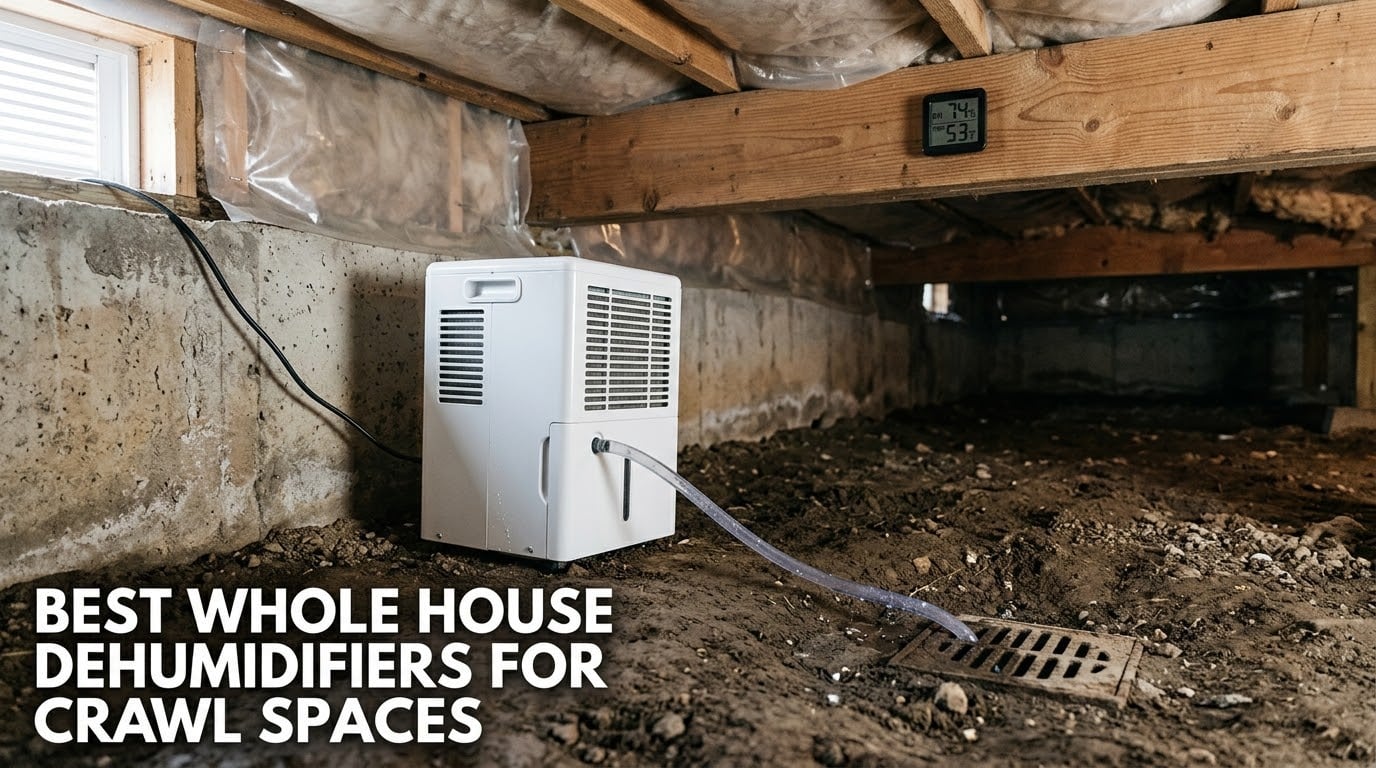
A crawl space needs a low-temperature compressor or desiccant unit rated to keep working below 60°F, with continuous gravity drainage or a built-in condensate pump, installed under a house to hold relative humidity near 50-55% and protect floor joists and subfloor from rot and mold.
That single sentence covers most of what separates a crawl space dehumidifier from the kitchen-cabinet appliance you plug into a bedroom outlet. If you are shopping for the best whole house dehumidifiers for crawl spaces, the four things that actually decide whether a machine survives its first winter are the operating temperature floor, how water leaves the unit, the rated capacity measured the honest way, and whether the body physically fits through your access hatch.
I have spent the last few weeks reading specification sheets, warranty terms and owner reviews across ten of the most widely reviewed crawl space machines, and comparing them on the criteria that show up in real installations rather than on marketing language. What follows is a ranked list of the ten units worth your attention in 2026, a buying guide that explains the traps in this category, and an honest answer to when a dehumidifier is the wrong purchase entirely.
One framing note before the list. The word “whole house” in this category covers two very different machines. One group is ducted into a forced-air system and treats the entire home, which is an HVAC project. The other group is a compact, continuous-duty box you set on the crawl space floor next to a drain line. Almost every crawl space owner in the forum discussions we reviewed wanted the second type, and nine of the ten machines below are built for it. Read the category labels carefully, because a home warranty and a crawl space warranty are not the same thing.
Table of Contents
Top 3 Crawl Space Dehumidifiers (2026)

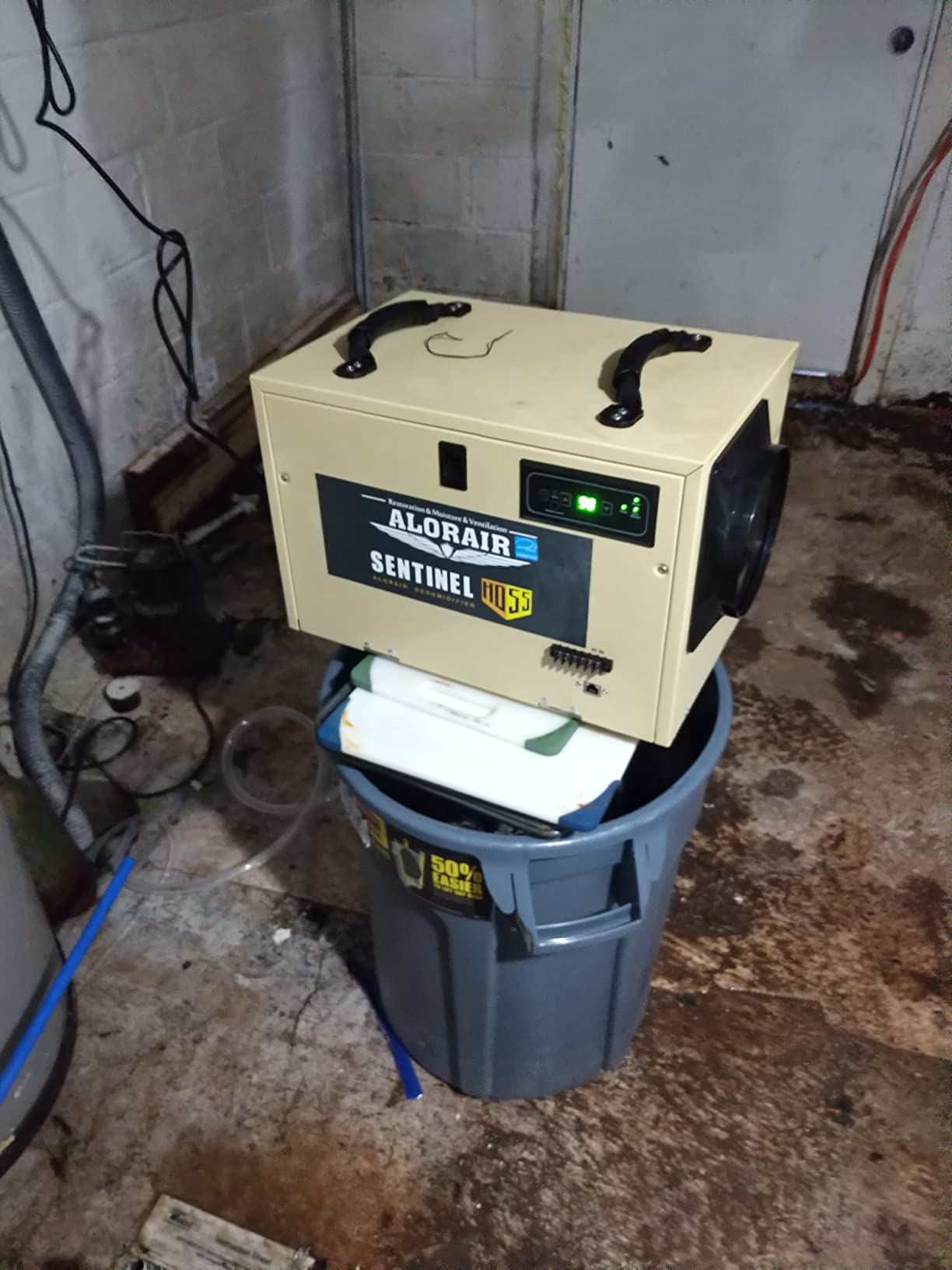
ALORAIR Sentinel HD55S 120 Pint
- 55 PPD at AHAM
- 1300 sq ft coverage
- Auto defrost
- Gravity drain

The Sentinel HD55S takes the top slot because it is the most widely reviewed crawl space machine in this group, with well over a thousand owner ratings behind it, and because its auto-defrost cycle is the feature that decides whether a compressor unit survives a cool crawl space. The Waykar earns the value badge by pairing real capacity with a built-in pump and a 16.4 ft drain hose. The Moiswell carries a 4.5 average and a 78 percent five-star share alongside the highest maximum output, and its horizontal body solves the clearance problem that ends a lot of installations before they start.
Crawl Space Dehumidifier Quick Specs (2026)
Every machine below is compared on the same five numbers. Note the split between maximum capacity and AHAM capacity, which is the single most misunderstood figure in this category and is explained in the buying guide below.
| Product | Specs | Action |
|---|---|---|
| ALORAIR Sentinel HD55S 120 Pint |
|
Check Latest Price |
 Waykar 125 Pint with Pump Waykar 125 Pint with Pump |
|
Check Latest Price |
 ALORAIR 70 PPD with Pump ALORAIR 70 PPD with Pump |
|
Check Latest Price |
| Moiswell 155 Pint Commercial |
|
Check Latest Price |
 Airecoler 125 Pint Commercial Airecoler 125 Pint Commercial |
|
Check Latest Price |
 AprilAire E080 Pro 80 Pint AprilAire E080 Pro 80 Pint |
|
Check Latest Price |
 AprilAire E070 Pro 70 Pint AprilAire E070 Pro 70 Pint |
|
Check Latest Price |
| AprilAire E100 Pro 100 Pint |
|
Check Latest Price |
 Abestorm 70 PPD with Pump and Hose Abestorm 70 PPD with Pump and Hose |
|
Check Latest Price |
 ALORAIR Smart Wi-Fi 70 Pint with Pump ALORAIR Smart Wi-Fi 70 Pint with Pump |
|
Check Latest Price |
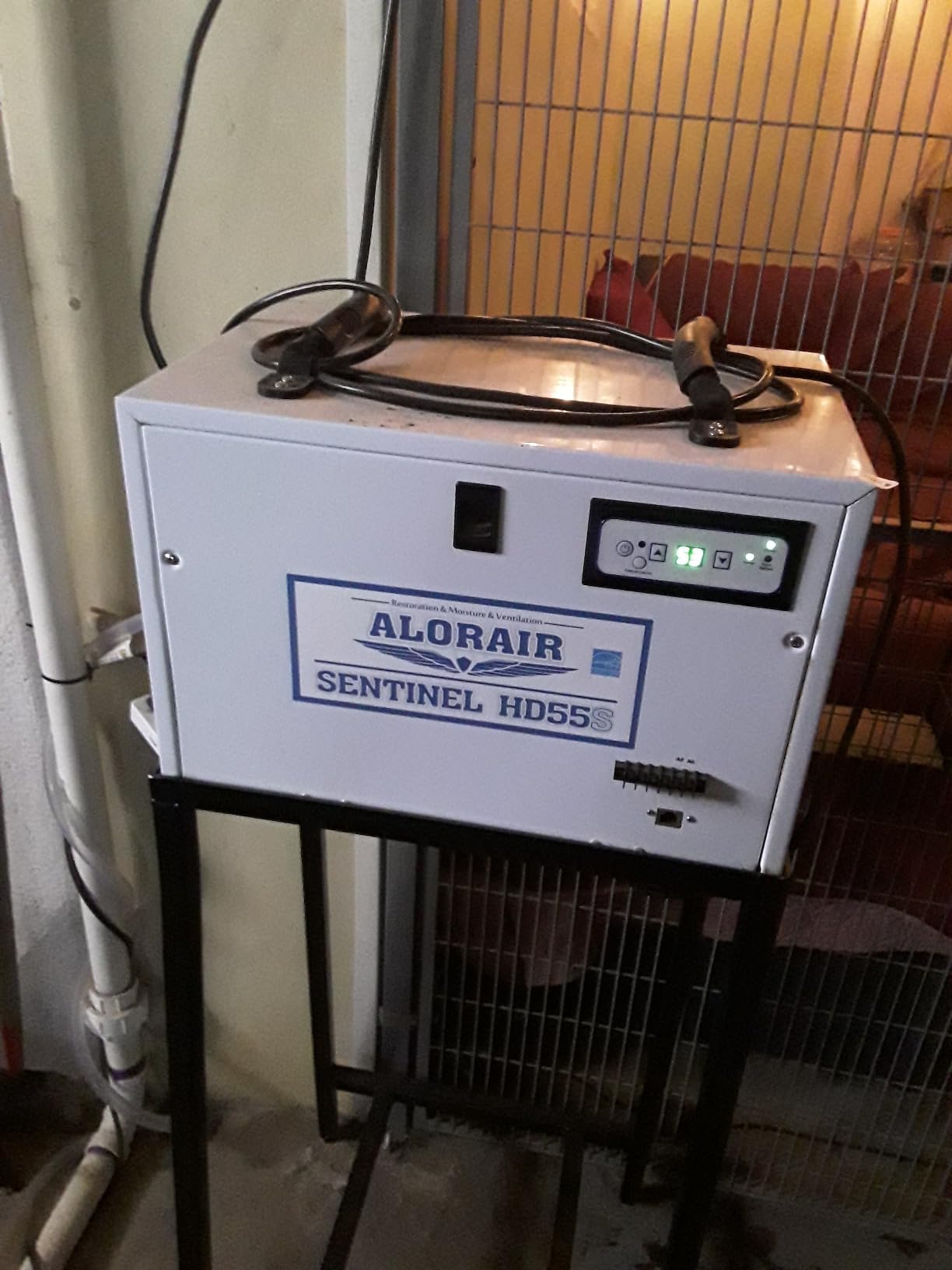
1. ALORAIR Sentinel HD55S 120 Pint – The Crawl Space Workhorse With the Deepest Track Record
ALORAIR 120 Pints Energy Star Crawlspace Dehumidifier, Sentinel HD55S
120 pints max
55 PPD at AHAM
Covers 1300 sq ft
41.7 lb
19.2 x 12.2 x 13.3 in
Pros
- Over 1300 owner ratings to draw on
- Auto defrost manages cool crawl temperatures
- Continuous gravity drain
- Metal housing
- 130 CFM airflow
Cons
- 41.7 lb is awkward through a small hatch
- Gravity drain only so it needs height
- Monitoring accessory sold separately
More crawl space owners have run this machine than any other in the guide, and that shows in the reviews. Owners describe visible humidity drops within days, musty odor disappearing from the space above, and a defrost cycle that keeps the coil from icing up when the crawl space temperature drops. It is the unit I recommend when the question is simply which box is least likely to become an expensive problem while you are asleep upstairs.
Capacity is listed two ways. The headline figure is 120 pints, while the measured figure at standard conditions is 55 pints per day, and rated coverage is 1,300 square feet. Airflow is 130 CFM, which is modest, and the 15 gallon tank is a fallback for testing rather than a primary drainage method.
The defrost system is the reason it works in a crawl space. A compressor dehumidifier chills a coil, and when the coil drops below freezing the ice has to be melted before it can collect water again. This unit cycles that melt automatically using temperature sensors, so you are not walking under the house with a hair dryer in February.
Owners also point out that the metal housing feels commercial grade and that the machine is quieter than expected for its output. Those are the two things that matter most when the unit sits eight feet from a bedroom floor.
Is gravity drainage enough for your install?
Gravity drainage works fine when you can set the unit high enough that the drain line runs downhill to a discharge point, and it is the most reliable arrangement there is because it has no moving parts. If your crawl space has no fall available, this is the wrong machine and you should look at a pump model instead.
There is a related constraint that catches people out. If you plan to hang this from joists or mount it up near the subfloor, gravity drainage stops working immediately, and 41.7 pounds is a heavy lift through a small opening in the first place.
What should you check before closing the hatch?
Confirm that the drain line is actually sloped the whole way to its discharge, and that you have secured it so it cannot sag and hold a trap of water. Then watch the drain for a full week before you seal everything up.
Also place a separate hygrometer next to the machine. Owners report the onboard reading can drift by roughly plus or minus 5 percent, and a cheap mechanical hygrometer mounted in the corner of the space gives you an independent check on what the space is actually doing.
2. Waykar 125 Pint with Pump – Most Raw Capacity Per Dollar with a Built-In Pump
Waykar 125 Pint Crawl Space Dehumidifier with Pump & Drain Hose for Basements, Commercial & Water Damage Spaces up to 6500 Sq. Ft., Compact, Strong Dehumidification, 5-Year Quality Coverage
125 pints max
Covers 6500 sq ft
Pump lift 19.6 ft
49.8 lb
530 watts
Pros
- Highest capacity in the guide at 125 pints
- Built-in pump with 16.4 ft hose
- 10-90 percent humidity range
- Rotary compressor efficiency
- Metal casing
Cons
- 49.8 lb is heavy for a crawl hatch
- Optional remote sold separately
- Single fan speed
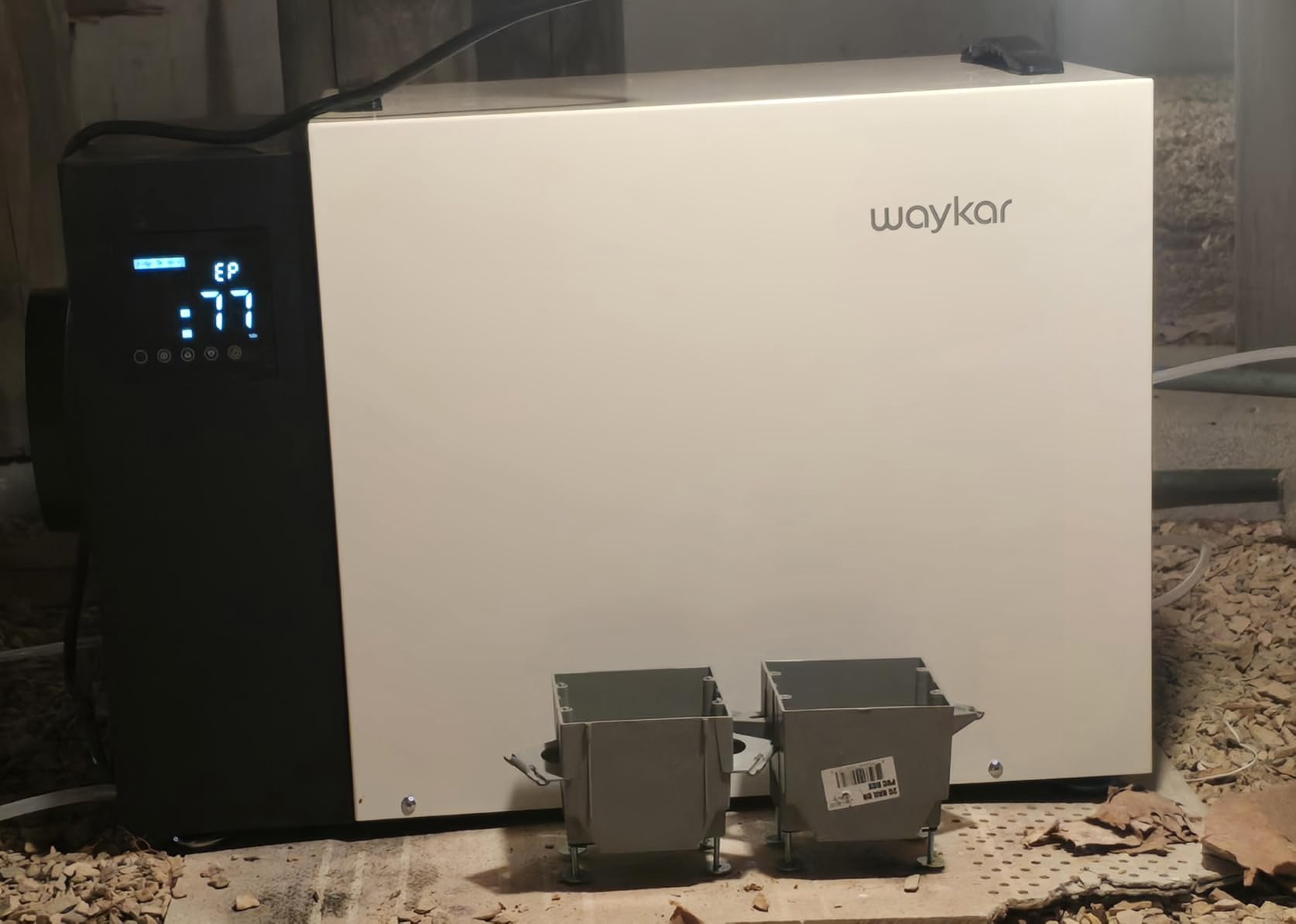
This is the machine I point at when someone has a large crawl space, a damp basement, or a water damage job and wants one box that covers all three. At 125 pints rated capacity with 176 CFM airflow, it pulls far more air through the space than anything else in this guide, and the built-in pump means it does not care where the drain line goes.
Coverage is claimed up to 6,500 square feet, which is at the extreme end of what any single crawl space machine realistically conditions, but the 125-pint figure is the honest maximum rating and the extra headroom costs you nothing but a slightly larger footprint and more power draw.
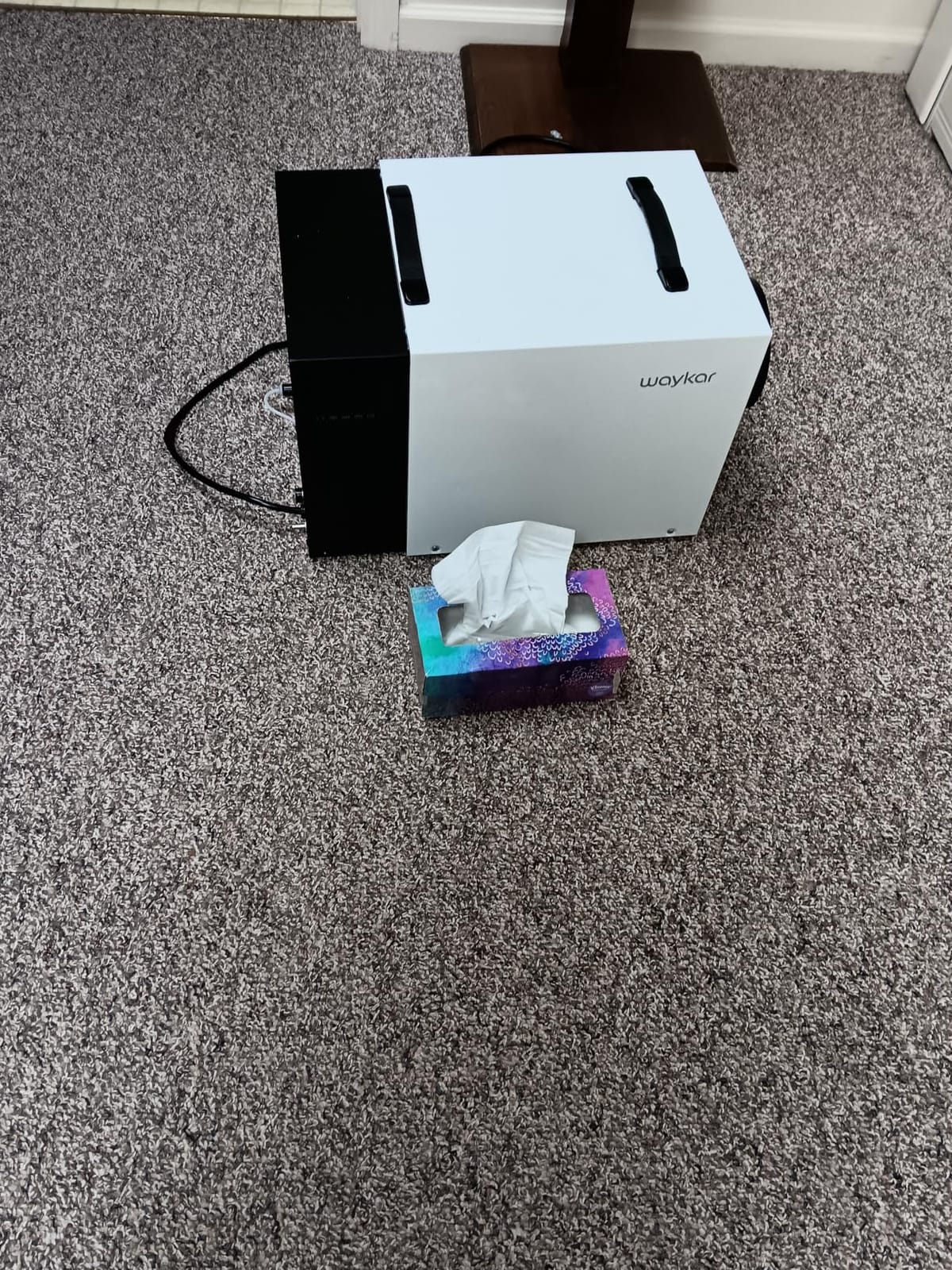
The pump is the headline feature for crawl space use. It lifts water up to 16.4 ft, and the listing also includes a separate 6.6 ft gravity hose plus a 5.9 inch pipe mount option if you prefer a gravity run. That combination means the install adapts to whatever your space allows rather than forcing you to solve drainage first.
Inside, a rotary compressor is rated 5 to 10 percent more efficient than the piston compressors used in many budget units, and the manufacturer claims 15 to 20 percent lower power consumption. Adjustable feet cut vibration and noise by up to 30 percent, which matters when the machine is running continuously under living space.
How large a crawl space does this actually suit?
For a standard residential crawl space of 1,200 to 1,800 square feet with genuinely damp ground, this is more capacity than you need, and that is a good thing. Oversizing in this category is not wasteful the way it is with a furnace, because a dehumidifier that cycles on and off is more efficient than one that runs flat out and never catches up.
If you are drying out a basement after a flood, or you are a restoration contractor moving between jobs, the 125-pint figure and the pump are exactly what you want.
What do you give up compared with the smaller units?
At 49.8 pounds it is the second heaviest machine in the guide, and getting it through a crawl hatch is a genuine two-person job on a tight opening. The single fan speed also means less control over noise than a unit with a low and high setting.
Remote monitoring is available but sold as an accessory, so if you want to check humidity from your phone you need to add that separately.
3. ALORAIR 70 PPD with Pump – Smallest Footprint and the Longest Pump Reach
ALORAIR 70 PPD Dehumidifier with Pump for Crawl Space and Basement
70 pints max
35 PPD at AHAM
Covers 1000 sq ft
Pump lift 19.6 ft
Under 50 dB
Pros
- Compact 15.2 x 11.2 x 11.4 inch body
- 19.6 ft pump lift
- Quiet under 50 dB
- MERV-1 filter
- Auto restart
Cons
- 35 PPD at AHAM is half the headline figure
- 1000 sq ft is the smallest coverage here
- Only rated to a 90 F upper limit
Where clearance is the deciding factor, this is the answer. The body measures 15.2 by 11.2 by 11.4 inches, which fits between floor joists and goes down a standard crawl access opening without the disassembly that heavier machines require. At 38.2 pounds it is also one of the lighter options here.
The pump lifts condensate up to 19.6 ft vertically, and a 19.6 ft hose is included, so you can discharge upward to a drain line, a sump, or a discharge line through the crawl space wall. That removes the single most common installation blocker.
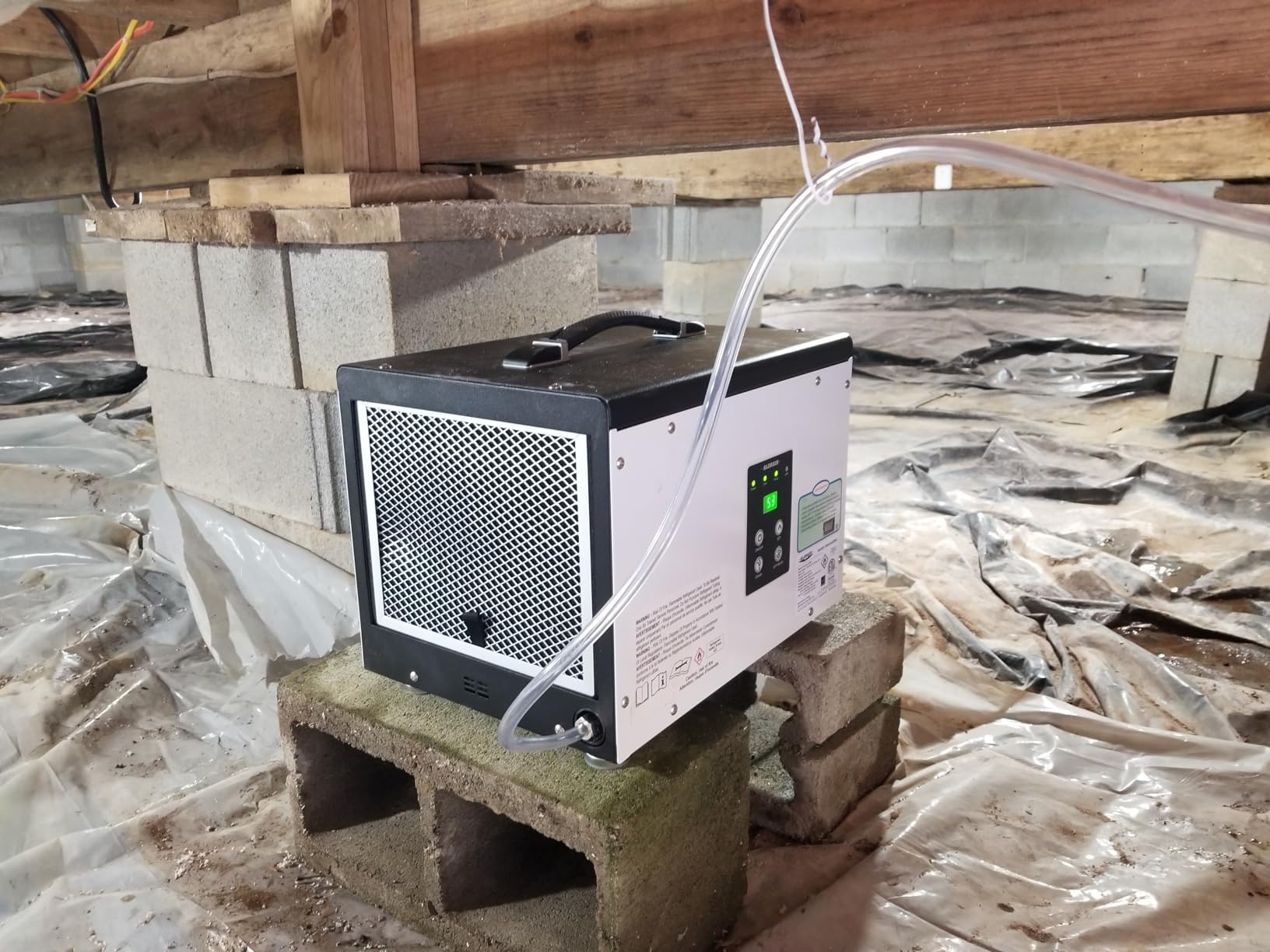
Operation under 50 dB is the second reason owners like it. If the crawl space sits directly under a living area and you plan to run the machine continuously, noise becomes a household issue rather than an appliance issue, and this is one of the quietest boxes in the guide.
Auto restart resumes operation after a power interruption, which matters more than it sounds. Crawl spaces are on the least reliable circuit in most houses, and a unit that forgets its set point every time the breaker trips is a unit you will stop trusting.
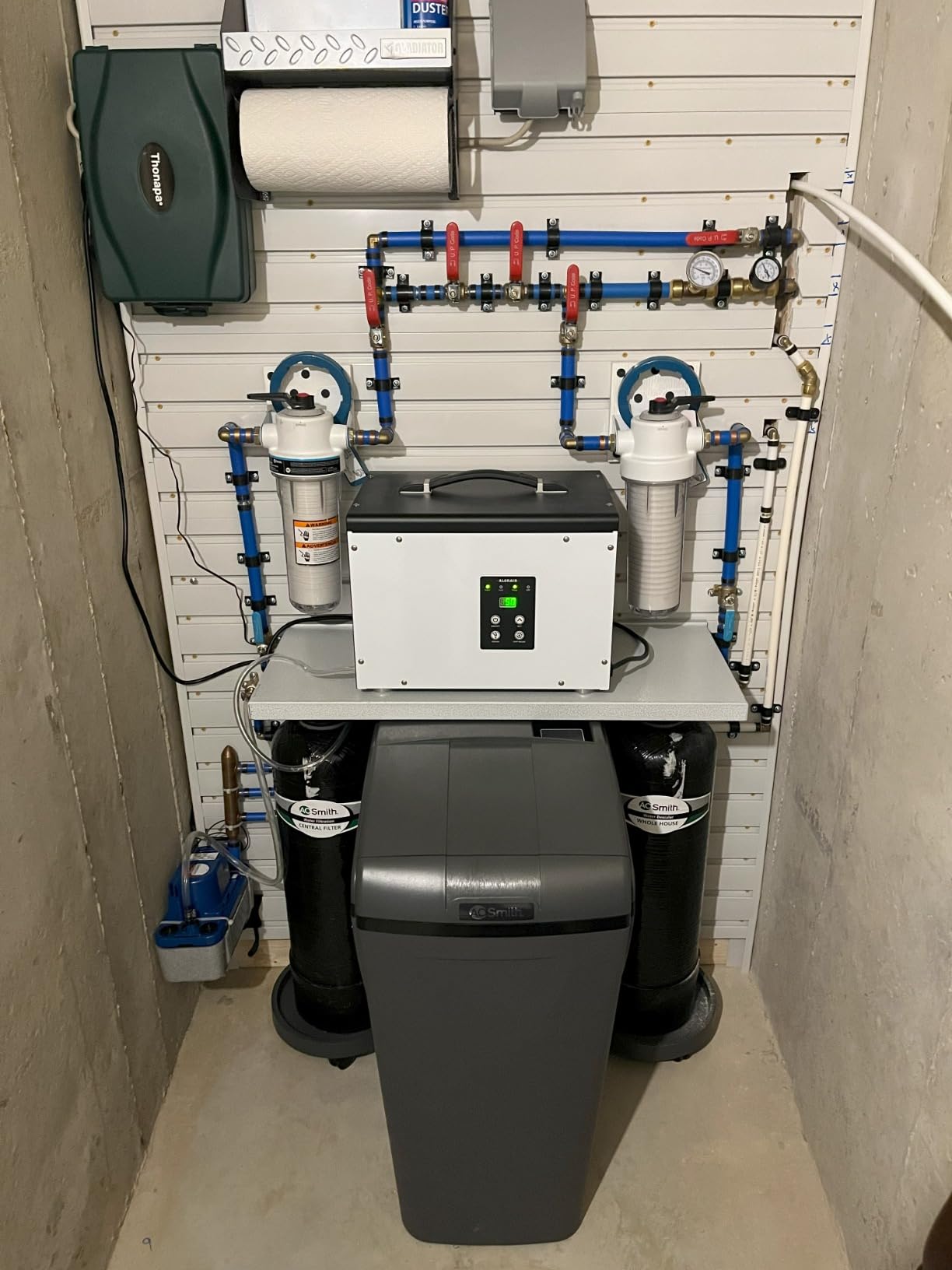
Does 35 pints a day cover a typical crawl space?
For a crawl space of 1,000 square feet or less with a vapor barrier in place, 35 pints a day at standard conditions is a sensible match. That figure is measured at the standard test condition rather than at peak saturation, which is exactly what you want to plan against.
The same number is not enough for a large, unencapsulated, genuinely wet crawl space, and the coverage rating of 1,000 square feet is the smallest in the guide. Measure your footprint before choosing this over a larger machine.
Where will this disappoint you?
Capacity is the honest concern. The 70-pint headline number is measured at saturation, and reviewers repeatedly describe real performance as closer to a 50-pint class machine, so treat 35 pints a day as the planning figure.
The upper temperature rating of 90°F is also lower than several competitors here, which matters if the space is under a slab-on-grade or gets significant solar gain through vents in summer.
4. Moiswell 155 Pint Commercial – Highest Maximum Output With a Horizontal Body
Moiswell 155 Pint Commercial Dehumidifier with Drain Hose for Crawl Spaces
155 pints max
70 PPD at AHAM
Covers 6000 sq ft
63 lb
Horizontal 22.5 x 14 x 14.7 in
Pros
- Highest maximum capacity in the guide
- Energy Star certified
- Horizontal body fits between joists
- 265 CFM airflow
- 5-year warranty
Cons
- Heaviest machine here at 63 lb
- Gravity drain only
- 860 watts is the highest draw
This unit has a 4.5 average rating with a 78 percent five-star share, the highest of any unit in the guide, and the most raw drying capability in the guide at 155 pints maximum and 70 pints per day at AHAM conditions with 265 CFM airflow. Owners describe fast drying of genuinely damp spaces.
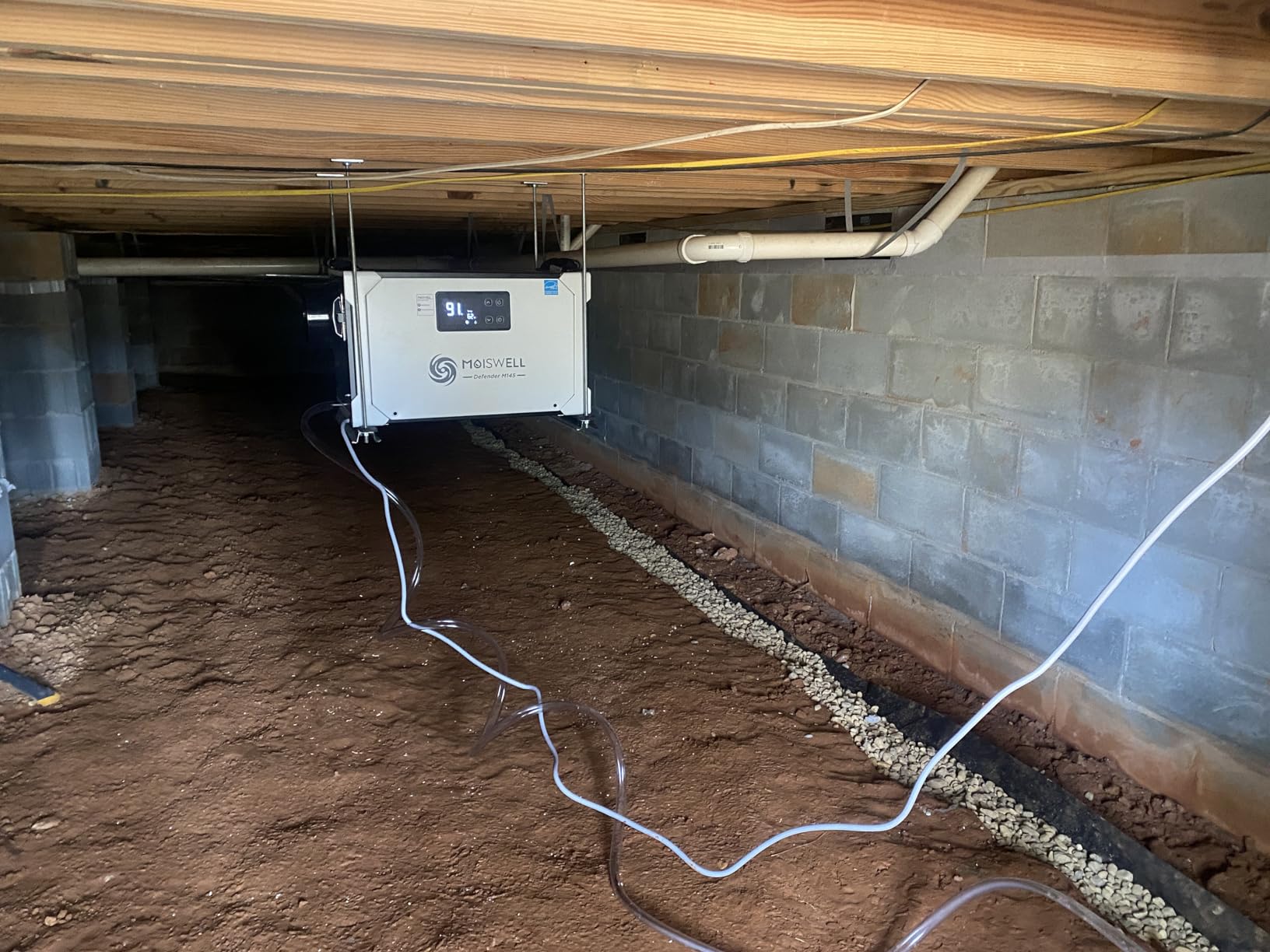
The reason it earns a place on a crawl space list at all is its shape. The body is a horizontal 22.5 by 14 by 14.7 inches, so it fits between floor joists or mounts overhead where a tall tower unit simply will not go. Coverage is rated up to 6,000 square feet.
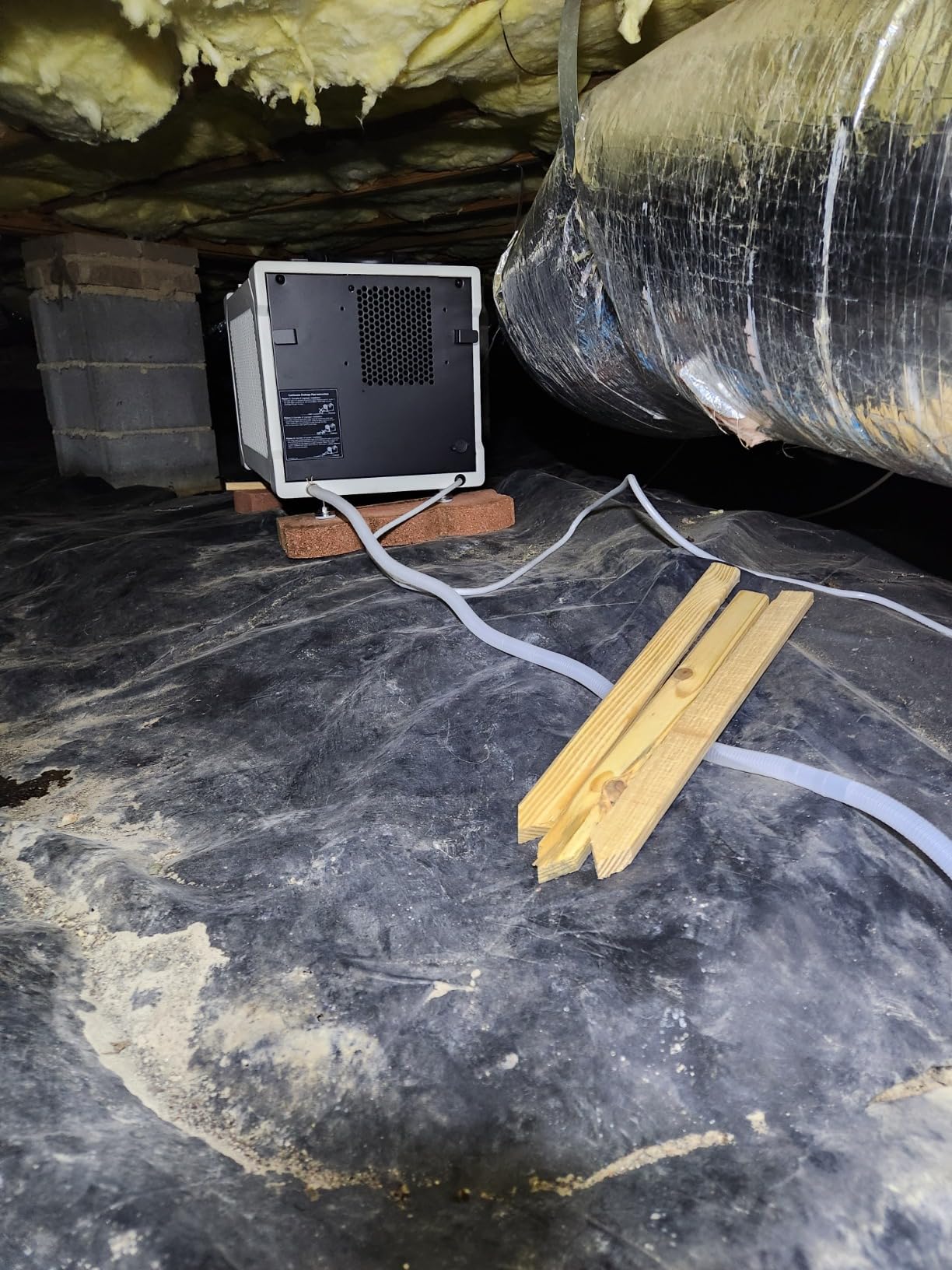
Energy Star certification on a machine with this much output is unusual, and it translates directly into lower running costs for a device that will run around the clock. The feature set is complete for unattended use: auto humidity control, a 24-hour timer, auto drain, auto defrost, and auto restart after a power outage.
Warranty terms are structured as five years total, with two years on the whole dehumidifier and three years on parts, which is a reasonable commercial-style split.
Is the capacity overkill for a normal crawl space?
For a typical 1,500 square foot crawl space with a working vapor barrier, yes, this is more machine than the job needs. That is not a criticism so much as a reminder to size honestly. Pick the smallest unit that can hold your set point on the worst week of the year.
Where it makes sense is a large footprint, a high water table, no vapor barrier yet, or a basement and crawl space that share the same machine.
What are the real drawbacks?
It weighs 63 pounds, the heaviest in the guide, and that is a serious consideration for a crawl hatch installation. Drainage is gravity only, so the unit must sit high enough for the line to fall.
Power draw of 860 watts is the highest here, and it also carries a shorter public review history than the established brands, so there is less long-term data on component durability.
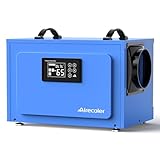
5. Airecoler 125 Pint Commercial – Best Fit for Very Low Clearance Installs
Airecoler 125 Pints Commercial Dehumidifier for Crawl Space & Basement
125 pints max
60 PPD at AHAM
Covers 6000 sq ft
50 lb
830 watts
Pros
- R32 refrigerant system cuts power use
- 60 PPD at AHAM is strong for the size
- 19.2 x 12.2 x 13.4 inch body
- Can suspend between joists
- 74 percent five-star share
Cons
- Listing shown is the no-pump version
- 830 watt draw is high
- Lower review count
The distinguishing feature here is an R32 refrigerant system, which the manufacturer credits with reduced power consumption compared with conventional units, and a 125-pint maximum with 60 pints per day at AHAM conditions. That measured figure is one of the better capacity-to-size ratios in the guide.
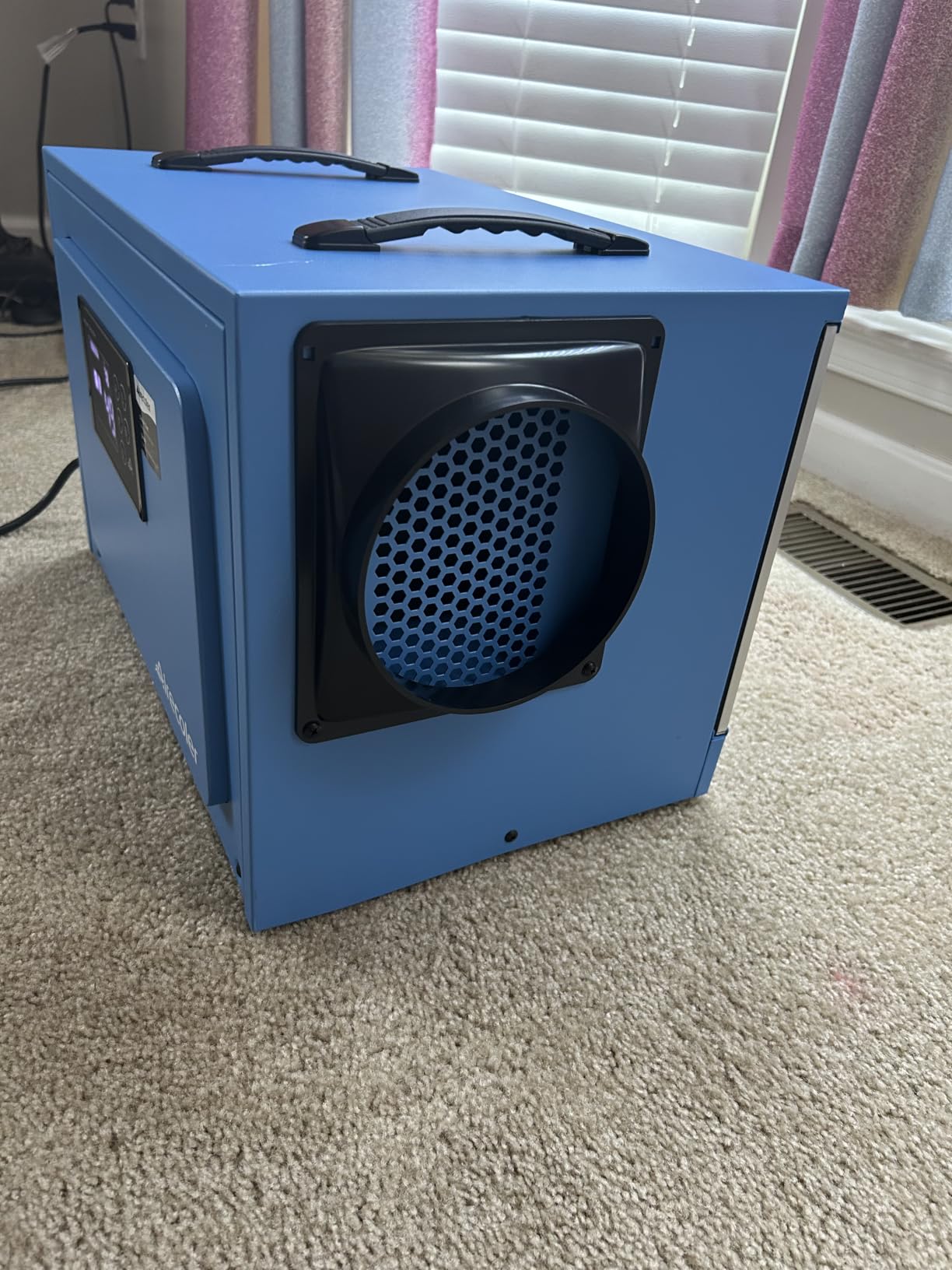
At 19.2 by 12.2 by 13.4 inches the body is small for the output, and it can be freestanding, set on a countertop, or suspended between floor joists. That mounting flexibility is what makes it a good fit for a crawl space with a very low bay.
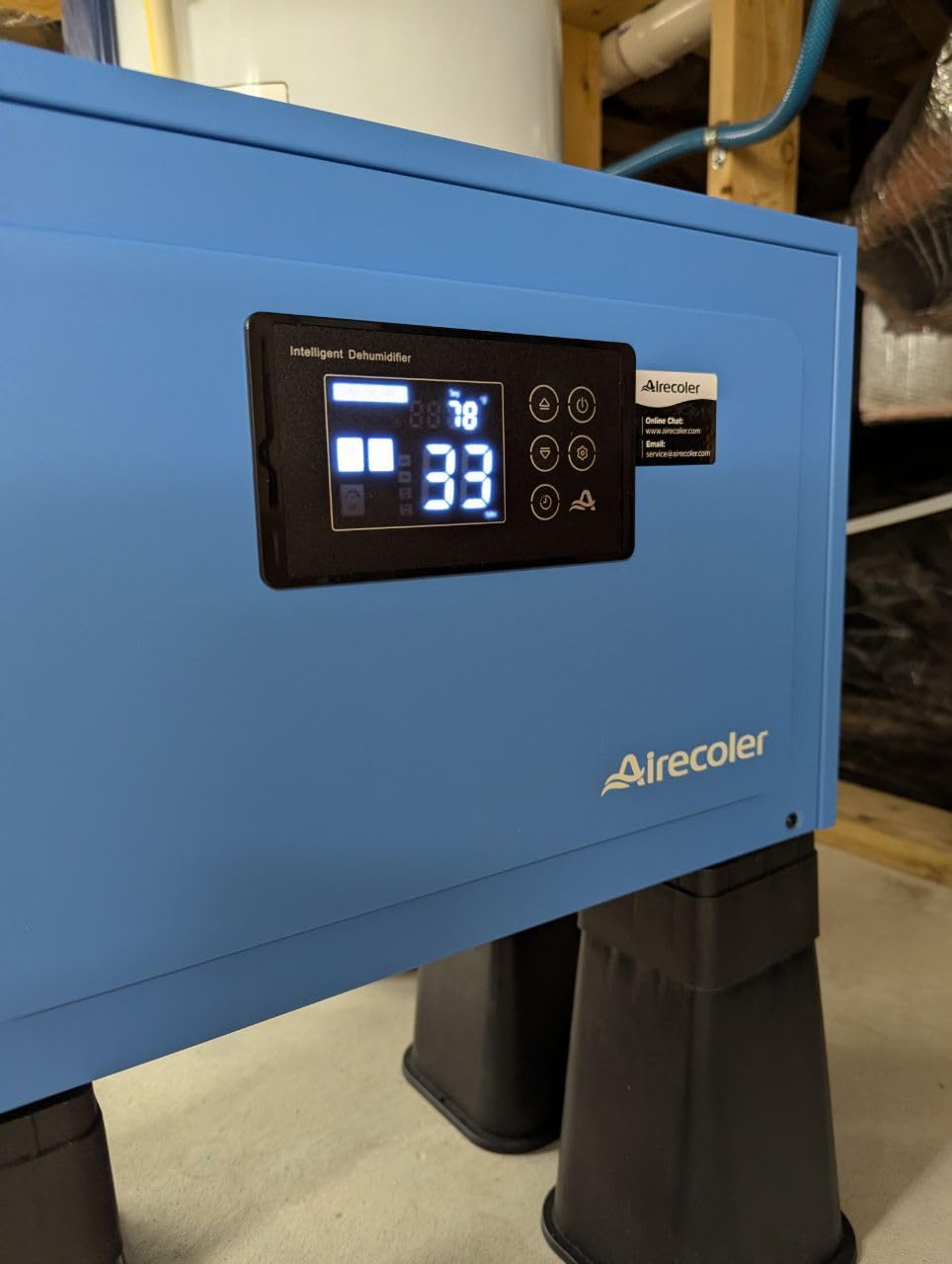
Airflow is 265 CFM, which explains how a unit this size keeps pace in a large space, and the control set includes a 24-hour auto on and off timer, continuous mode, auto defrost, and auto restart. A 6.56 ft drain hose is included.
Owners consistently highlight the R32 efficiency system and the ability to mount the unit out of the way, and 74 percent of ratings are five star with only 5 percent at one star.
Do you need the pump variant?
The listing we analyzed is the no-pump version, so drainage depends on gravity. Pump-equipped variants in this line exist as separate options, and if your install has any upward routing in the drain path you should plan on that variant from the start rather than trying to work around it.
If your crawl space allows a downhill gravity run, the base unit is the simpler and more reliable choice.
What should temper expectations on?
At 830 watts, this draws more power than most of the guide, and efficiency claims on a machine of this class depend heavily on how much time it spends actually removing water rather than sitting at set point.
With 290 ratings it also has a shorter public history than the two ALORAIR units, so long-term component reliability is less well documented.
6. AprilAire E080 Pro 80 Pint – Quietest Option and the One to Duct If You Must
AprilAire E080 Pro 80-Pint Whole-House Dehumidifier, Energy Star Certified, Commercial-Grade for Basement, Crawlspace or Whole House up to 4,400 sq. ft.
80 PPD
Covers 4400 sq ft
185 CFM
612 watts
5-year warranty
Pros
- Quietest machine in the guide
- Energy Star Most Efficient certified
- Corrosion-resistant aluminum coils
- Filter access on both sides
- Ductable with 10 inch collars
Cons
- Drain hose not included
- Installation needs ducting planning
- Highest price tier
The AprilAire line is what most people mean when they say whole house dehumidifier, and the E080 Pro is the version that makes sense if your crawl space is tied into a forced-air system or you want one machine to treat a basement and a crawl. It removes 80 pints per day and covers up to 4,400 square feet.
Owners report it is effectively inaudible from an adjacent floor, and that it brought a chronically damp basement from roughly 75 percent relative humidity down to 50 percent within about a day. Once it reaches set point, owners report it runs far less often than consumer-grade machines.
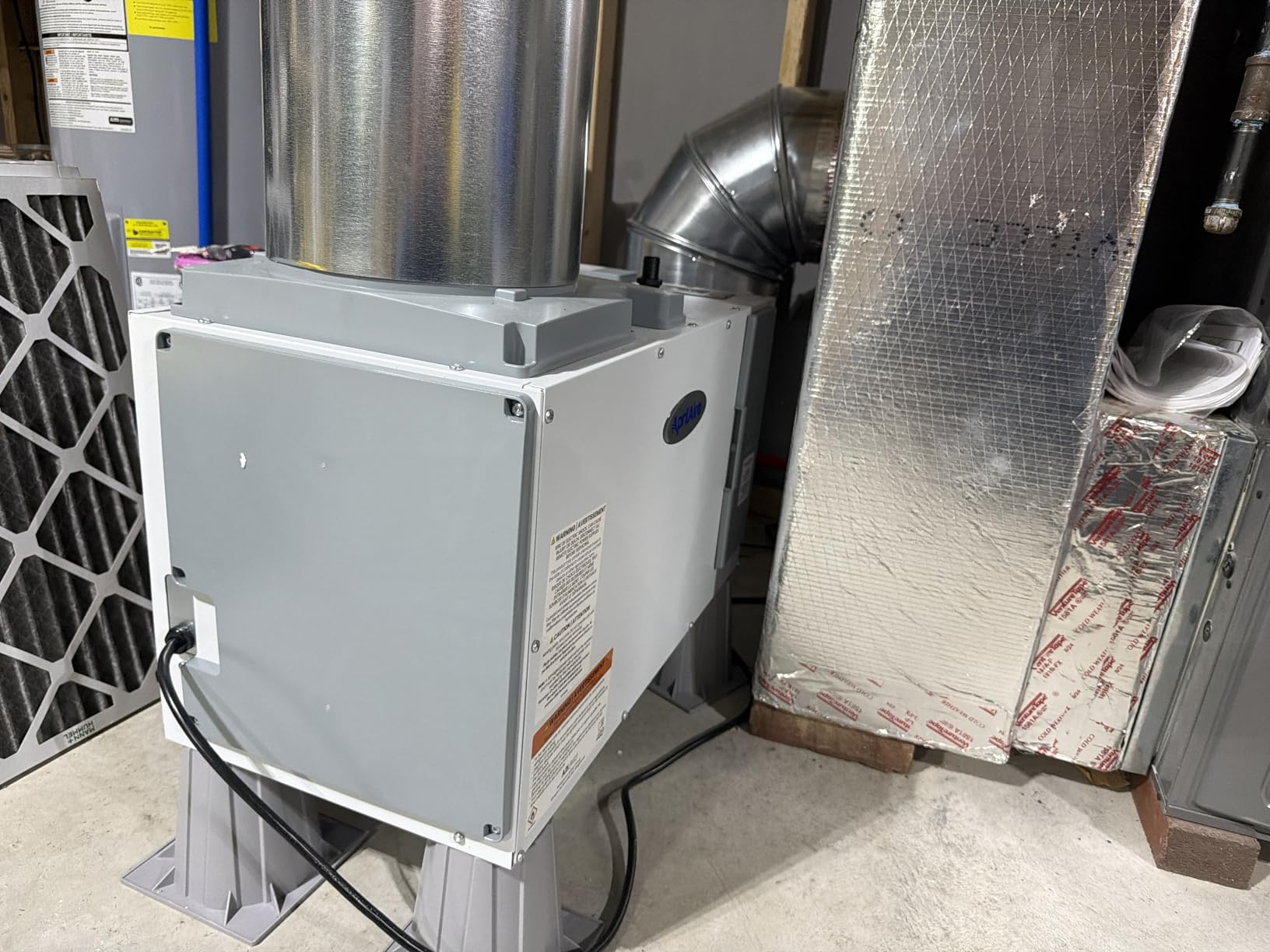
Smart sensing is the feature that makes that behaviour possible. The fan samples the air for three minutes every hour and only starts the compressor when humidity exceeds the target, so the machine is not cycling blindly. The cabinet is heavily insulated with internal styrofoam panels and uses corrosion-resistant aluminum coils manufactured in the USA.
It ships with 10-inch inlet and outlet duct collars, a backdraft damper, a washable MERV 8 filter with access on both sides, leveling feet, and a barbed drain fitting. The warranty is five years from the manufacturer.
Is a ducted unit right for a crawl space?
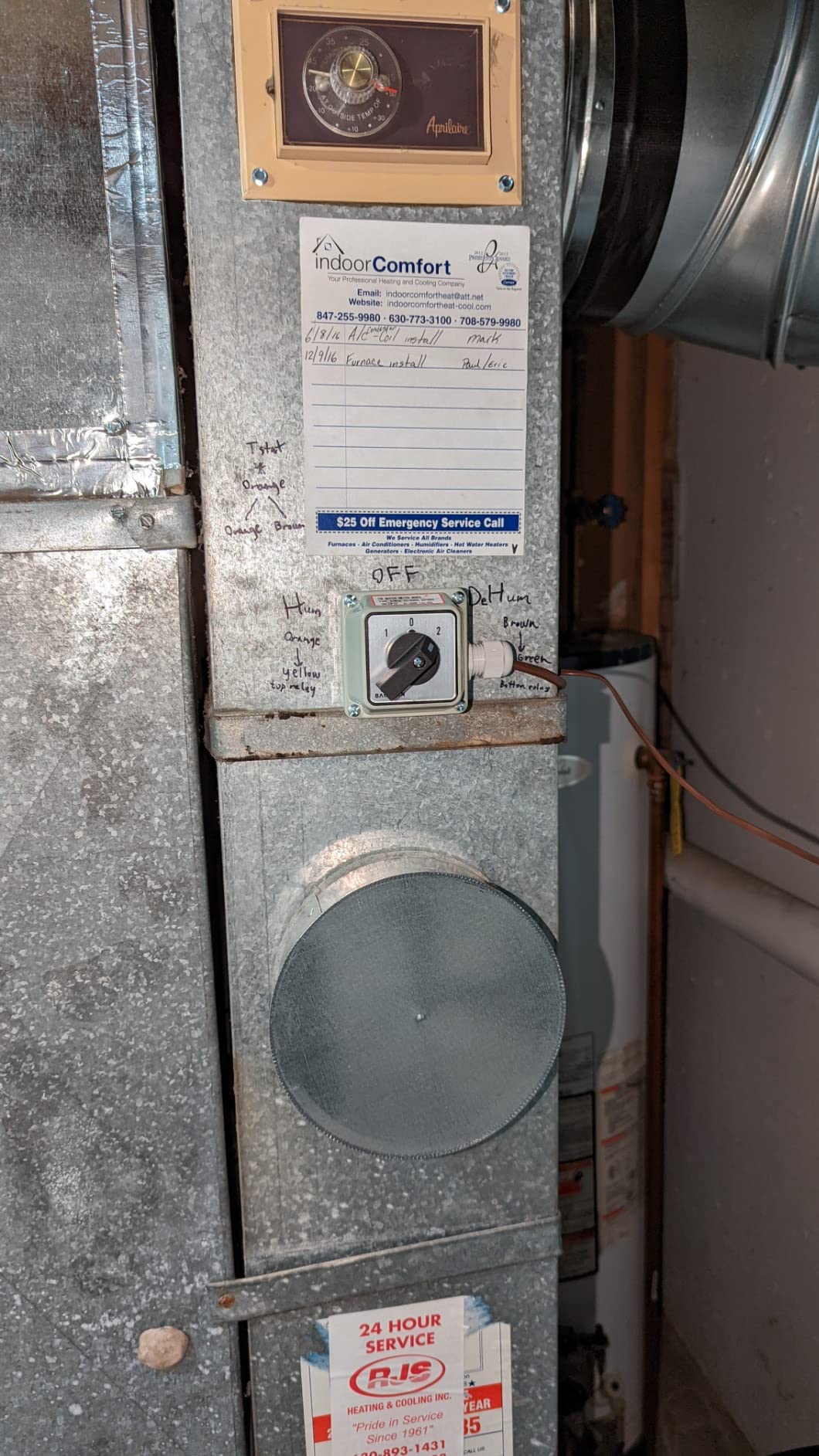
Only if your crawl space is already connected to your air distribution system or you want whole-home humidity control rather than a crawl space fix. A ducted installation requires planning for duct runs and pressure balancing, which is HVAC work rather than an appliance swap.
For a standalone crawl space with a single drain line, one of the compact units elsewhere on this list is a simpler installation for a similar result.
What do reviewers flag as downsides?
The drain hose is not in the box, so budget for the drain line and a fitting before the unit arrives. Installation complexity in tight ductwork runs is the other recurring complaint.
It also sits in the highest price tier in the guide, and the crawl space door on many older homes is not going to accept a 26-inch wide body without planning the approach in advance.
7. AprilAire E070 Pro 70 Pint – Purpose-Built to Pass Through a Crawl Space Door
AprilAire E070 Pro 70-Pint Crawl Space Dehumidifier with Drain Hose, Commercial-Grade Whole-House Dehumidifier for Crawlspace, Basement, or Whole Home up to 2,200 sq. ft.
70 PPD
Covers 2200 sq ft
12.5 x 12.5 x 25 in
56 lb
Includes 10 ft drain tubing
Pros
- Narrow 12.5 inch footprint fits crawl doors
- Only machine here that ships drain tubing
- Quiet relative to its class
- 8 inch duct collars included
- 5-year warranty
Cons
- Smallest rated area of the AprilAire line
- Highest cost per pint of capacity
- 25 inch tower needs headroom
This is the unit to look at first when access is the constraint. The body is 12.5 by 12.5 by 25 inches, and it is the only machine in the guide explicitly designed to pass through a standard crawl space door and then sit between joists. That physical fit is the deciding factor far more often than capacity.
It removes 70 pints per day and covers up to 2,200 square feet, with 200 CFM airflow and 696 watts of rated draw. Corrosion-resistant aluminum coils are made in the USA.
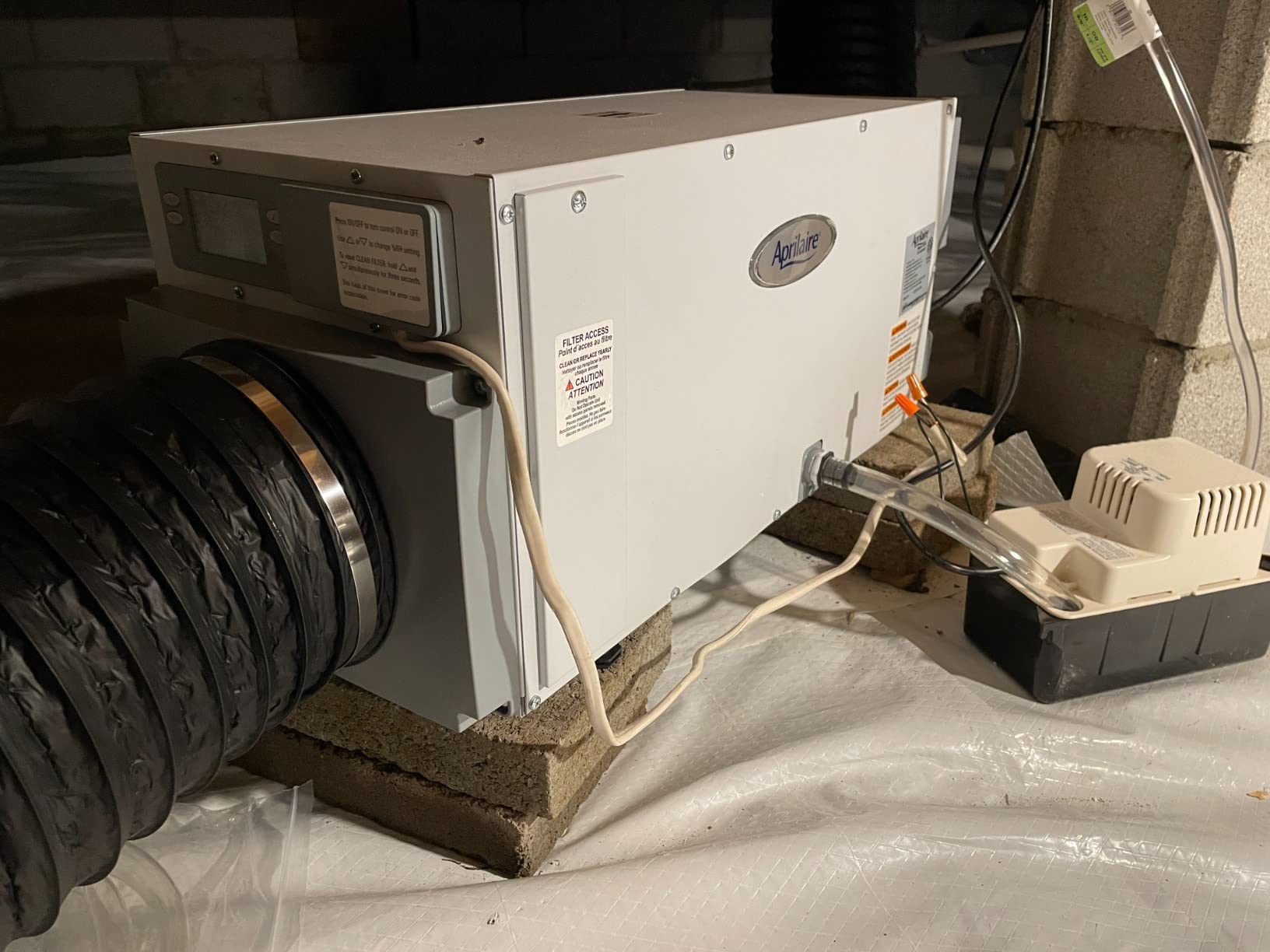
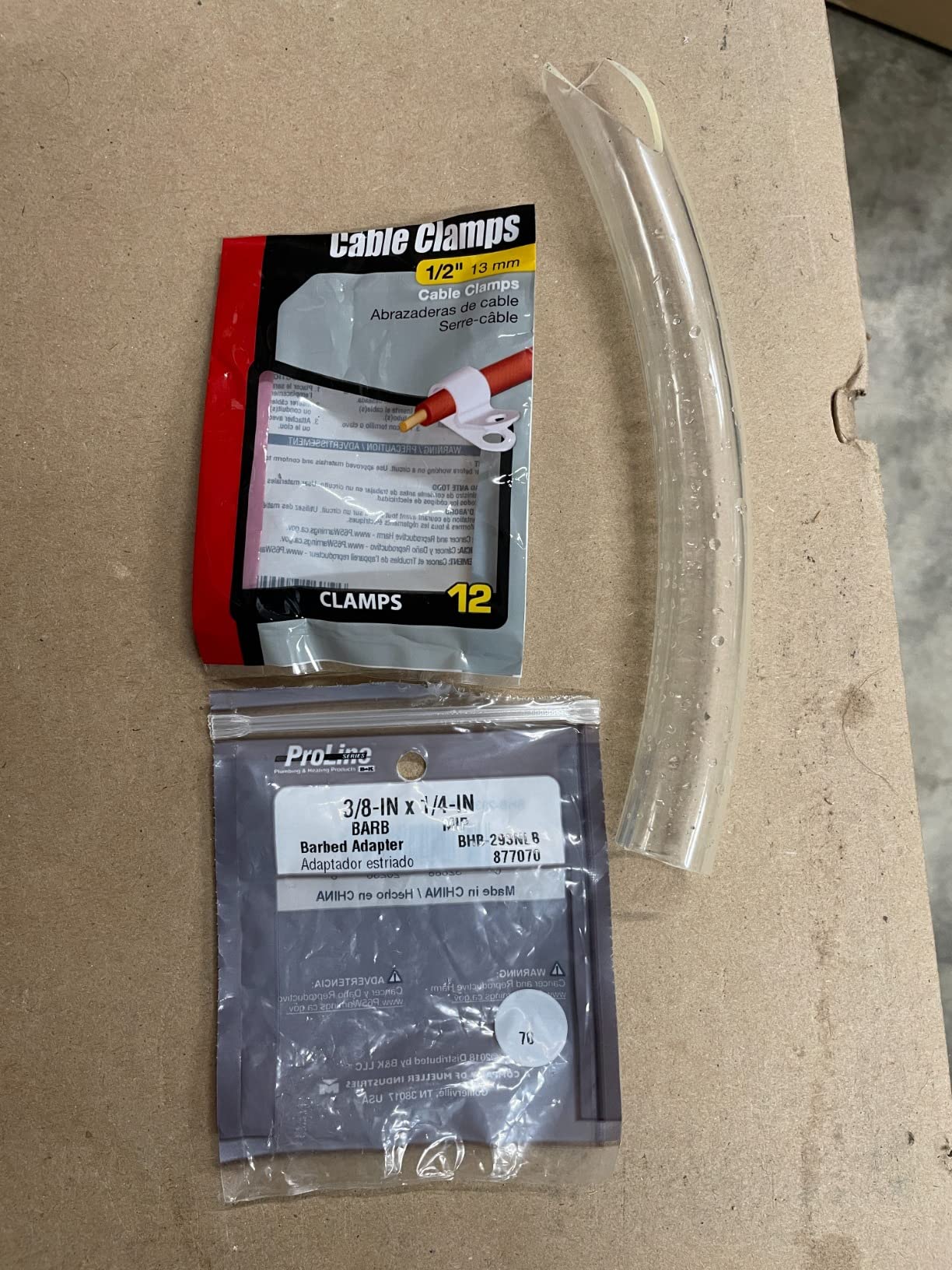
The most practical detail is the 10-foot drain tubing in the box. Every other compact machine in this guide relies on you sourcing a drain hose separately, and one of the most common failure patterns described by owners across this category is a loose or missing drain connection found months later.
Smart sensing works the same way as the E080, with the fan sampling the air hourly for three minutes before the compressor engages, and it ships with 8-inch inlet and outlet duct collars for whole-home integration when floor space is tight.
Does the tower shape create new problems?
At 25 inches tall, the unit needs vertical clearance. That is fine in a standard crawl space with a raised floor and joists, but it will not work under a very low suspended floor or a tightly framed bay where you planned to lay the machine flat.
At 56 pounds it is also heavy, so plan the descent before you commit to this specific body.
What are you paying for the brand and the fit?
The honest answer is build quality and a five-year manufacturer warranty, plus the included drain tubing and the narrow footprint. On a cost per pint of capacity basis it is the most expensive machine in the guide.
If your crawl space is roomy, one of the compact units in the middle of this list delivers more measured capacity for considerably less money, and you lose very little except warranty length.
8. AprilAire E100 Pro 100 Pint – Most Capacity From a Ducted-Ready Platform
AprilAire E100 Pro 100-Pint Whole-House Dehumidifier, Energy Star Certified, Commercial-Grade Whole-Home Dehumidifier for Basement, Crawlspace, or Whole House up to 5,500 sq. ft.
100 PPD
Covers 5500 sq ft
280 CFM
828 watts
5-year warranty
Pros
- Largest AprilAire capacity at 100 PPD
- 280 CFM is the strongest airflow here
- Energy Star Most Efficient certified
- Backdraft damper included
- USA-made corrosion-resistant coils
Cons
- Most expensive unit in the guide
- Drain hose not included
- Highest share of one-star ratings among the AprilAire models
If you are combining a large crawl space, a basement, or a whole-home humidity control project, the E100 Pro is the ceiling of this category. It removes 100 pints per day, covers up to 5,500 square feet, and moves 280 CFM, which is the highest airflow figure in the guide.
It carries Energy Star Most Efficient certification, which is worth paying attention to on a machine intended to run continuously, and the coil package is corrosion-resistant aluminum manufactured in the USA. The body is 14 by 26 by 15 inches at 64 pounds.
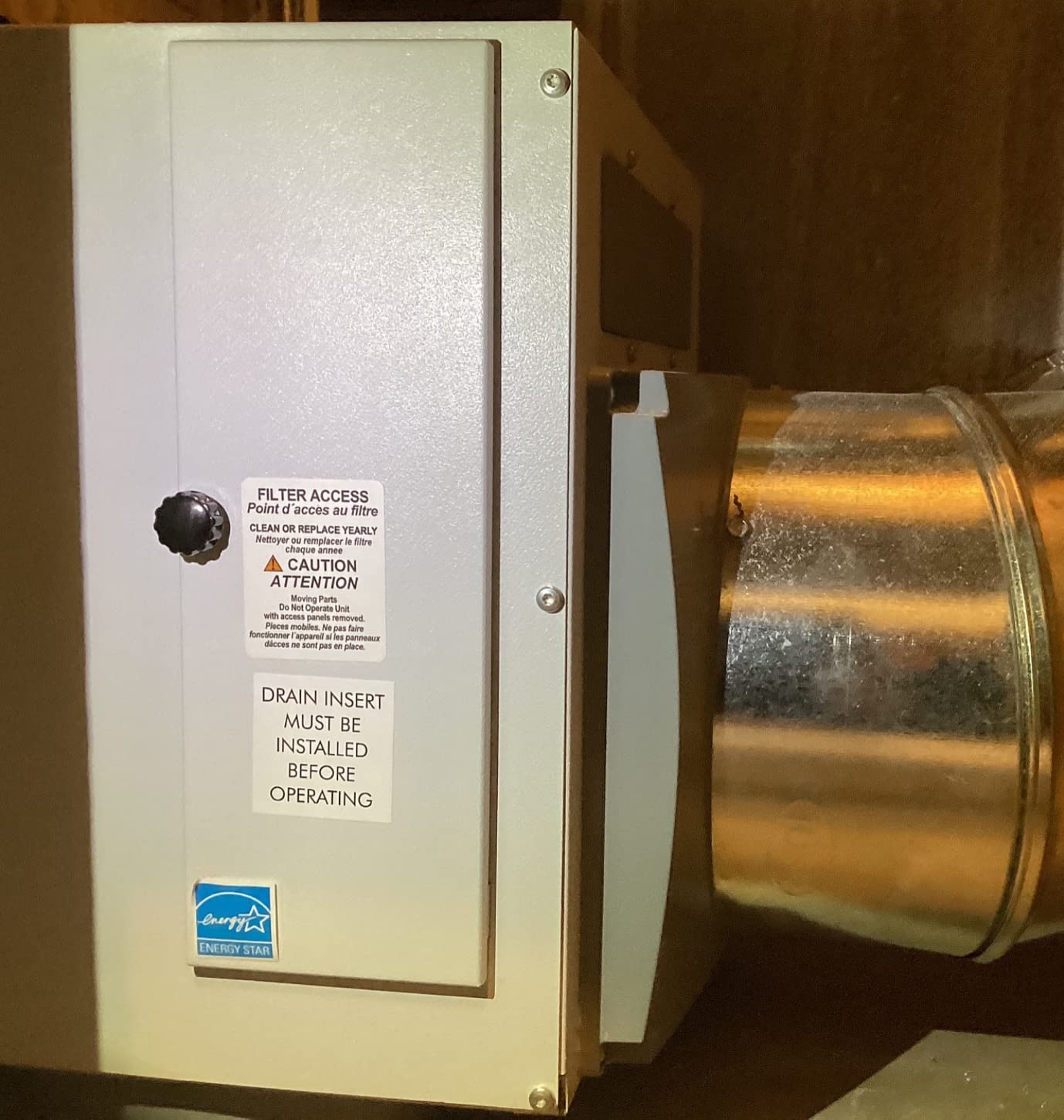
The box includes 10-inch inlet and outlet duct collars, a backdraft damper, leveling feet, a barbed drain fitting, an 8-foot power cord, and a washable MERV 8 filter. Wall control and Wi-Fi variants exist for this model as separate options, which is the usual AprilAire pattern.
Owners credit it with the capacity and ductability needed for large homes and commercial spaces, and Energy Star Most Efficient certification and coil construction come up repeatedly as reasons to trust it.
Is this sized right for a crawl space?
For most residential crawl spaces it is one tier more than needed. It makes sense when the crawl space is large and shares air with a basement, when several zones need conditioning, or when the machine will also serve an enclosed garage or storage area.
It is also the model to consider if you want a single appliance for a whole-home project rather than a dedicated crawl space box.
What do reviewers complain about?
Cost is the dominant complaint, and it is the most expensive unit in the guide by a wide margin. The drain hose is also not included, so add that to the plan.
Its average rating of 4.4 is the lowest of the three AprilAire models here, with 8 percent of ratings at one star, the highest share among that line, and several of those reviews point to installation and ducting rather than the machine itself.
9. Abestorm 70 PPD with Pump and Hose – Entry-Level Pump and Hose Package
Abestorm 70 PPD Dehumidifier with Pump & Hose for Crawl Space & Basement
70 pints max
35 PPD at AHAM
Covers 1000 sq ft
Pump lift 19.6 ft
38.2 lb
Pros
- Pump and hose included for unattended operation
- Pumps up to 19.6 ft vertically
- Compact metal body
- Free replacement filters with registration
- 5-year limited warranty
Cons
- Audible pump when it cycles
- Real output closer to a 50-pint class
- 16 percent of ratings are one-star
This is the value entry point if your crawl space is 1,000 square feet or smaller and you have no gravity fall. The built-in condensate pump lifts water 19.6 ft vertically, and the hose is included, which is the combination that lets a unit run for months without anyone descending into the space.
Owners report the unit holding a 45 to 55 percent humidity range reliably in crawl spaces and basements, and several describe the compact metal body as a step up from the plastic-cased machines in the same class. Auto stop at set humidity and auto restart after a power interruption are both present.
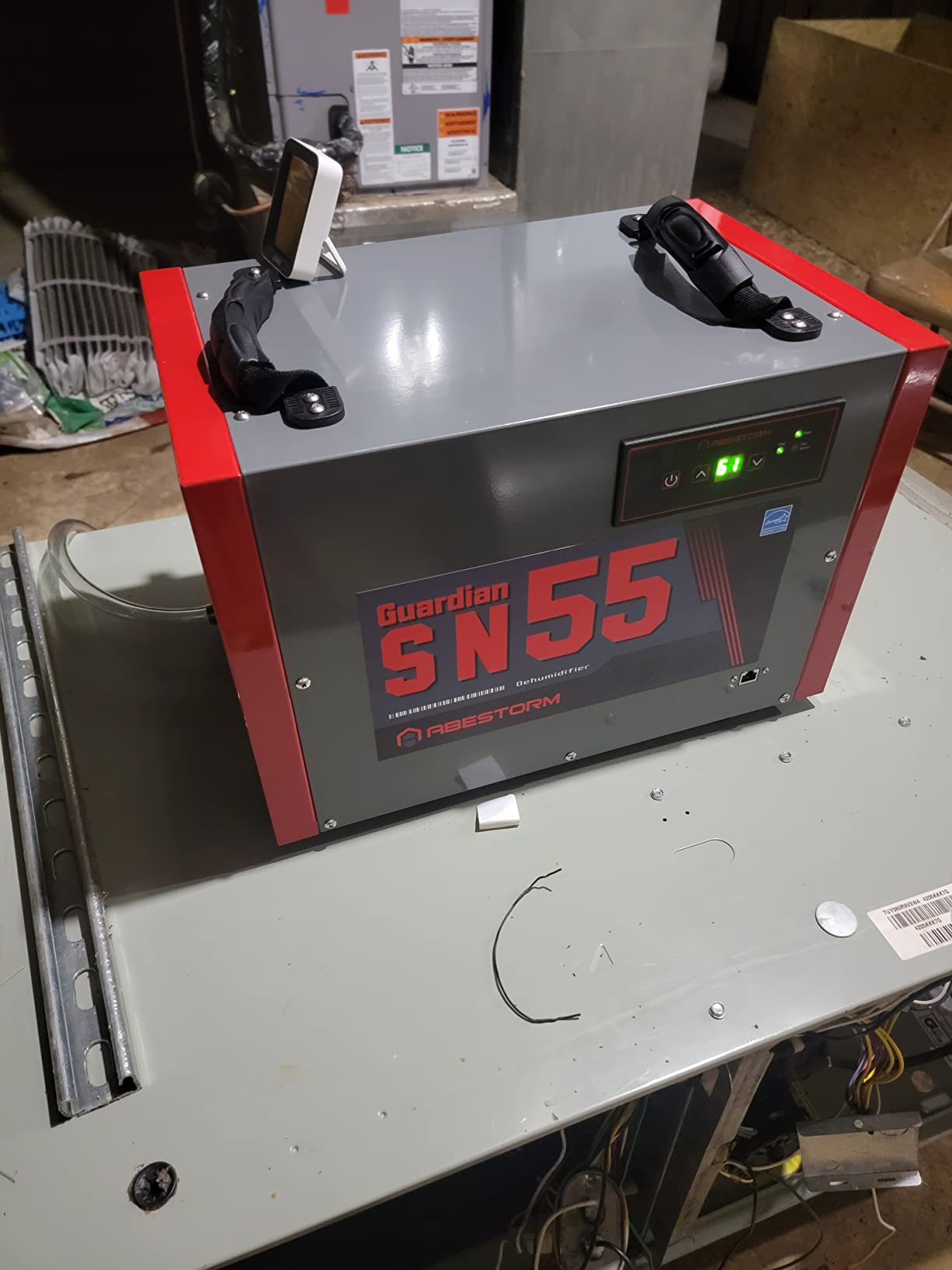
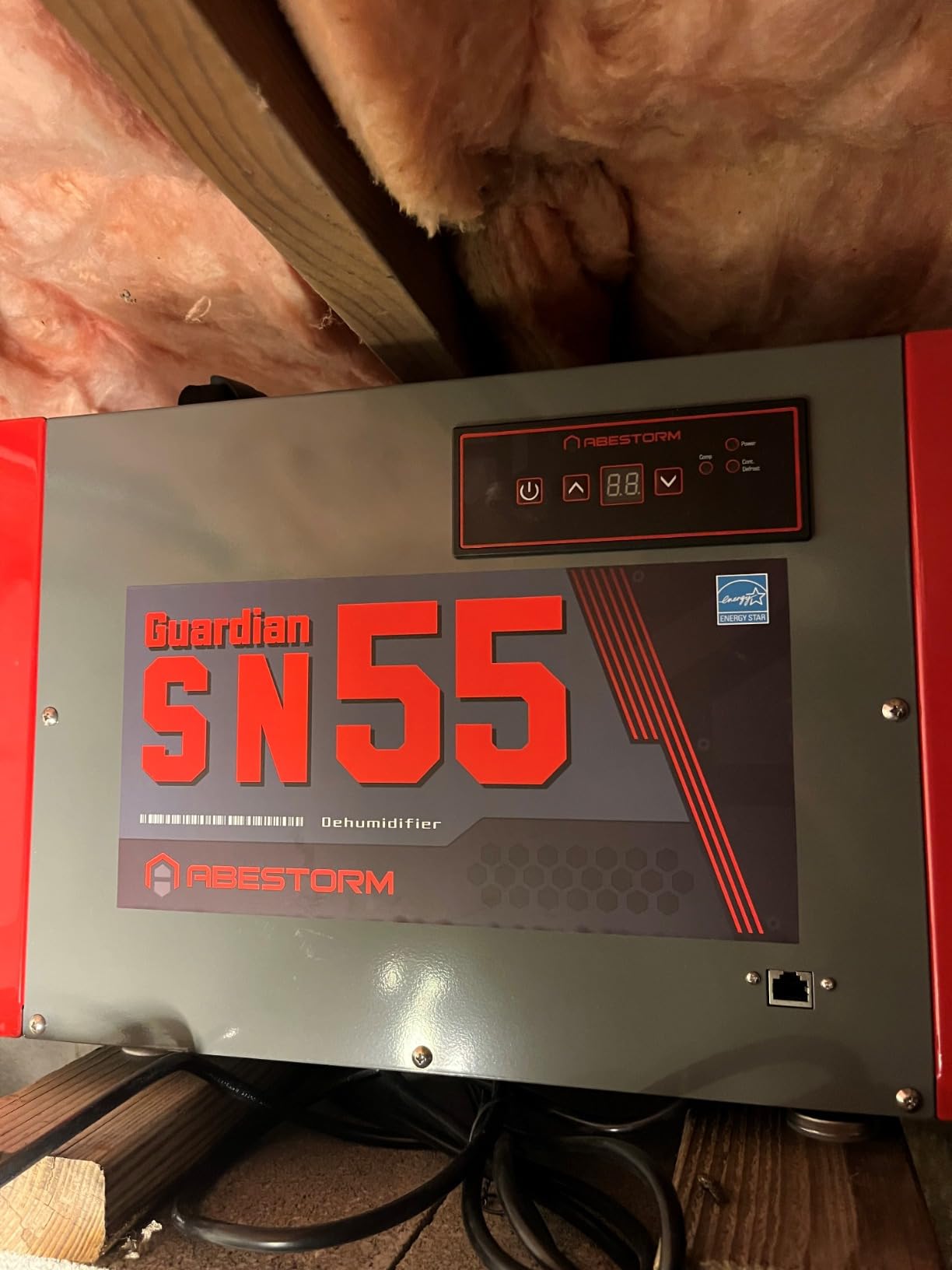
The body is 15.2 by 11.4 by 11.2 inches at 38.2 pounds, so it is one of the easier units to get through a crawl access opening. Automatic defrost uses ambient temperature sensors, and you can select gravity or pump drainage depending on the install.
Support is a genuine strength here. Owners describe free replacement filters with warranty registration, and at least one account describes customer service resolving a filter icing issue on a unit well past a year of use.
Will the pump be a problem under a living space?
Possibly. Owners specifically mention that the pump is audibly noticeable when it cycles, and that the machine overall is louder than expected at roughly refrigerator level. If the crawl space sits directly beneath a bedroom or living room floor, that is a fair trade to evaluate before you buy.
The alternative is a gravity-drain machine of similar size, which is silent but requires a fall to a discharge point.
What is the reliability picture?
With a 4.0 average and 16 percent of ratings at one star, tied for the highest share in the guide, durability is the weak point. Reviews describe refrigerant failures at six and 16 months that required return shipping, and note that real output is closer to a 50-pint class machine than the 70-pint headline.
Plan for a five-year limited warranty and register the unit, because the support response described by owners is the main reason this stays on the list.
10. ALORAIR Smart Wi-Fi 70 Pint with Pump – The Only Machine Here With App Monitoring
ALORAIR Smart Wi-Fi 70 Pints Crawlspace Dehumidifier with Pump Compact Unit
70 pints max
35 PPD at AHAM
Covers 1000 sq ft
Pump lift 19.6 ft
Wi-Fi enabled
Pros
- Built-in Wi-Fi app for live humidity monitoring
- 19.6 ft pump with pipe included
- Very quiet in real owner reports
- Drains directly to a sump
- 6-year warranty
Cons
- Onboard humidity reading ran about 12 percent off
- Included exhaust adapter did not fit
- Dries slower than larger replacements
This is the one to buy if nobody wants to physically enter the crawl space to check a reading. It is the only machine in the guide with built-in Wi-Fi app control for live humidity monitoring and remote adjustment of settings, and for a space you may only enter twice a year that is worth a great deal.
Underneath the app it is a standard 70-pint class unit: 35 pints per day at AHAM conditions, coverage up to 1,000 square feet, 130 CFM airflow, and a 15.2 by 11.2 by 11.4 inch body at 38.2 pounds. The pump lifts 19.6 ft with 19.6 ft of pipe included.
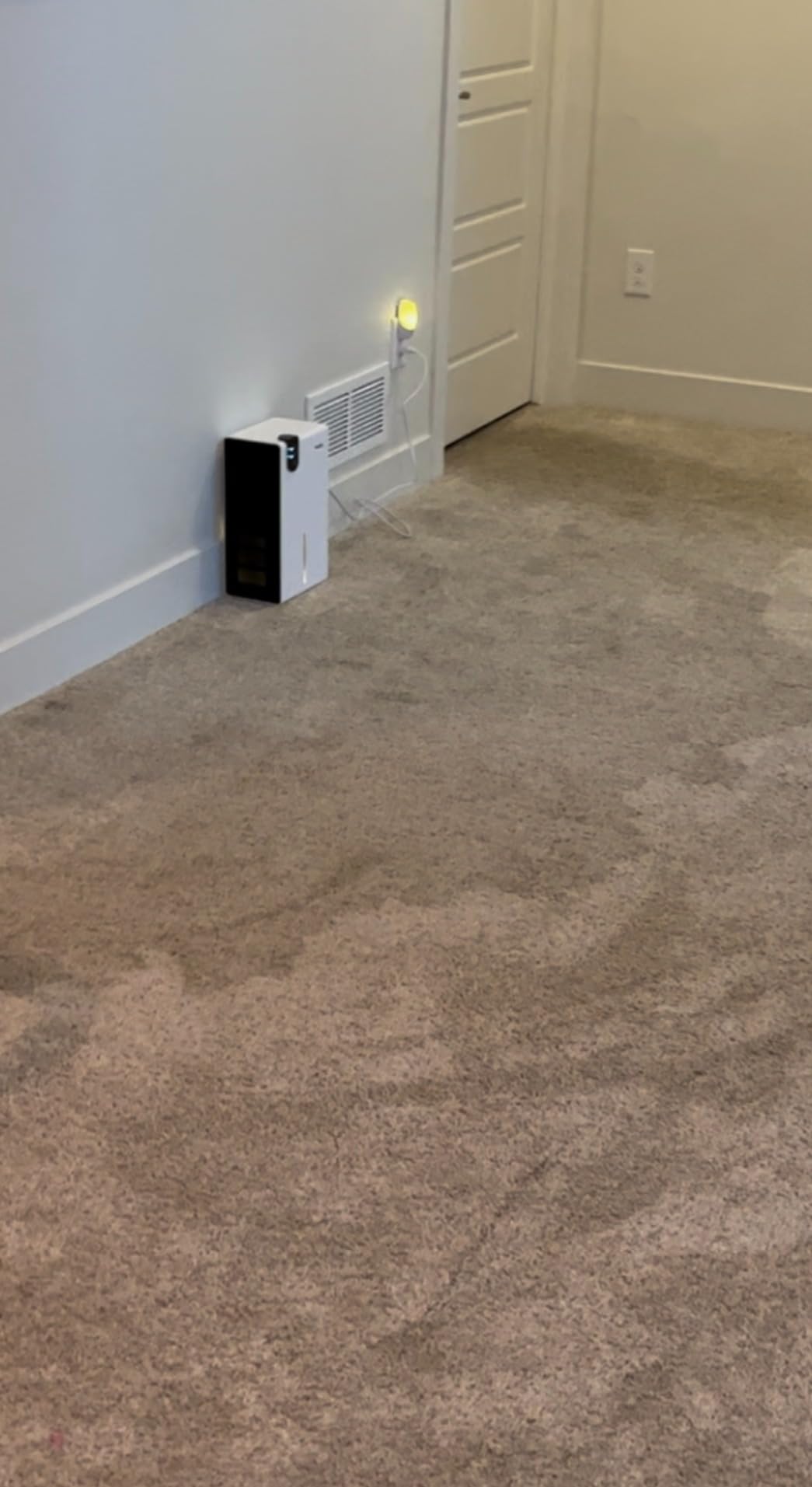
Owners report very quiet operation, in some cases inaudible from an adjacent room, and reliable drainage directly to a sump using existing drain lines. Automatic defrost with ambient temperature sensors handles cool crawl temperatures, and the warranty is six years, ETL listed.
Support also performs well on this model, with owners describing a replacement motherboard shipped outside warranty after two years and a free replacement unit after a refrigerant failure was verified.
Is the app worth giving up capacity for?
If your crawl space is small, the app is a genuine benefit rather than a compromise. A 35 pints per day measured capacity matches the other 70-pint class machines here, so the monitoring does not come at the expense of drying power.
It dries more slowly than the larger machine some owners replaced, and for a large, genuinely wet space you would be better served by one of the 125-pint or 155-pint options.
What has gone wrong in practice?
The most consistent complaint is measurement accuracy, with the main control panel reportedly reading about 12 percent off. Treat the app as a trend indicator and confirm with a separate hygrometer before you make a decision about whether the space is under control.
There are also reports of the included air exhaust adapter not fitting and cracking on installation, and of a control board that required repeated power cycling. These are quality control issues rather than design flaws, and they account for a 14 percent share of one-star ratings.
Buying Guide: How to Choose a Crawl Space Dehumidifier?
Choosing between these ten is mostly a matter of four numbers and one physical measurement. Get those right and the choice takes about five minutes. Get them wrong and you end up with an iced coil, a full tank, or a machine that never gets through the hatch.
Check the operating temperature floor before anything else
A crawl space is the coldest part of most houses. A compressor dehumidifier chills a coil to pull water out of the air, and when the space temperature falls to around 60°F that coil starts to freeze. Standard consumer units have no defrost cycle, so they ice over and shut down at exactly the moment you need them most.
Look for an explicit auto defrost cycle, which every machine in this guide has, and for a manufacturer that states an upper temperature rating comfortably above what your space reaches in summer. Desiccant units avoid the problem entirely because they pull moisture into a chemical wheel with no cold coil, but they draw more power and warm the air slightly, and none of the ten models in this roundup use that technology.
Decide how water leaves the machine
This is the criterion forum owners raise most often, and it is not close. A tank that fills silently in an unvisited space is the single most cited failure pattern in crawl space dehumidification, and it is the reason gravity drainage or a pump is effectively mandatory rather than a nice-to-have.
Gravity drainage needs a fall. A drain port on the unit or an attached hose runs downhill to a floor drain, a sump, or a discharge line through the foundation wall. It has no moving parts, which makes it the most reliable arrangement, and contractors working crawl spaces request gravity-drain-capable machines by default for that reason.
A condensate pump removes the fall requirement. The units in this guide that include one lift water up to 19.6 ft, and the Waykar adds a 16.4 ft pump hose alongside a gravity hose. A pump adds a small failure point and some noise, but it is the only option when your space has no usable grade to drain toward.
Understand why two brands can both claim 100 pints
Dehumidifier capacity is quoted under two different test standards and the numbers are not comparable. The older AHAM method measures a saturation figure, essentially the best case at near-saturated air. The DOE standard measures removal at a more realistic indoor condition.
The gap is large. The ALORAIR 70 PPD machine in this guide is listed at 70 pints and 35 PPD at AHAM, and the Moiswell at 155 pints and 70 PPD at AHAM. Use the lower, AHAM figure for planning and treat the headline number as marketing. Two machines both labelled 100 pints can differ by nearly a factor of two in real output, and that difference is entirely a labelling convention rather than a quality judgement.
Size to the footprint and the water source
Measure the crawl space floor area and pick from the coverage ratings in the table above, then step up one size if the ground is bare soil with no vapor barrier, if the water table is high, or if you are dealing with flood or water damage rather than seasonal dampness.
For a crawl space up to about 1,000 square feet with a vapor barrier, the 35 PPD at AHAM class in this guide is a sensible match. From roughly 1,000 to 2,000 square feet, aim for a unit in the 55 to 60 PPD at AHAM range. Above that, or with an unencapsulated damp space, you want 70 PPD at AHAM or more.
Set the target relative humidity at 50 to 55 percent. Above roughly 60 percent, wood surfaces stay wet enough to support mold and rot, and that is the number that matters for your floor joists and subfloor rather than the comfort of anyone living above.
Decide whether to encapsulate first
You can run a dehumidifier in a bare, vented crawl space, and it will help, but you are fighting the ventilation. Foundation vents that stay open pull humid outside air in, and the machine then works continuously without ever catching up. Multiple sources across the forums we reviewed describe the older “just vent it” advice as now being considered wrong practice, though local code and climate still matter.
Encapsulation means sealing the crawl floor and sometimes the walls with a heavy vapor barrier and insulating the rim joists. It cuts the moisture load dramatically, which lets a smaller unit do the work. If you already have a barrier in place, a dehumidifier becomes close to essential rather than optional, because the space is sealed and the only path for moisture out is mechanical.
The downsides are real, and this is where we would caution you. A professional encapsulation of a 2,000 square foot crawl space is typically quoted in the several-thousand-dollar range, which is a significant part of most household budgets. It requires access through the hatch to do properly, it must be planned with ventilation in mind so you do not trap a wet space, and a badly detailed encapsulation can make moisture problems worse by sealing in damp ground. Find a contractor who will look at the water source before quoting a barrier.
Know when not to buy a dehumidifier
The consensus position across owner discussions is consistent and worth repeating. A dehumidifier is maintenance, not rescue. It cannot fix standing water, an active plumbing leak, a failed sump pump, or groundwater coming through a foundation wall, and a machine running against a bulk water problem will fail early and leave you with a warranty claim instead of a dry crawl space.
The correct order is fix bulk water first, seal the ground second, then choose a machine third. If you have a musty smell and damp joists with no water source, a dehumidifier is exactly the right purchase. If you have water appearing on the floor, call someone about the water.
Plan the install before the unit arrives
Measure your hatch opening and compare it to the machine’s smallest face before you order, and get a second person for anything over 50 pounds. Decide where the condensate goes and run the line before the unit is in position, because routing a drain through a crawl space wall or tying into a sump is far easier with the space clear.
Place a separate hygrometer in the corner of the space at joist height, away from the unit’s discharge, and check it monthly. Owners on several of these models report onboard readings that drift, and a five dollar mechanical hygrometer is the only way to know whether the space is actually where you set it. Memory restart is worth confirming on your chosen model, because a unit that forgets its set point after every breaker trip will slowly drift.
Frequently Asked Questions
What type of dehumidifier is best for a crawl space?
A low-temperature compressor unit with an automatic defrost cycle, rated to keep working below 60F, with continuous gravity drainage or a built-in condensate pump. Pair it with a sealed vapor barrier, set the target relative humidity to 50-55 percent, and place a separate hygrometer in the space to confirm the reading.
Is it worth putting a dehumidifier in a crawl space?
Yes, when the moisture problem is humidity rather than bulk water. Holding relative humidity near 50-55 percent keeps wood above mold and rot risk and protects floor joists and subfloor. A dehumidifier cannot fix standing water, an active leak, or a failed sump pump, so fix the water source first.
What is the most reliable whole house dehumidifier?
Reliability in this category tracks warranty length, build quality, and how much long-term owner data exists. The ALORAIR Sentinel HD55S has the deepest review history with well over 1300 ratings, and the AprilAire E080, E070, and E100 models carry five-year manufacturer warranties and corrosion-resistant aluminum coils. Ducted whole house models also need professional installation.
Can I put a dehumidifier in my crawl space without encapsulation?
You can, and it will help, but leaving foundation vents open while the machine runs invites humid outside air in and the dehumidifier will lose. If you run one, close the vents where code allows, and plan on more runtime and a larger unit. Encapsulation cuts the moisture load so a smaller machine can keep up.
Do I need a dehumidifier if I encapsulate my crawl space?
In most cases yes, because sealing the crawl space traps the moisture already in the ground and the only way out is mechanical. Dehumidification is what protects the subfloor and floor joists from rot and mold in a conditioned crawl, and owners report a noticeable drop in musty smells and warmer floors above once humidity is controlled.
How much does it cost to encapsulate a 2000 sq ft crawl space?
A professional encapsulation of a 2,000 square foot crawl space is typically quoted in the several-thousand-dollar range, with cost driven by access through the hatch, whether the rim joists are insulated, and how much soil needs to be cleared first. Get quotes that separate the vapor barrier work from any repair work.
What are the downsides of crawl space encapsulation?
The main downsides are cost, access, and the risk of sealing in a damp space if the water source is not fixed first. A barrier needs proper detailing around vents and access points, poorly done work can make moisture problems worse, and it removes your ability to inspect the underside of the floor easily in future.
What should the humidity be in an encapsulated crawl space?
Target 50 to 55 percent relative humidity, measured at joist height in the corner of the space rather than at the unit. Above roughly 60 percent, wood surfaces stay wet enough to support mold and rot. Verify with a separate hygrometer, since onboard readings on several of these models drift by several percent.
Conclusion
The best whole house dehumidifiers for crawl spaces are the ones rated for cold spaces, drained continuously, and sized to the AHAM figure rather than the headline number. For most homeowners, the ALORAIR Sentinel HD55S is the safest default: the deepest owner history in this group, an auto defrost cycle that survives a cool crawl, and continuous gravity drainage. Choose the Waykar 125 Pint when the space is large or the ground is bare, the ALORAIR 70 PPD with Pump when you need drainage lift and clearance, and the AprilAire E070 when the hatch is the problem.
Whichever you pick, fix the water source first, seal the ground, and verify the result with a hygrometer you did not get from the machine. That sequence does more for your floor joists than any rating on a spec sheet.