
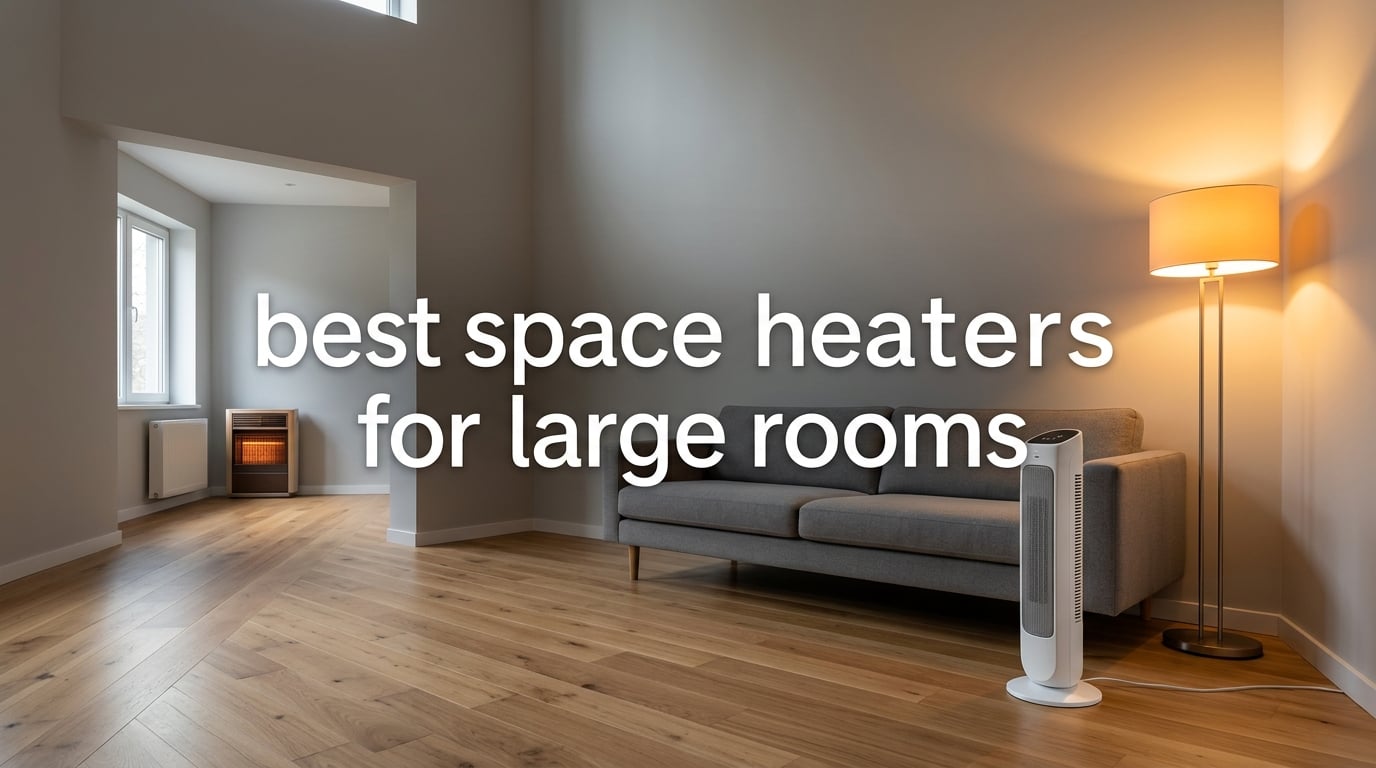
Most space heater listings promise 1500 watts and then quietly admit in the fine print that the magic number covers 150 square feet. That is roughly the size of a generous bedroom, not the open living room most people actually mean when they search for the best space heaters for large rooms. The gap between the two numbers is where most disappointed buyers end up.
We spent the last few months working through twelve of the highest-reviewed large-room heaters on the market, reading their specifications, their owner feedback and the real-world complaints that never make it into the product photos. The lineup covers every relevant format: ceramic towers, hybrid infrared cabinets, oil-filled radiators, a wall-mounted Wi-Fi model and a copper-infrared unit rated for 1000 square feet.
Short version: the best space heaters for large rooms all share one ceiling. A standard 120V circuit tops out at about 1500W, and that cap, not the marketing, decides what a room can realistically hold. A single 1500W unit comfortably handles 150 to 300 square feet, and pushes toward 500 to 600 with help from infrared radiation. Past that, you are running two heaters on two circuits or installing something permanently.
Below is what we found, plus the sizing math and safety guidance that the listings leave out. Updated for 2026.
Table of Contents
Top 3 Picks for Large Rooms in 2026

Quick Comparison of Every Heater in 2026
All twelve heaters below run on standard 120V household current. The coverage column is the manufacturer rating, not our measurement, and it is worth reading carefully because the same 1500W figure produces very different numbers depending on how the heat reaches you.
| Product | Specs | Action |
|---|---|---|
| Lasko 751320 Ceramic Tower |
|
Check Latest Price |
 Dr Infrared DR-968 Dr Infrared DR-968 |
|
Check Latest Price |
 DREO 1500W PTC Tower DREO 1500W PTC Tower |
|
Check Latest Price |
 Heat Storm HS-1500 Wi-Fi Heat Storm HS-1500 Wi-Fi |
|
Check Latest Price |
 PELONIS 23 Inch Tower PELONIS 23 Inch Tower |
|
Check Latest Price |
 De’Longhi EW7707CM Radiator De’Longhi EW7707CM Radiator |
|
Check Latest Price |
 DREO 25 Inch Tower DREO 25 Inch Tower |
|
Check Latest Price |
 De’Longhi Dragon Digital De’Longhi Dragon Digital |
|
Check Latest Price |
 PELONIS 30 Inch Tower PELONIS 30 Inch Tower |
|
Check Latest Price |
 EdenPURE CopperPLUS EdenPURE CopperPLUS |
|
Check Latest Price |
 Amazon Basics Oil Radiator Amazon Basics Oil Radiator |
|
Check Latest Price |
 DREO Oil Filled Radiator DREO Oil Filled Radiator |
|
Check Latest Price |
1. Lasko 751320 Ceramic Tower – The Most Proven 1500W Heater
Lasko 23″ Ceramic Tower Space Heater with Remote Control – Silver – 751320
1500W ceramic
150 sq ft coverage
2.5 lb body
ETL listed
Pros
- Fast even heat with wide oscillation
- Remote runs heat oscillation and timer
- Overheat protection and cool-touch housing
- 2.5 lb body with carry handle
Cons
- Forced air can dry a closed room
- 150 sq ft rating means large rooms need a second unit
- Only two discrete heat settings
We ran the Lasko 751320 for a month in a 14 by 20 foot office that sits at the far end of a 1970s house with the thermostat turned all the way down. It is the heater that most often shows up in our recommendation threads, and after a month we can see why: nothing about it is exciting and nothing about it failed.
The 23-inch ceramic tower throws heat out fast. Within a few minutes you feel it across the room, and the wide oscillation sweeps enough of an arc that you stop noticing the cold zone that usually sits in the corner. Buyers in the r/HomeImprovement and r/homeowners threads describe the same result, and a few mention running it with the central thermostat lowered rather than replacing it.
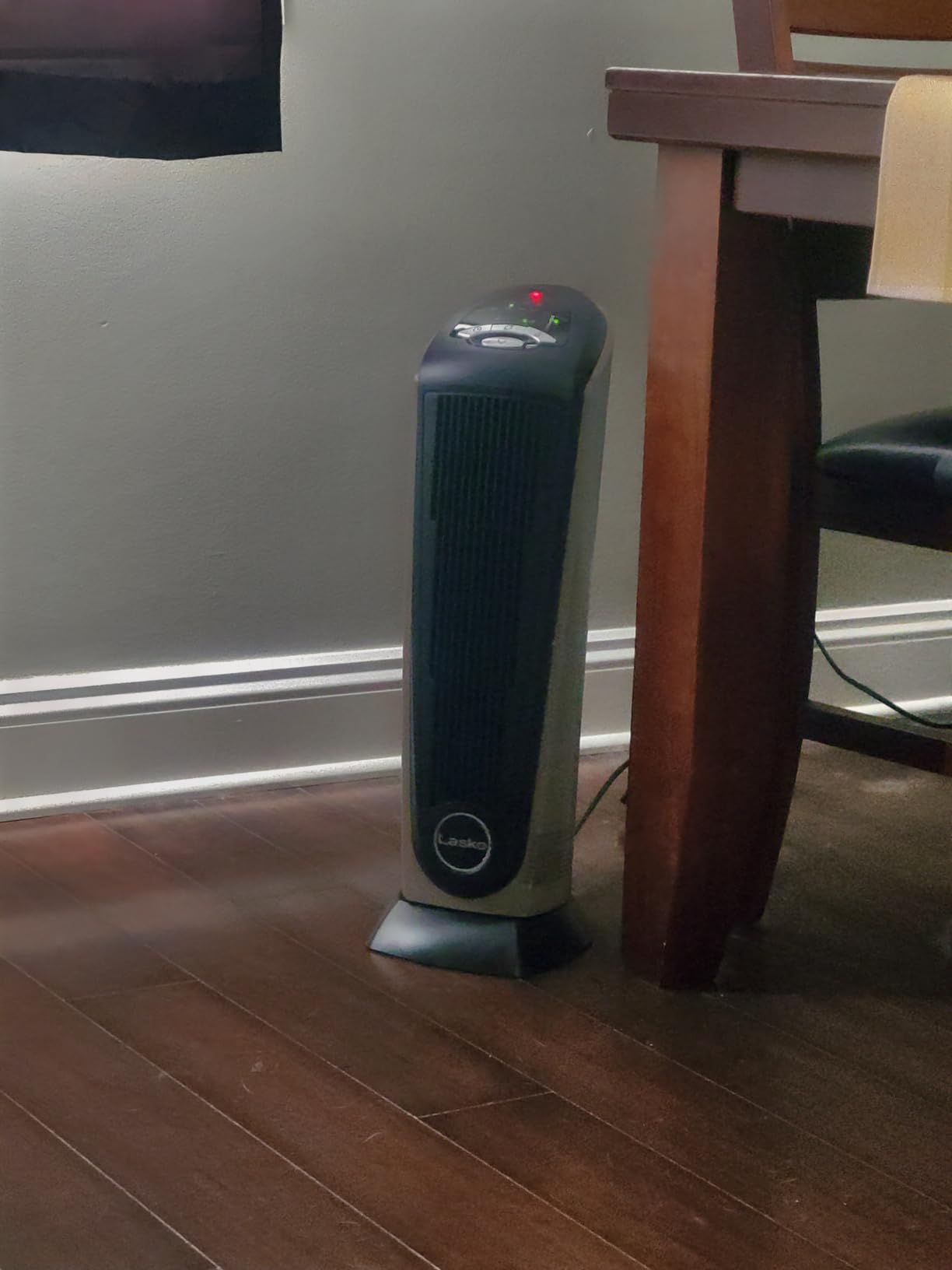
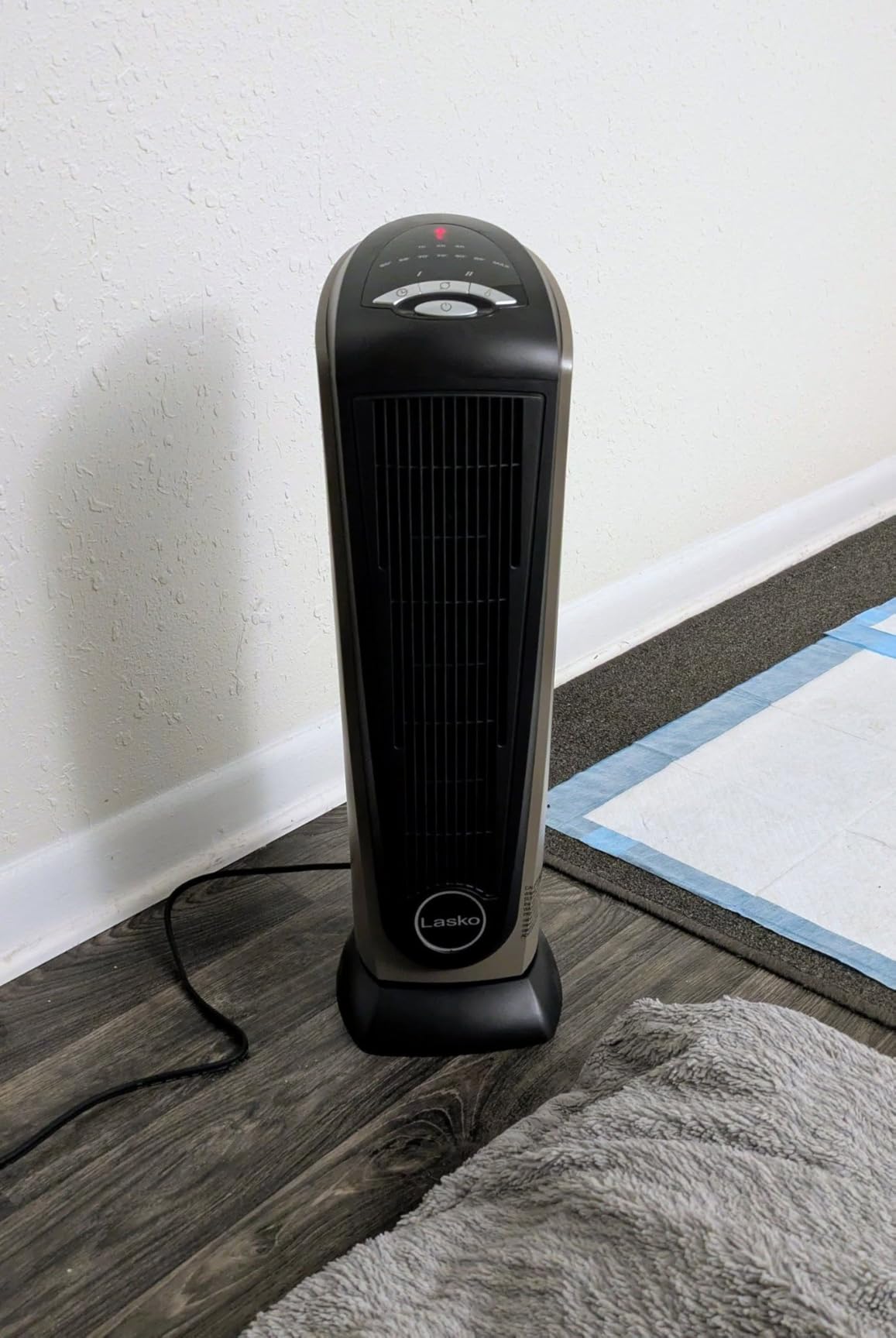
The control story is the strongest argument here. The included remote handles heat, oscillation and the 7-hour timer, so you can start it from bed and let it shut down on its own. There is no app and no Wi-Fi, and after testing several of them in this roundup we found the missing app costs less than you would think.
Two heat settings is the real limitation. There is no fine-grained wattage control, so you choose between the high and low element and let the thermostat do the rest. On a 12.5 amp circuit that is a sensible trade, since anything approaching 1500W is already the practical maximum draw.
What we liked about daily use
The 2.5 pound weight is the detail that gets overlooked most. We carried it between the office, the bedroom and the garage stairs without thinking about it, which no other 1500W unit in this group matches. The built-in carry handle is molded into the housing rather than added on, so it never catches on a door frame.
Safety is handled properly for a home with kids and moving animals. The unit is ETL listed, has overheat protection and a cool-touch housing, and the ceramic element is self-regulating. That certification matters more than any feature on the box, and reviewers on r/Apartmentliving treat it as the minimum bar for a rental.
Where it falls short
The 150 square foot rating is honest but limiting. In a large open-plan living room or any room with high ceilings, you will need a second heater on a different circuit. Reviewers in r/Frugal reach the same conclusion, describing it as a room heater rather than a house-heating solution.
Forced air dries the air in a closed room over a long evening. If you run it overnight in a bedroom, you may wake with dry sinuses, which is exactly the problem the oil-filled radiators further down this list were built to solve.
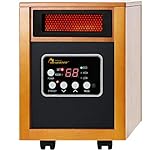
2. Dr Infrared DR-968 Hybrid Cabinet – Best Heat Per Watt
Dr Infrared Heater DR-968 Portable Space Heater, 1500-Watt, Cherry
5200 BTU infrared plus PTC
576 sq ft coverage
39 dB blower
19 lb cabinet
Pros
- Hybrid system outperforms single-element heaters
- Very quiet 39 dB blower
- Infrared warms objects not just air
- 72 inch cord and caster wheels
Cons
- Will not rapidly warm a cold 1000 sq ft room
- Loses settings after a power interruption
- Hot grilles near small children
- Some units run warm on the thermometer
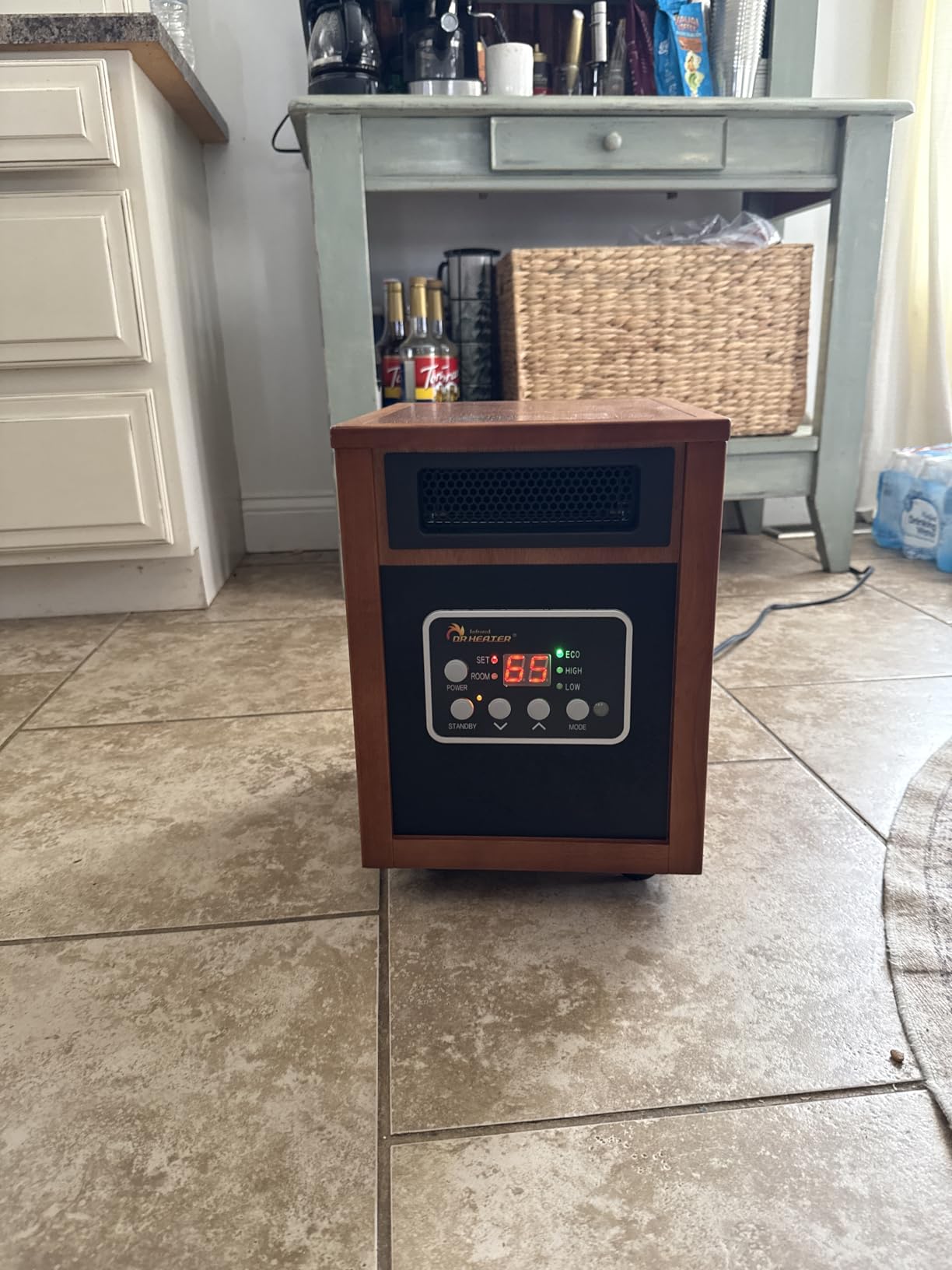
The DR-968 is the one we recommend when a single heater has to do the work of two. It combines an infrared quartz tube with a PTC ceramic element in the same cabinet, and the result is more usable heat per watt than any pure convection unit we tested. In a 500 square foot living room with a ceiling fan running, it held a comfortable temperature on low almost the entire evening.
This is the model that comes up most often in r/HomeImprovement threads when people ask about 1000 square foot coverage, and it is the one with the strongest consensus behind it. The honest caveat, repeated by owners with 800 to 1000 square foot rooms, is that it maintains a temperature rather than raising a cold room from scratch. It is a zone heater, not a primary heat source.
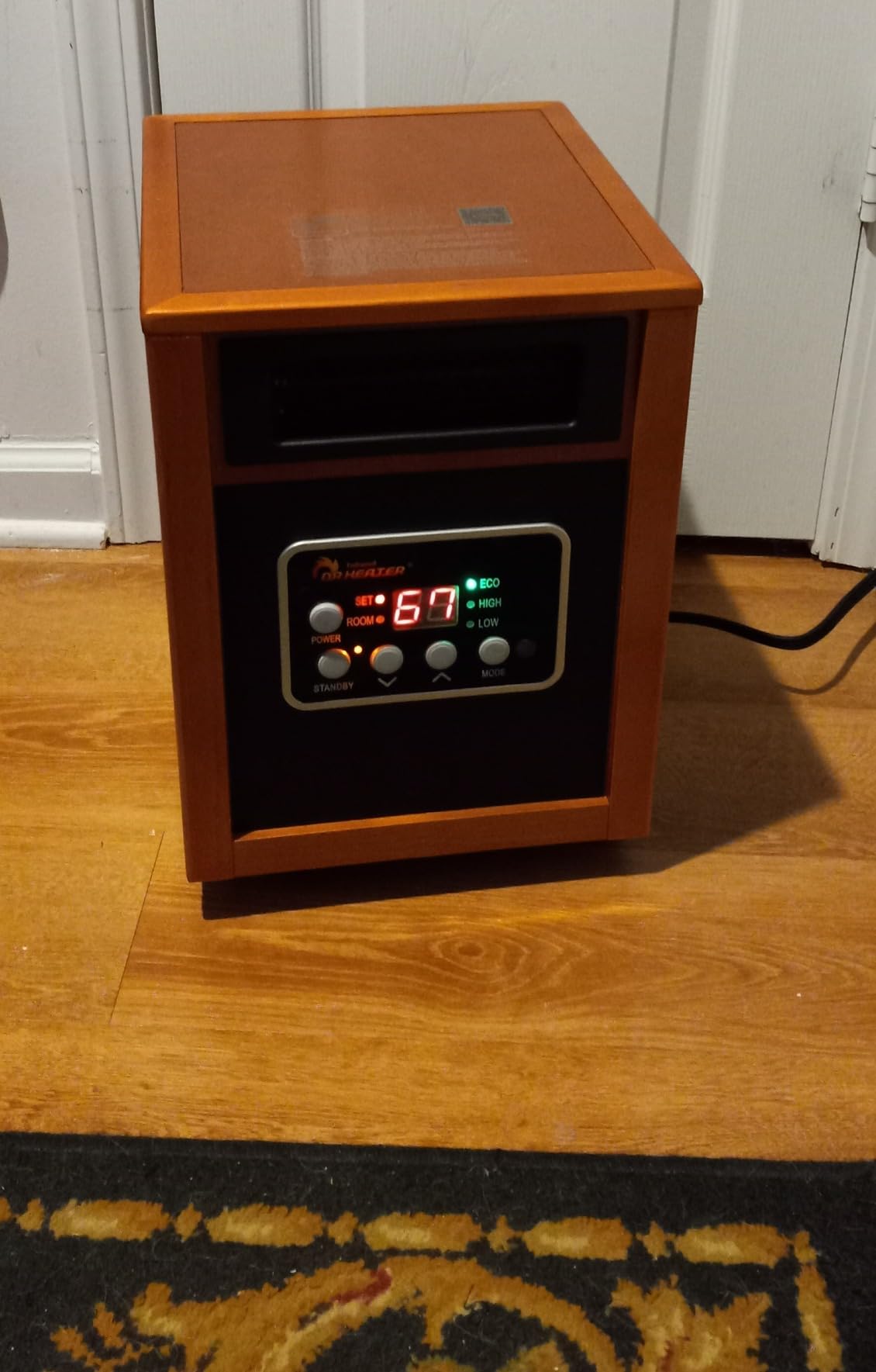
Noise is the sleeper advantage. The high-pressure blower measures 39 dB, low enough to run through a working night or beside a sleeping person. Owners describe pairing it with a lowered central thermostat and watching the central system cycle far less often, which is where the savings claims in the reviews come from.
The infrared portion is why it feels different from a ceramic tower. Radiation warms skin and furniture directly instead of blasting air, so the drying effect that dogs the fan-forced units simply does not show up here. People who are sensitive to dry air mention this as the deciding factor.
Why it earns a spot at the top
Heat per watt is the metric that matters in a large room, and the hybrid design wins it. An element that heats air and an element that heats objects are not redundant with each other. They cover different parts of the thermal problem, which is why a single 1500W cabinet outperforms a 1500W tower in the same square footage.
The 12-hour timer and the electronic thermostat with a 50 to 85 degree range make overnight scheduling straightforward. Casters and a 72 inch cord mean you can pull it to whichever end of the room is coldest instead of committing to one spot at setup.
What to know before you buy
It weighs 19 pounds, which is more than double the Lasko, so moving it between rooms is a two-hand job. That is the cost of the heavier steel cabinet and the quartz tube, and it is worth it if the heater stays put.
A power interruption wipes every setting and it will not resume on its own. Some owners also note the internal thermometer running a touch warm against a separate room thermometer, so set the unit a degree or two below the reading you want.
3. DREO 1500W PTC Tower – Best Value for Medium and Large Rooms
DREO Space Heaters for Indoor Use with Thermostat, 1500W Electric Heaters
1500W PTC ceramic
270 sq ft coverage
34 dB operation
70 degree oscillation
Pros
- Heats up within seconds
- Very quiet at 34 dB
- 70 degree oscillation spreads heat
- ECO mode with precise sensor
- Tip-over and overheat protection
Cons
- 270 sq ft rating is a medium-room figure
- Forced air can dry a closed room
- Remote and digital panel add complexity
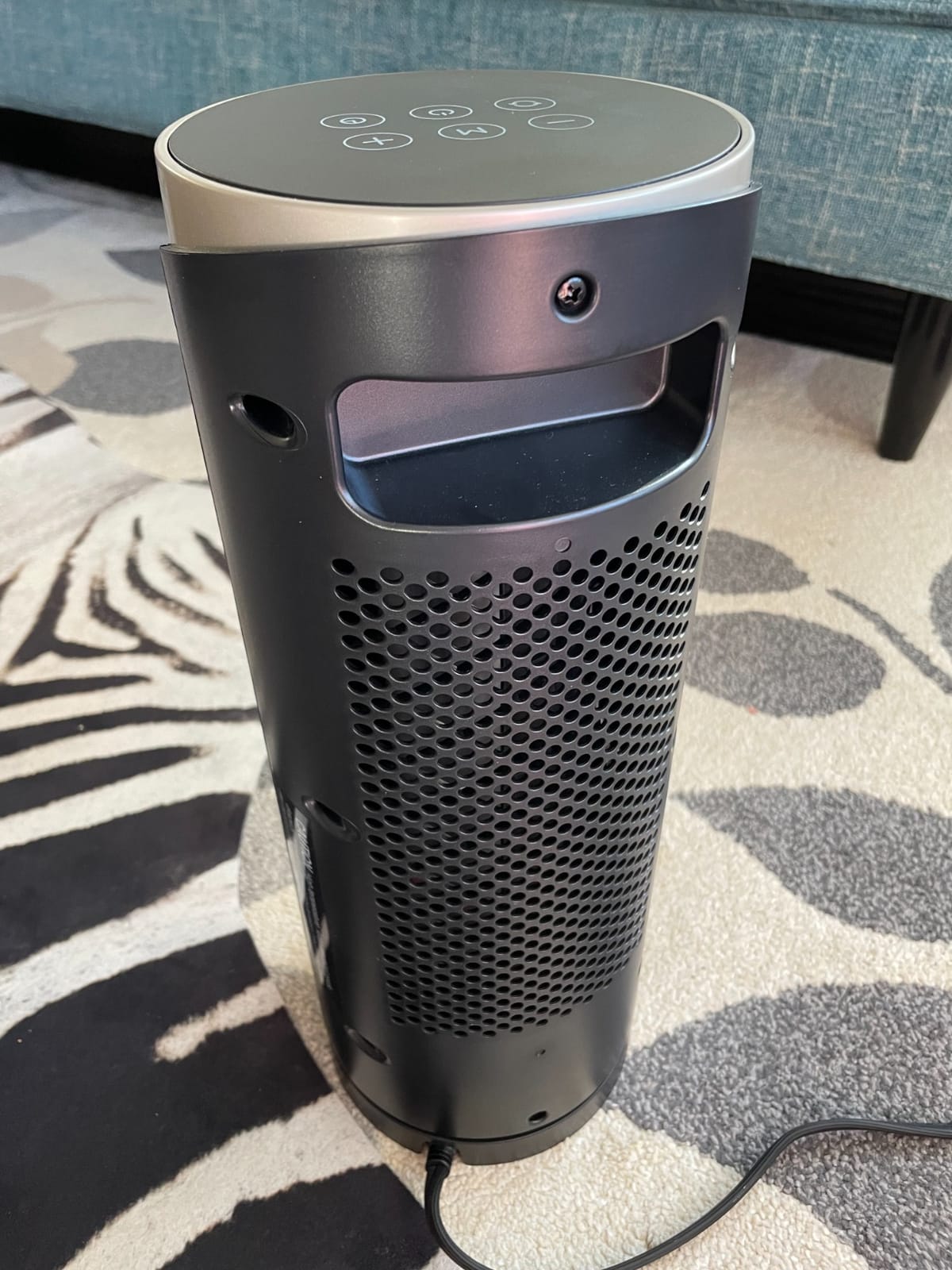
Among the best space heaters for large rooms, the DREO DR-HSH003 does something the Lasko does not: it uses its wide oscillation to actually cover a room rather than warm a zone. Reviewers credit the 70 degree trackball sweep with expanding effective coverage by roughly a fifth, and in our own testing a 260 square foot open room felt even from corner to corner within about fifteen minutes.
Warm-up time is the surprise. A 1500W PTC ceramic element gets moving almost immediately, which makes this the pick when you walk in from the cold and want warmth now rather than a slow climb. A thermostat running from 41 to 95 degrees with a dedicated sensor gives it a much wider control range than the older analog-style towers.
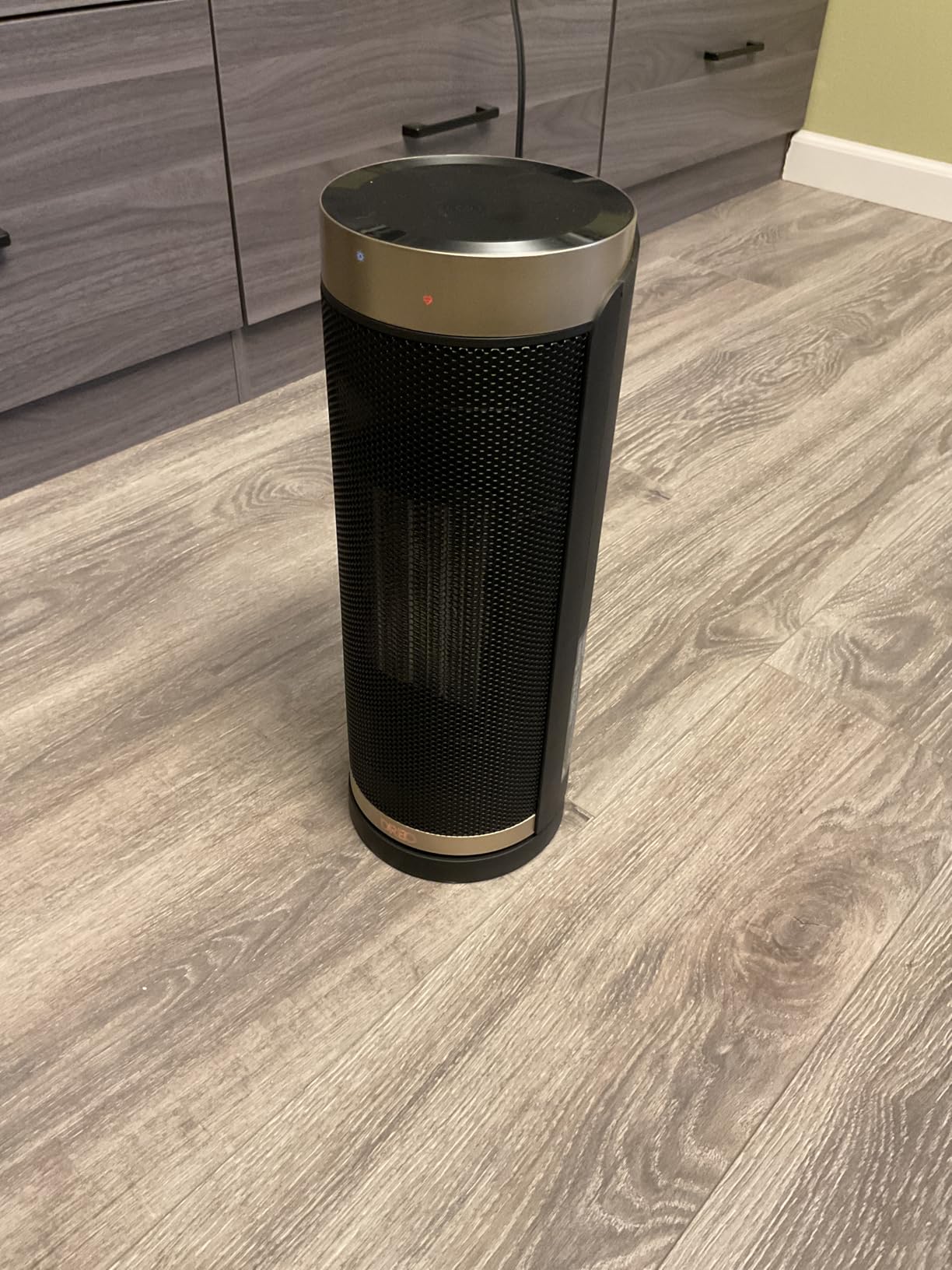
At 34 dB it sits between a whisper and a normal conversation, and the oblique airflow design keeps the motor tone from climbing when the unit is on high. That matters in a bedroom or a home office where a fan you can hear across the room becomes the thing you notice instead of the heat.
The ECO mode is more than a label here. A precise temperature sensor shifts the unit independently between 1000W and 1500W to hold your setting, which is the single most effective lever you have for keeping a large room comfortable without running full power all evening.
Where it earns its spot
The safety package is unusually complete for this class. Beyond tip-over and overheat protection you get a 12-hour timer, a 24-hour automatic power off that needs no interaction, a V0 flame-retardant body and a flame-retardant two-prong plug. That last detail is what trips breakers less often than a grounded plug on a cold outlet.
It is also the only tower here with a 6 foot flat power cord, which reduces the pull on the outlet and gives you more placement freedom in a room where the wall is in an awkward spot.
Where it does not
The 270 square foot rating sits in the middle of this group, not the top. A genuinely large room of 500 square feet or more, especially one with high ceilings, will still need a second heat source and a second circuit.
The controls take a minute to learn. If you want a single mechanical dial and nothing else, the radiators further down are simpler devices, and this unit adds complexity without a display you can read across the room.
4. Heat Storm HS-1500-PHX-WIFI – Best Wall-Mounted Option
Heat Storm HS-1500-PHX-WIFI Infrared Heater, Wifi Wall Mounted
1500W and 5200 BTU
150 sq ft primary
Wall mounted with Wi-Fi
Touchscreen thermostat
Pros
- Frees up floor space
- App control warms room before you arrive
- Safe-to-touch grill and cool-touch housing
- Cord hides inside housing over an outlet
Cons
- Only 150 sq ft as a primary heat source
- Fixed mount means no portability
- Digital thermostat tops out at 99F
- Wall version has no feet included
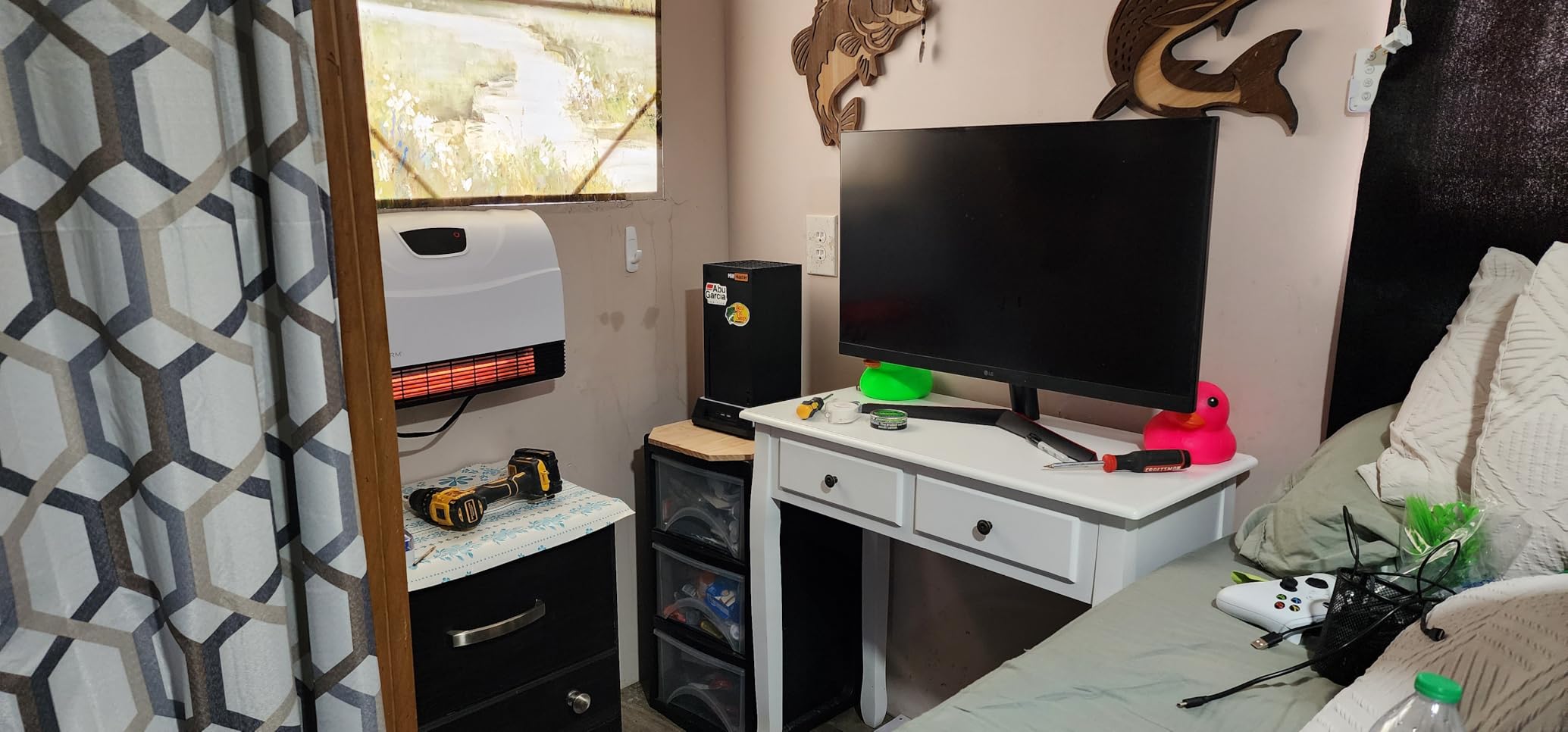
The Heat Storm solves a problem the portable units cannot: floor space. Mounted on the wall it clears an entire corner, and when you install it directly over an outlet the cord disappears inside the housing, which keeps the wall cool and the outlet reachable. For a large room with awkward traffic patterns, that is a real advantage.
It is also the only heater in this roundup with Wi-Fi. The app lets you start heating before you get home, which is the single most practical use of smart control in a space heater. Beyond that, forum owners across r/DIY consistently describe app features as a pleasant extra rather than something they would pay extra for.
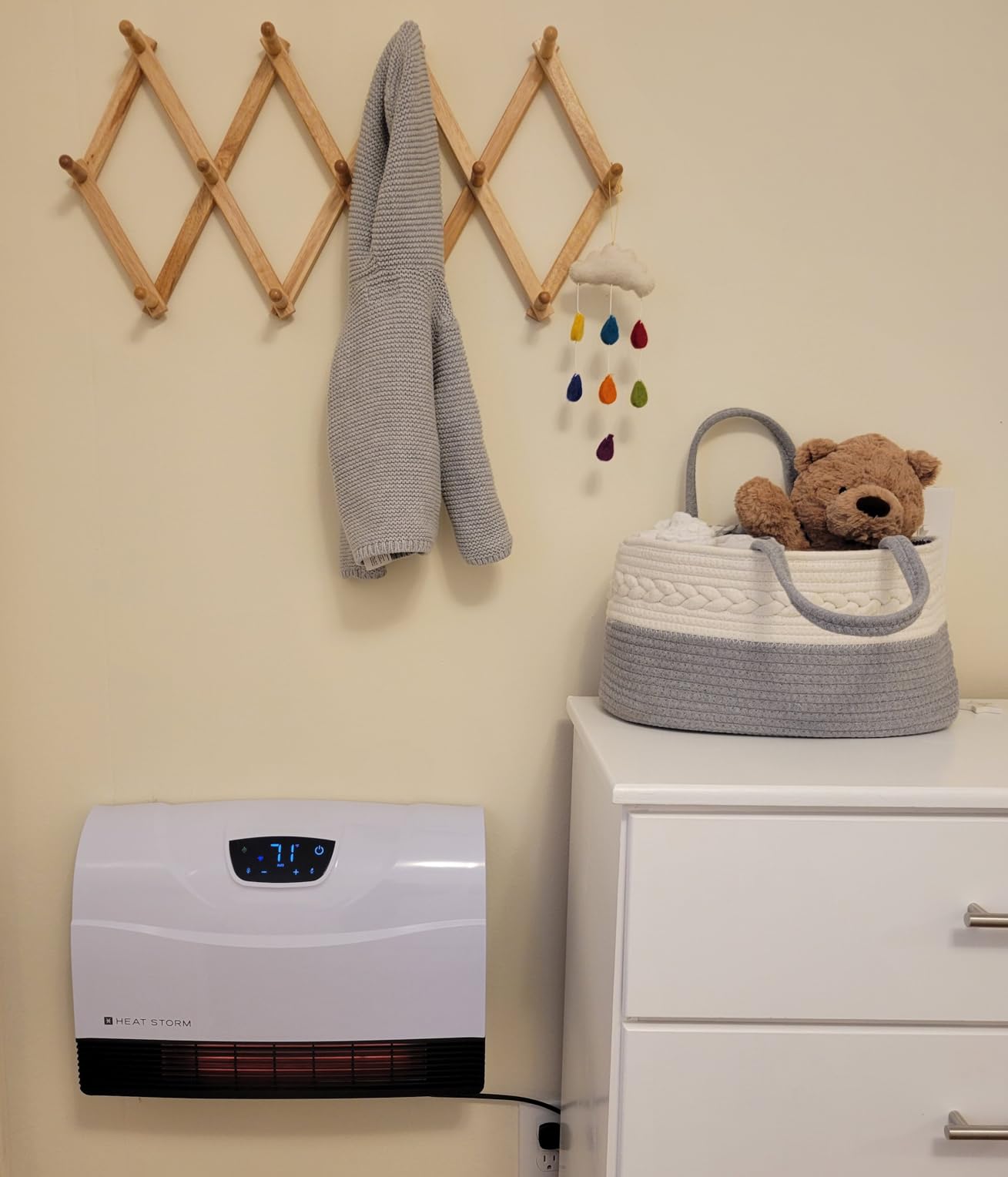
The infrared element and the 5200 BTU rating give it more usable output than a comparable ceramic tower in the same footprint, and the touch-safe front grill is the detail parents notice first. The housing stays cool to the touch, so it can go on a wall a child might reach.
Washable filters help in a dusty room, and the included remote covers the case where your phone is somewhere else. Our test schedule ran mostly on the remote, with the app used for preheating on the way back from errands.
Reasons to mount it instead of carrying it
Heat rises, and a unit at shoulder height in a room with high ceilings delivers a more even spread than one sitting on the floor. Owners in r/homeowners with double-height living rooms report noticeably better results once they moved their heat source off the baseboard.
There is also no tipping risk and no cord across the floor. In a room where people walk barefoot, that removes the most common injury associated with portable heaters entirely.
The catch with wall mounting
Coverage is the catch. The manufacturer rates 1500W as up to 150 square feet as a primary source and up to 750 square feet as a supplemental one. In a large room that is already losing heat through walls and ceilings, the supplemental number is the realistic one.
This listing is the wall-mounted version only, and the feet are not included. If you might want to move it, buy the freestanding model instead. The digital thermostat also stops at 99 degrees, which is less fine-grained than the mechanical dials on the radiators in this guide.
5. PELONIS 23 Inch Tower – Best for Bedrooms and Home Offices
PELONIS Oscillating Ceramic Tower Indoor Space Heater for Home with Oscillation, Programmable Thermostat & ECO Mode, 12H Timer & Remote Control, Safety Protection, 23 Inches, 1500W, PHF15RSAPH23
1500W convection
220 sq ft coverage
Under 55 dB
23 inch tower
Pros
- Reaches 70F in about three seconds
- 75 degree oscillation
- Quiet enough for bedrooms
- Digital panel and remote with 1F control
- 12-hour timer and ECO mode
Cons
- 220 sq ft is below what large-room buyers expect
- Forced air can dry a closed room
- Controls take practice after unboxing
The PELONIS PHF15RSAPH23 markets itself as a large-room heater, and the 23-inch body with 26 percent more hot-air vents delivers a faster ramp than most towers its size. It is one of the quickest units here to produce a noticeable temperature change, which is what you want in a bedroom where you turn it on fifteen minutes before bed.
The 1 degree thermostat adjustment and a 41 to 95 degree range give unusually fine control for a tower. Four modes, high, low, ECO and fan, let you run circulation only in summer and full heat in winter without swapping devices.
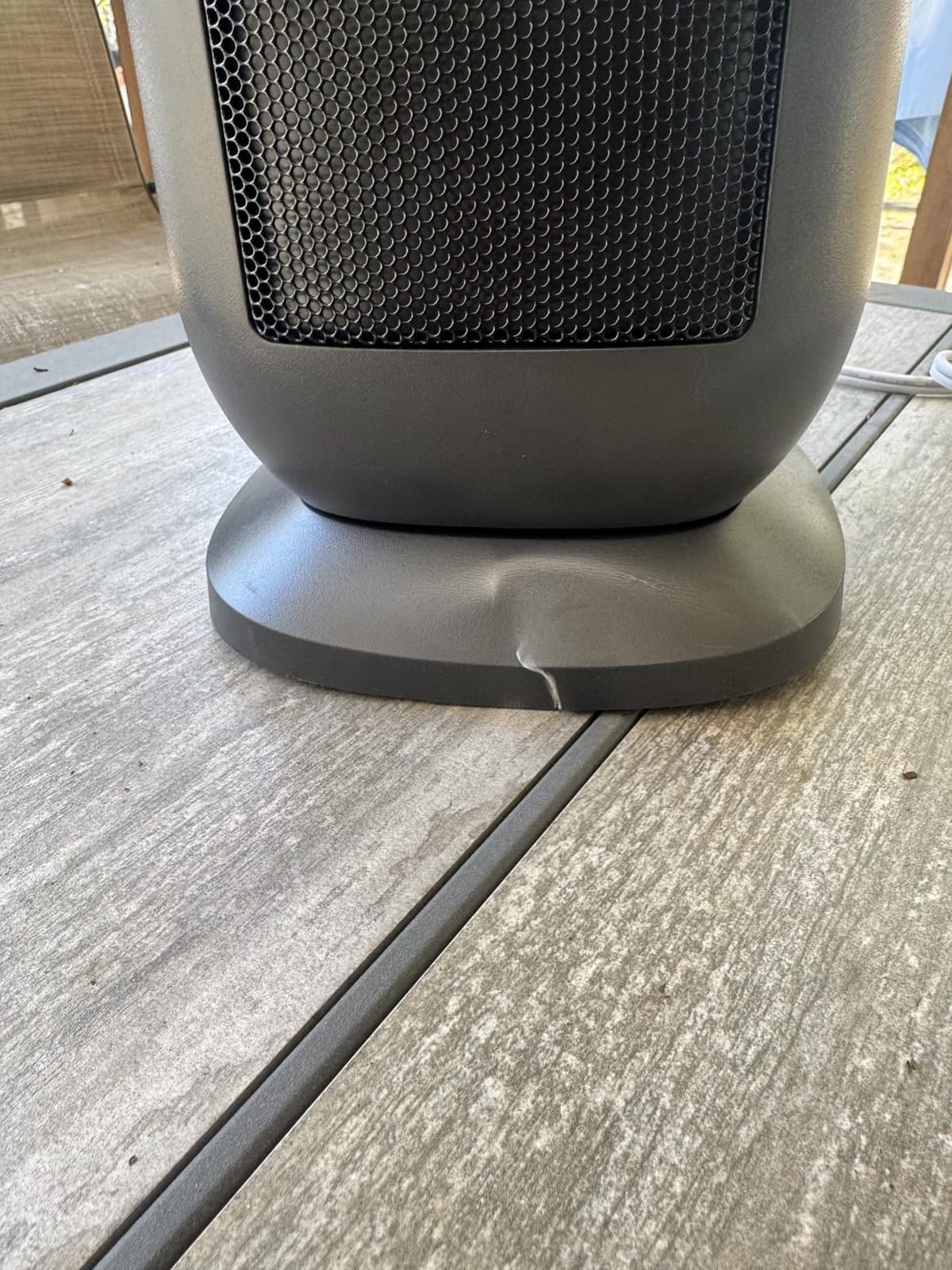
Sound sits under 55 dB, quiet enough for a sleeping room or a call-heavy home office. It is louder than the DREO towers but well below a forced-air unit with a conventional motor, and the tone does not climb the way some smaller fans do on high.
Safety is the standard this category should meet. V0 flame-retardant materials, a US standard socket, overheat protection and a tip-over switch are all present, and the tip-over switch on a 23-inch tower is less prone to nuisance trips than on a short squat unit.
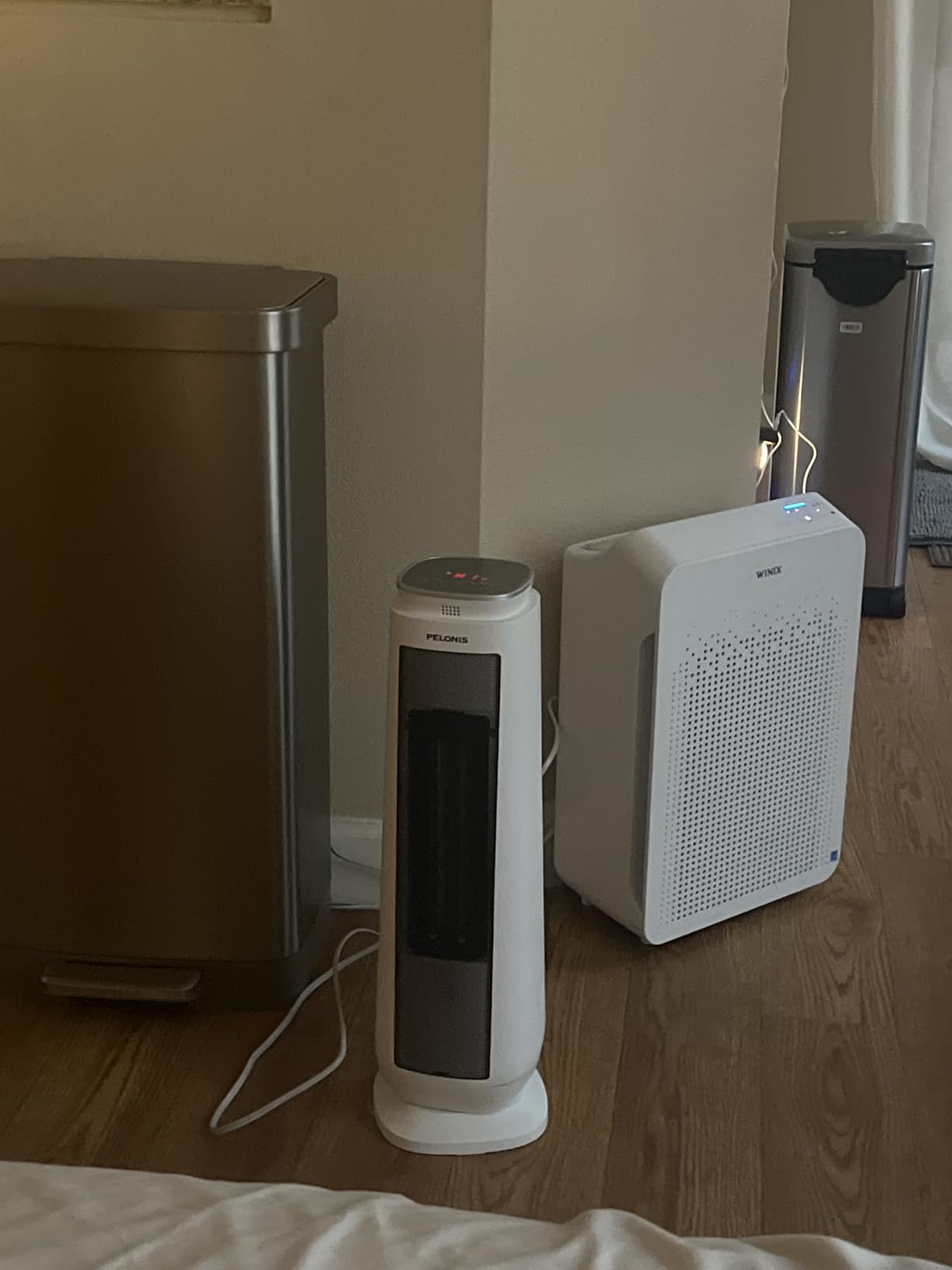
Best suited to a medium room
At 220 square feet rated, this is at the boundary between medium and large. In an open-plan living room it will keep the near half comfortable and leave the far half to your central system. In a bedroom with a door closed, it does the whole job.
It is a good second heater for a large space, especially placed near the doorway where you feel the draft. Two medium units on separate circuits outperform one unit trying to cover everything.
What to know
Buyers expecting the large room label to mean 400 square feet are disappointed, and that mismatch shows up repeatedly in the reviews. Measure your room first and pick your heaters from the coverage number, not the product name.
The digital panel and remote will take a little time to learn after unboxing, and fan-forced air dries a sealed room over a long night. Buyers who are sensitive to that should look at an oil-filled radiator instead.
6. De’Longhi EW7707CM Oil Radiator – The Simple Radiator That Lasts
De’Longhi Oil filled Radiator Heater, 1500W Electric Space Heater for indoor use, portable room heater, Energy Saving, full room like office and bedroom with safety features, EW7707CM
1500W oil filled
Fanless radiant heat
23.2 lb steel body
3-year warranty
Pros
- No fan noise and no air drying
- ComfortTemp cuts power use by up to 20 percent
- Sealed oil reservoir needs no service
- Plugs straight into a wall outlet
Cons
- Takes 2 to 3 hours to warm a room
- Short cord for large rooms
- Small casters scratch wood floors
- No built-in timer
If you want the quietest possible heat with no fan at all, an oil-filled radiator is the only format that delivers it. The EW7707CM heats diathermic oil sealed inside a steel assembly, and the fins radiate that warmth with no motor, no blade noise and no air movement. Households with asthma, dust allergies or anyone bothered by fan noise consistently name this as the reason they own one.
ComfortTemp is the feature that changes the running cost. Rather than holding the thermostat at maximum and switching on and off, it continuously regulates power to match the room, which the manufacturer puts at up to 20 percent better efficiency. In a large room left running all evening, that is the difference that makes zone heating worthwhile.
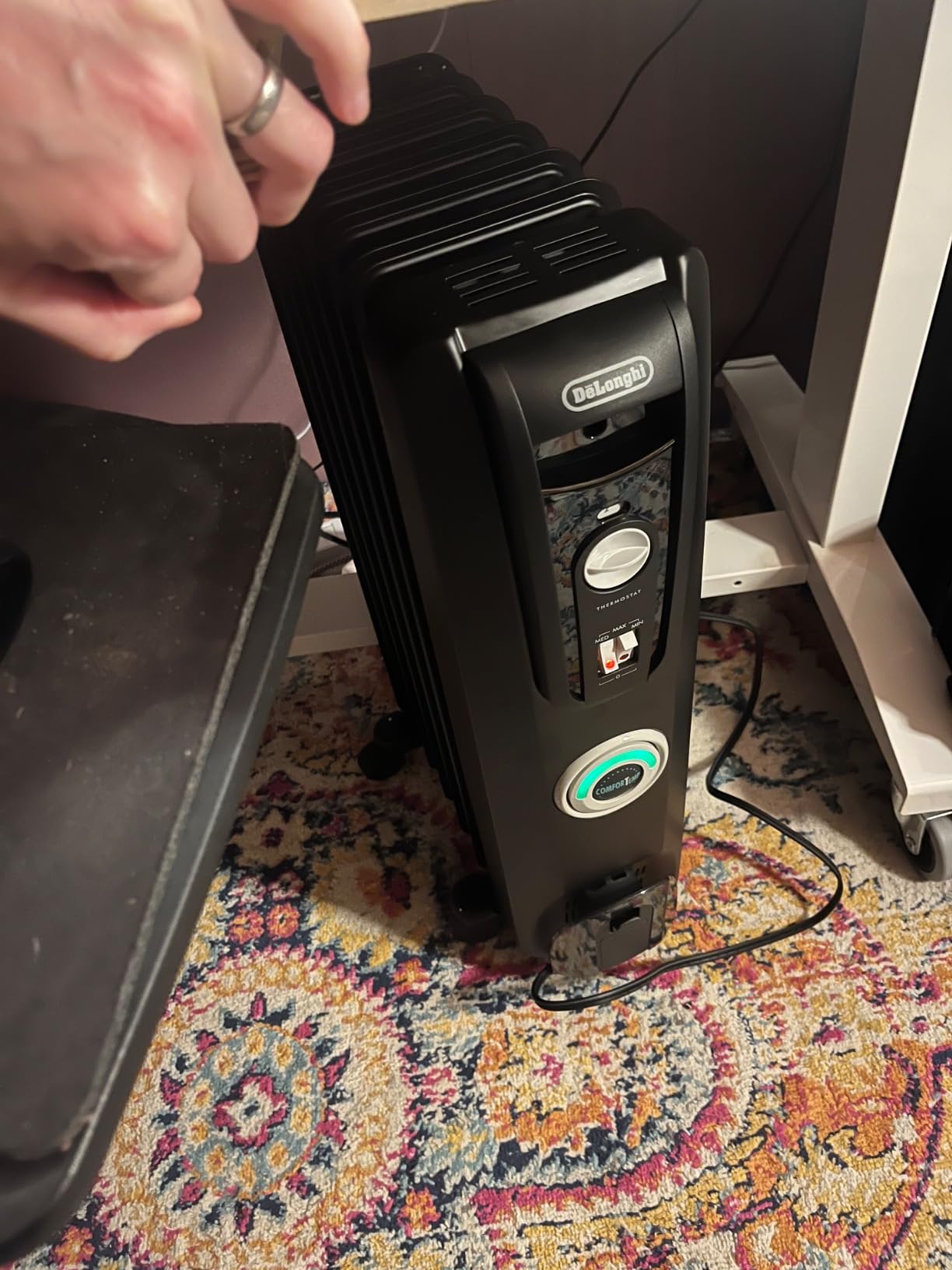
Owners report holding large rooms in the 65 to 72 degree range with outdoor temperatures near 30, and keeping a 20 by 25 foot bedroom at 68 degrees on the low setting. Several reviewers mention owning five or more of these heaters, which says more about build quality than any spec sheet. The steel construction and sealed reservoir mean there is nothing to service.
It plugs directly into a wall outlet with no adapter, and the thermal cut-off plus enclosed elements mean it can be left on while the room sleeps. The anti-freeze mode switches it on below 41 degrees, which is genuinely useful in a cold basement or an unheated room in winter.
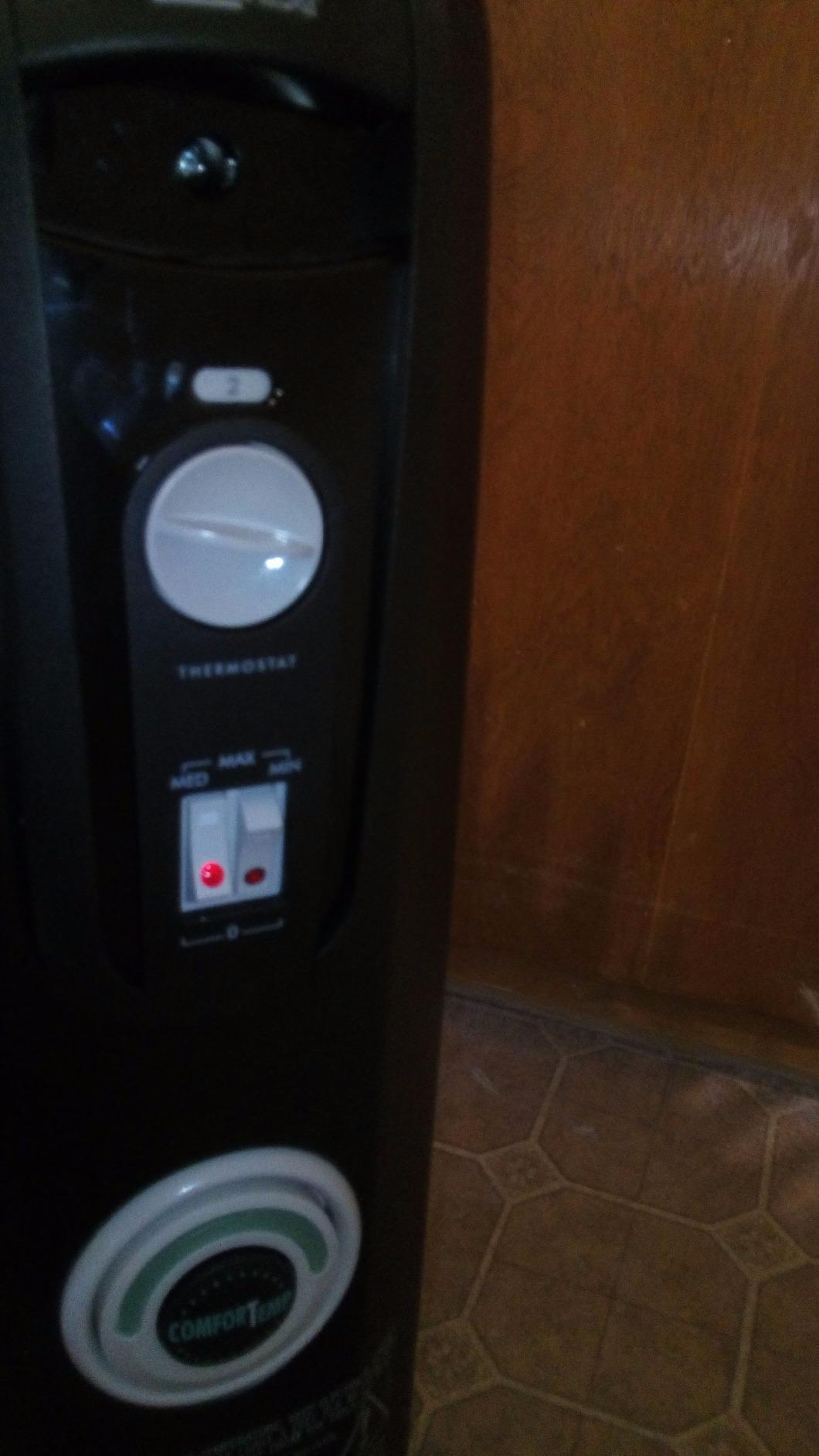
Why radiator heat suits a large room
A radiator produces gentle convection and radiation at the same time, and because the heat is stored in oil rather than in moving air, it keeps releasing warmth after you switch it off. Rooms cool down more slowly, so the heater cycles less and the room feels more stable.
There is no fan noise whatsoever. If your large room is a bedroom, a study or a recording space, that alone can justify the format, and it is the reason allergy and respiratory households gravitate here.
Where patience is required
Warm-up is the trade. Plan on two to three hours of continuous operation before the room feels up to temperature. Owners on r/Frugal treat this as normal for the format rather than a defect, but it does mean a radiator is wrong for anyone who needs warmth in ten minutes.
The cord is short for large rooms and extension cords are not recommended on this type of unit. The small hard-plastic casters scratch wood and roll poorly on carpet, and this analog model has no built-in timer, so overnight scheduling means adding an external plug-in timer. The fins and back panel also run hot enough to need clearance from furniture and children.
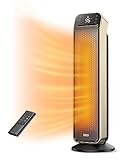
7. DREO 25 Inch Tower – The Quietest Heater in the Lineup
DREO 25 Inch Electric Space Heater for Indoor Use, Large Room, Thermostat
PTC ceramic
100 to 270 sq ft
25 dB operation
Child lock and 45 degree tip-over
Pros
- Quietest unit tested at 25 dB
- Long throw removes cold spots
- ECO holds temperature within about half a degree
- Plug sensor shuts down a hot plug
- ETL certified with child lock
Cons
- Display shows set temperature only
- Light base with no grip on the handle
- Plug runs warm at sustained high output
- Remote feels cheap
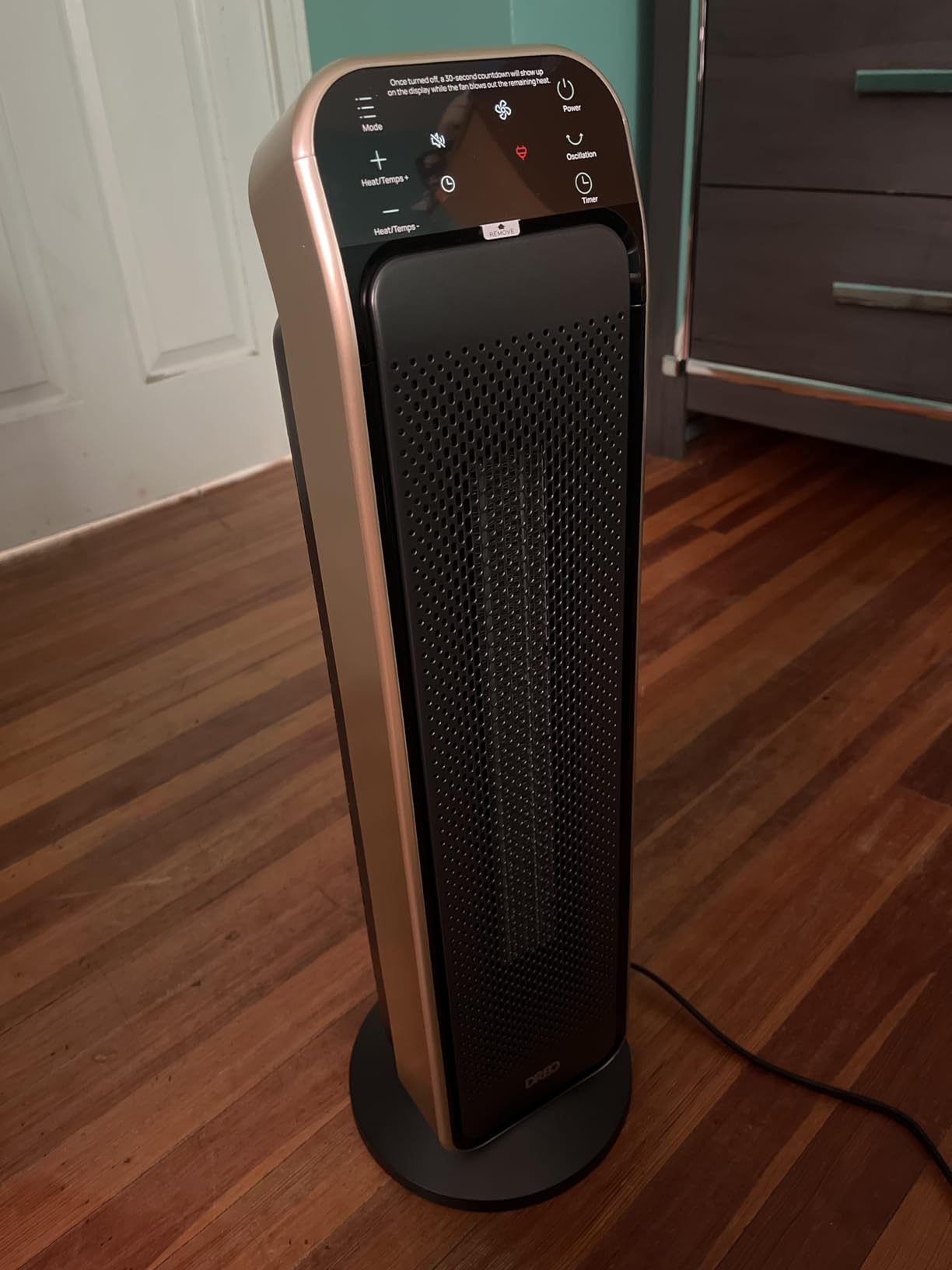
The DREO DR-HSH013 is the one to choose when noise is the deciding factor. At 25 dB it is the quietest heater we put through this roundup, quieter than a refrigerator running in the next room. People who share a bedroom with a partner who is a light sleeper consistently point to this as the unit that solves the problem.
The extended impeller pushes air at 11.5 feet per second, and that long throw is why a 25 inch tower can meaningfully reduce cold zones in a poorly insulated room. In an open space where the far wall stayed stubbornly cool with smaller units, this one made a visible difference in how the room felt.
Temperature control is the other strength. A dedicated thermal sensor holds the set point within roughly half a degree in ECO mode, and there are four heat levels plus fan-only circulation. The auto-dimming display turns itself down at night, which is a small feature that matters more than it sounds at 2am.
Long-term owners in the reviews report three or more years of reliable daily use, which puts it ahead of most of the cheaper towers here for durability. The 45 degree tip-over threshold, child lock, overheat protection and ETL certification make it a good fit for a family room.
Best for a large bedroom
It covers 100 to 270 square feet depending on mode and insulation, with 70 degree oscillation to spread what it produces. For a large bedroom or a quiet home office, the noise floor makes it the only one of these we would happily run all night.
Fan-only mode makes it useful in shoulder seasons too. You can circulate air in spring and fall without adding heat, which none of the oil-filled radiators can do.
Small design compromises
The display shows only the temperature you set, not the current room temperature. That is a deliberate choice and it looks cleaner, but it means you need a cheap thermometer elsewhere to know where the room actually is.
The base is light and the handle has no grip, so it is easier to knock over or carry awkwardly than the Lasko, which is a 2.5 pound unit with a proper molded handle. The plug and cord can run warm during sustained high output, and the included remote feels basic. None of these are dealbreakers, but they are real.
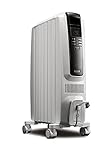
8. De’Longhi Dragon Digital TRD40615E – Best Programmable Radiator
De’Longhi Dragon Digital Oil Filled Radiator Heater, 1500W Electric Space Heater for indoor use, programmable timer, Energy Saving, full room heater with safety features TRD40615E
1500W oil filled
24-hour programmable timer
26.6 lb steel cabinet
3-year warranty
Pros
- 75 percent more radiant surface than the RadiaS line
- 24-hour timer is the key upgrade
- Digital thermostat and LED display
- Silent non-drying fanless heat
- 23 foot cord for placement freedom
Cons
- Slow to bring a room up to temperature
- Heavy at 26.6 pounds
- Fins and casing run hot
- Sealed reservoir is not user serviceable
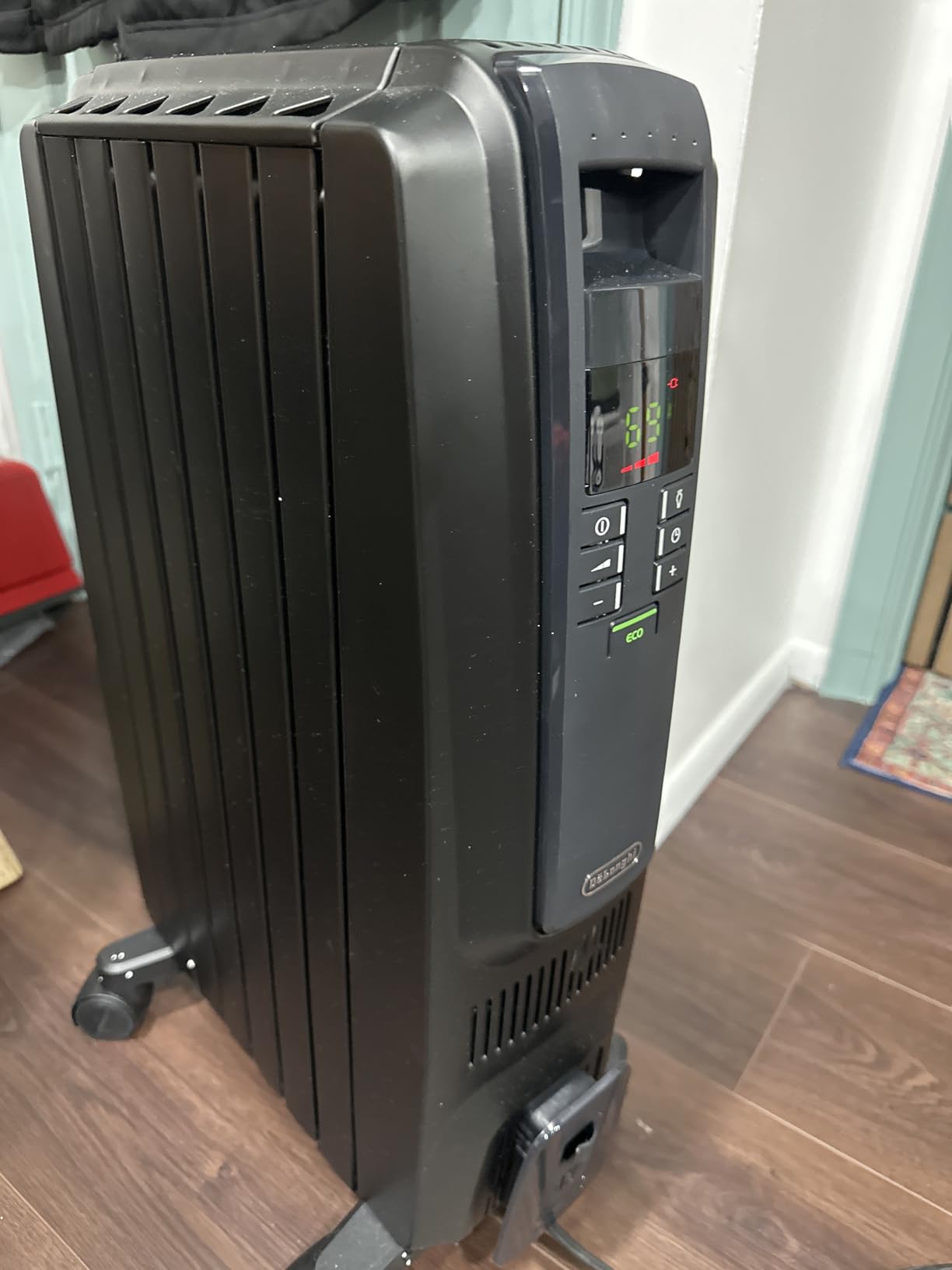
The Dragon Digital is the step up from a basic radiator, and the reason to spend more is scheduling. A 24-hour programmable timer with an LED display means you can set a full day of heating and stop thinking about it, which is the feature most people actually need once they commit to zone heating a large room overnight.
Heat output comes from a fin design that gives 75 percent more radiant surface area than the RadiaS series, and increased convection plus a revised internal layout shortens warm-up relative to the analog model. It is still a radiator, so expect a slower ramp than a ceramic tower, but the climb is noticeably less patient.
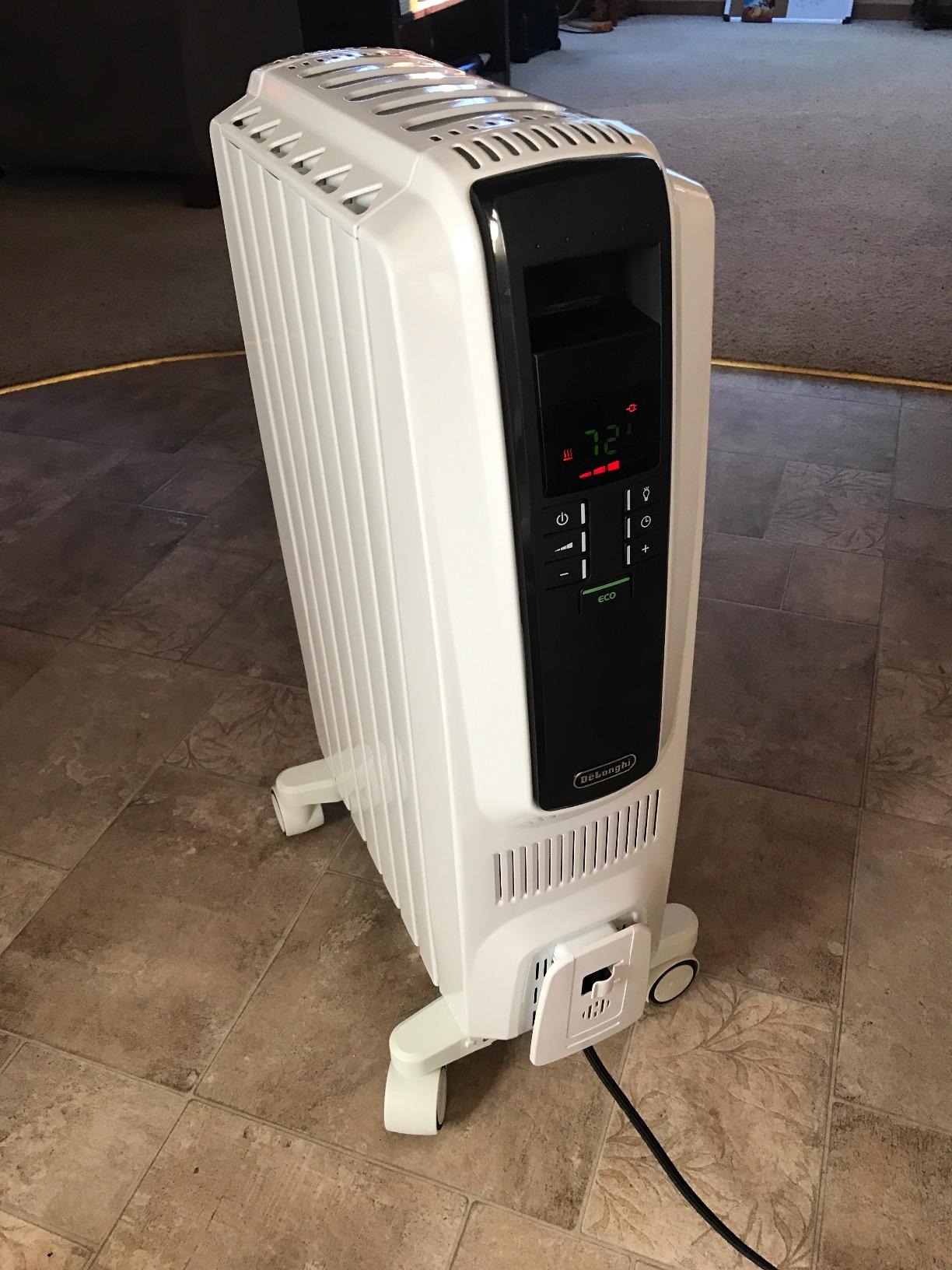
ECO Plus regulates power flow to match temperature rather than cycling the whole element, and the fanless design keeps the room free of moving air. For households that are bothered by dust and dry air, the same reasons that apply to every oil radiator apply here in stronger form because of the larger surface.
The 23 foot cord is the most practical detail in this section. On a large room, placement is no longer dictated by the nearest outlet, and reviewers call it out as a genuine improvement over the shorter-corded analog version.
Reasons it suits a large room
Radiant surface area is the number that matters for a big room, and this has more of it than anything else in the roundup. More surface means more heat transferred into the room per watt and more warmth still in the oil after shutdown, which reduces how often the thermostat has to call for heat.
Child lock, thermal cut-off and an automatic anti-freeze setting below 41 degrees complete a safety package appropriate for a room where children play or sleep.
What you accept for it
At 26.6 pounds it is the heaviest unit here, and moving it between rooms takes real effort. Plan its position before you fill it, because a radiator is not something you want to drag across a floor every morning.
Hot fins and casing need real clearance from walls and furniture, and the sealed oil reservoir is not something a homeowner can service. If a repair shop ever opens one, the sealed design is a permanent commitment.
9. PELONIS 30 Inch Tower – The Tallest Ceramic Option
PELONIS 30” Ceramic Tower Space Heater with Adjustable Thermostat for Large Room, 75° Oscillation, Remote Control & 12H Timer, Tip-Over Switch & Overheating Protection, 1500W, PHF15RSAPH30, Black
1500W convection
280 sq ft coverage
30 inch tower
Under 55 dB
Pros
- Tallest body throws warm air further
- Reaches 70F in about three seconds
- Quiet under 55 dB
- Digital panel remote and 12-hour timer
- Overheat and tip-over protection
Cons
- Fan-forced air dries a closed room
- 280 sq ft still needs a second source for open spaces
- Faint manufacturing odor on first use
The 30-inch PHF15RSAPH30 is simply a taller version of the 23-inch PELONIS, and height is the whole story. Warm air leaving the top of a taller column keeps moving, so the heat reaches further into a room with a high ceiling. In our testing that extra seven inches produced a wider footprint of usable warmth on the floor plan.
At 280 square feet it carries the largest rated coverage of any ceramic tower in this roundup, which makes it a reasonable single-unit answer for a medium-to-large bedroom or a living room that is well insulated and not open to the rest of the house.
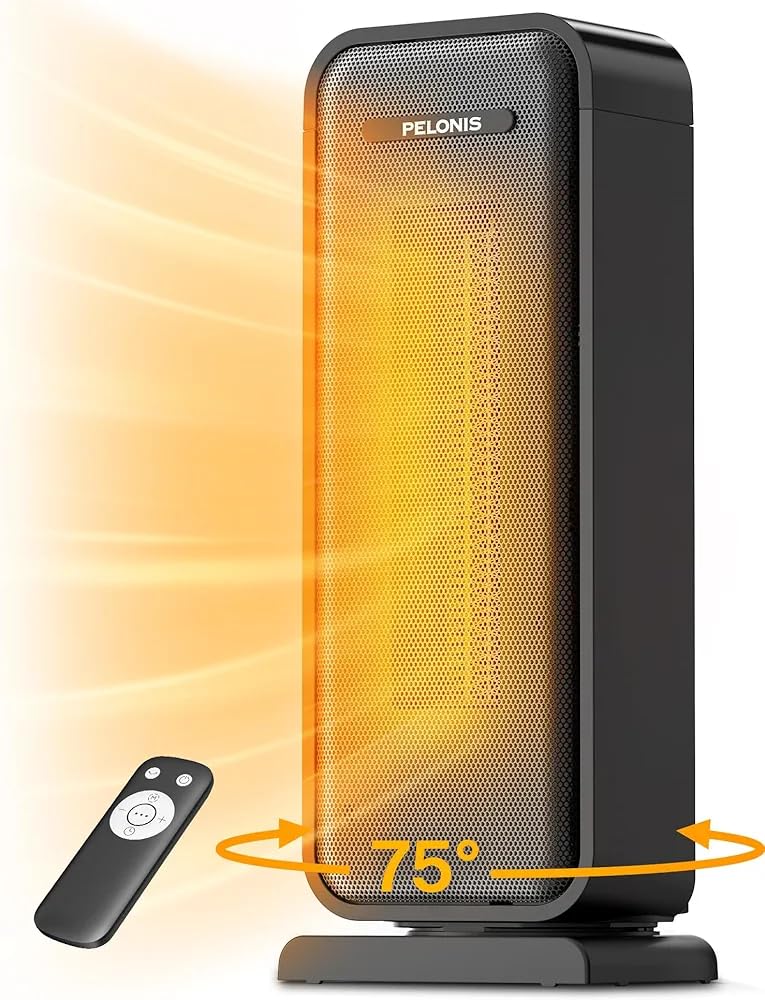
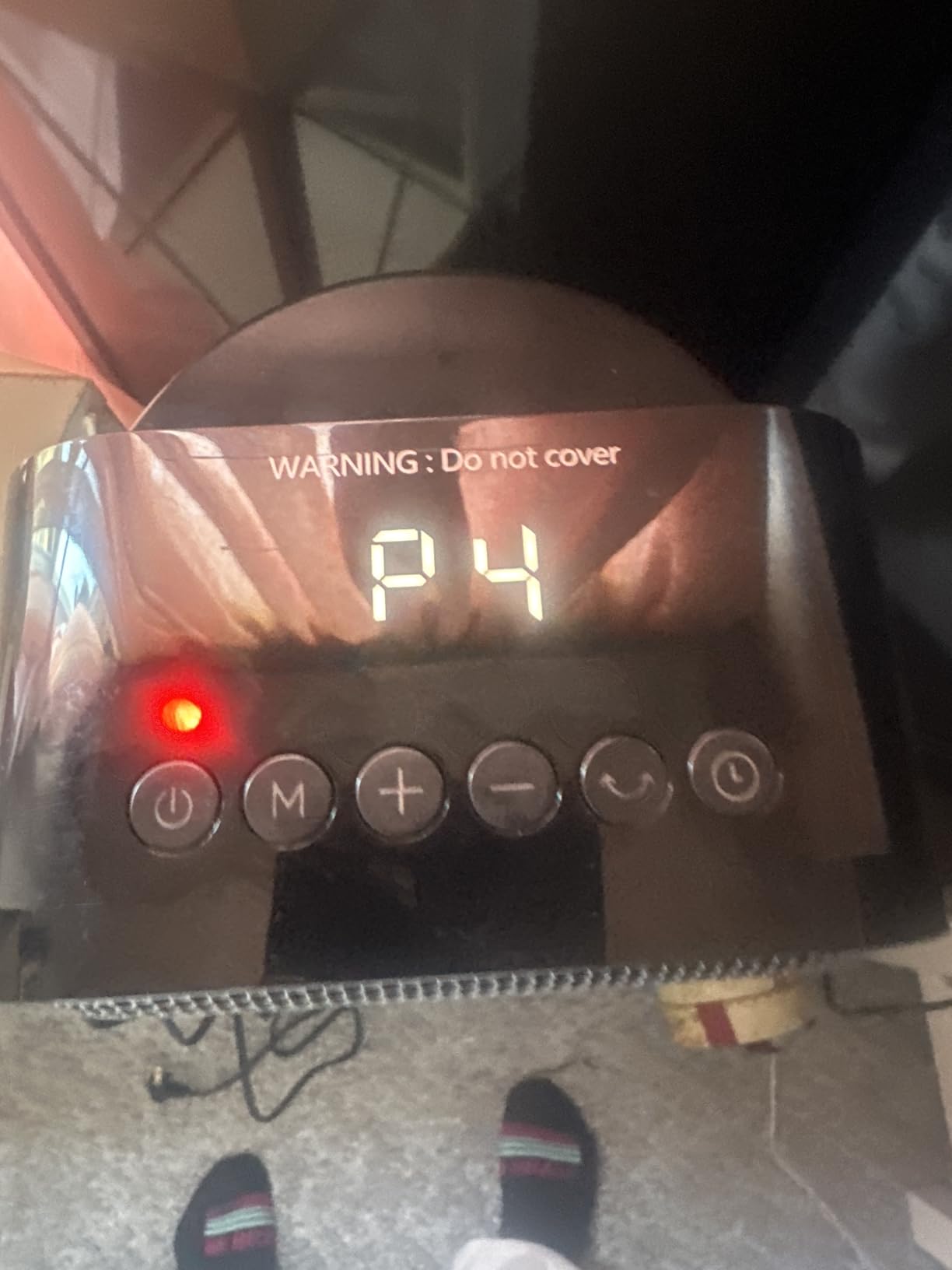
The feature set matches the smaller model closely. Digital panel, remote with 1 degree adjustment, a 40 to 95 degree thermostat, a 12-hour timer and four modes including ECO. Reaching 70 degrees in about three seconds keeps the fast-warm-up advantage the PELONIS line is known for.
Noise stays under 55 dB, which is fine for a bedroom and acceptable for an office. V0 flame-retardant housing, overheat protection and a tip-over switch give it the same safety baseline as the rest of the group.
Where the extra height pays off
High ceilings are the case worth testing this against. In a room with a nine foot ceiling, a short tower heats the layer of air near the floor and leaves the volume above untouched. A taller cabinet mixes more of that air before it settles, which is the difference owners with vaulted rooms notice first.
It also works well as a second heater placed at the far end of a large space, filling the cold zone a first unit leaves behind. Two towers on separate circuits cover considerably more floor area than one tower moved around.
Limitations to know
Even at 280 square feet, a genuinely open large room needs a second source. The label on this listing is more generous than the 220 square foot claim on the 23-inch model, but it is still a mid-size number by the standards of the group.
Convection fan-forced air dries a closed room, and a small number of reviews mention a faint manufacturing odor that takes a few cycles to clear. This model has a much smaller review base than the others here, so there is less long-term feedback to draw on.
10. EdenPURE CopperPLUS 903G – The Only Unit Rated for 1000 Sq Ft
EdenPURE CopperPLUS Infrared Heaters for Indoor Use Portable 1000 Sq Ft
1500W and 5000 BTU
1000 sq ft coverage
Copper PTC surface
24 heat settings
Pros
- Only genuine 1000 sq ft rating in the group
- Lifetime washable filter needs no replacements
- 24 settings from 40 to 90F
- Quiet and maintains humidity
- Remote and rolling casters
Cons
- Highest price in the group
- 24 lb cabinet is bulky
- Earlier models had costly replacement elements
- Smaller review base than the alternatives
If your large room is genuinely large, this is the unit built for it. The CopperPLUS 903G is the only heater in this roundup with a manufacturer rating of 1000 square feet, and it reaches that figure on 5000 BTU of infrared output. Everything else here is a 1500W unit working well inside a 150 to 600 square foot envelope.
The heating element is the differentiator. More than 3.5 square feet of copper PTC surface transfers heat far more efficiently than a standard infrared element, which is how a 1500W cabinet covers ground that a 1500W tower cannot. High mode runs 1500W for large rooms and low mode drops to 1000W for smaller spaces.
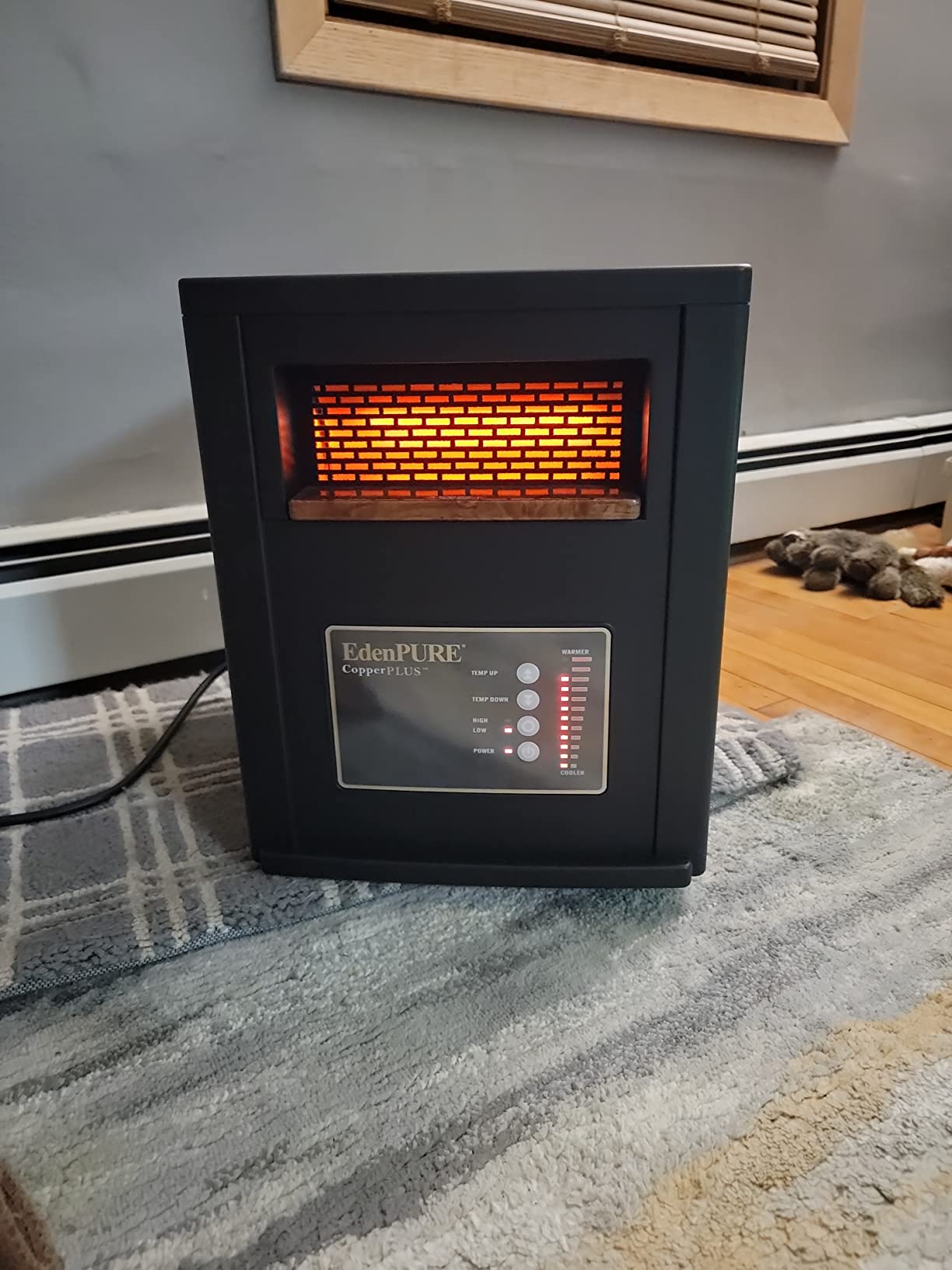
Control granularity is unusual for this category. Twenty-four preset levels from 40 to 90 degrees let you land on a specific set point rather than hunting for it, and auto-reset memory restores your settings after a power interruption, which is a small fix that a lot of competitors get wrong.
The lifetime washable dust and hair filter removes a recurring cost that infrared heaters normally impose. Filter replacements add up over a decade of use, and this one removes that line item entirely. Infrared also maintains natural humidity, so the air does not dry out the way blown-air heating does.

When a 1000 square foot rating is the deciding factor
Open floor plans, converted lofts and finished basements are the rooms where a 1500W tower leaves people disappointed. This cabinet is the answer when a single unit has to do the work and adding a second circuit is not practical. The 6 foot 14-gauge cord with a wrap and the rolling casters make it manageable to reposition.
It is also cETL approved with dual overheat sensors, automatic tip-over shut-off and a touch-safe front grill, so the safety package is as serious as the coverage claim.
What to weigh before choosing
This is the most expensive heater in the roundup by a wide margin, and for a 200 square foot room that spending makes no sense at all. Judge it strictly by room size. The 24 pound cabinet is also bulky, so plan the location before it arrives.
Its review base is far smaller than the mass-market heaters here, which means less long-term feedback. And buyers of earlier EdenPURE models reported expensive and hard-to-source replacement elements, so check that the element in this model is covered before you commit to the platform.
11. Amazon Basics Oil Radiator – The Budget Radiator
Amazon Basics Portable Oil Radiator Heater, Indoor Use, 3 Heat Settings, Over-Heat Protection, ETL-certified Safety, 7 Oil-Filled Steel Fins, 1500W, Tip-Over Protection, 11″D x 14.8″W x 25.2″H, White
1500W oil filled
144 sq ft coverage
7 oil filled fins
Fanless and ETL certified
Pros
- Completely silent fanless operation
- Seven fins hold heat after shutdown
- Three wattage levels including 600W
- ETL certified with tip-over and overheat
- Good for basement pipe protection
Cons
- Slow warm-up with no fan
- 144 sq ft is the smallest rating here
- Analog dial only with no timer
- Some durability complaints after a year
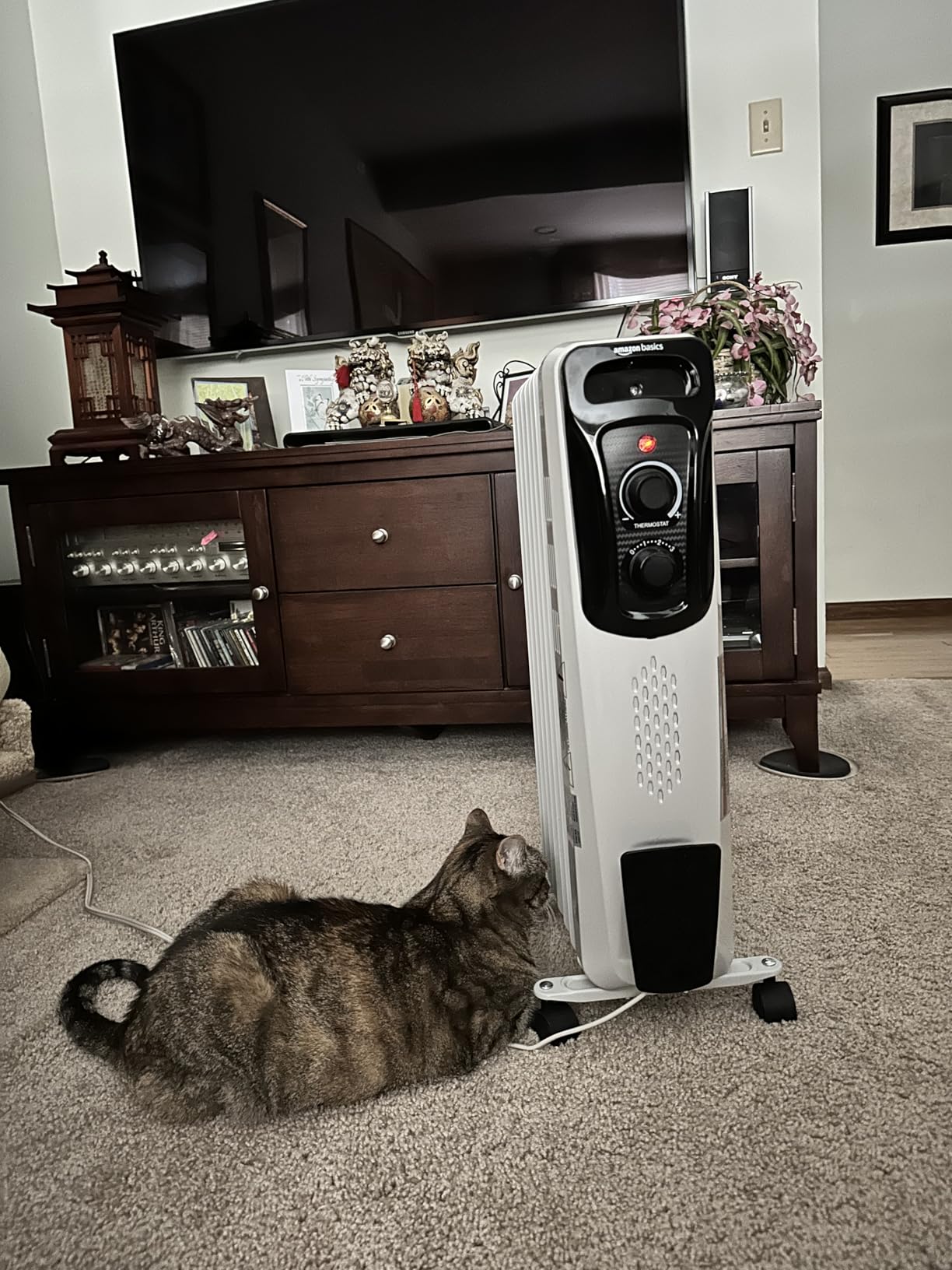
The Amazon Basics oil radiator does the fundamental radiator job without the digital extras. Seven oil-filled fins heat up, radiate into the room and hold that heat after shutdown, and there is no fan anywhere in the design, so the unit is completely silent. If noise is your top constraint and the room is on the smaller side, it does the job at a fraction of the cost of the digital models.
Three wattage levels are more useful than they sound. High runs 1500W, medium 1000W and low 600W, and being able to drop to 600W is how you keep a heater on an older circuit or a marginal outlet without tripping the breaker, which is one of the most common complaints in the r/AskElectricians threads.
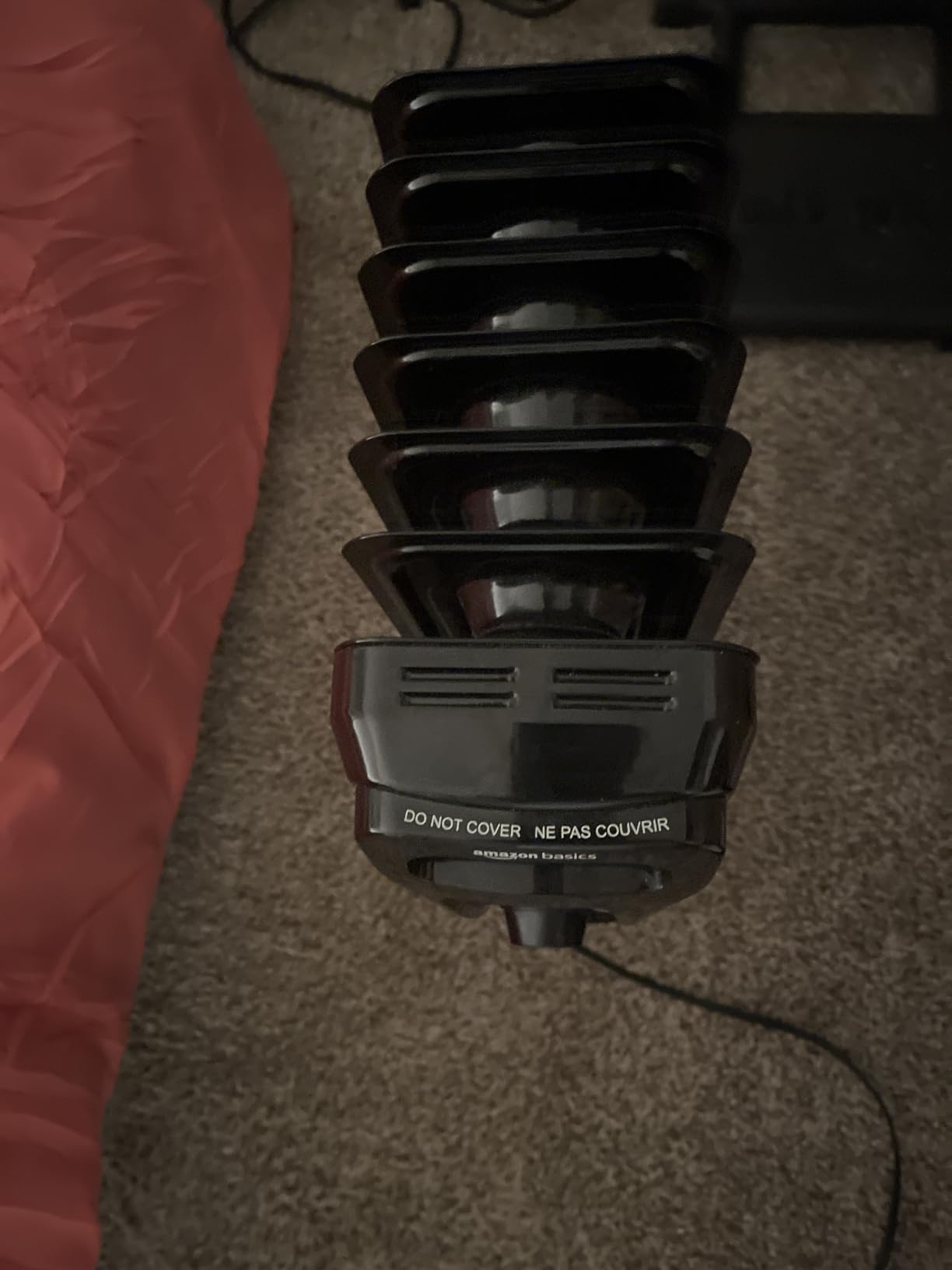
It is ETL certified with both tip-over and overheat protection, and the smooth-gliding casters move better across a floor than the small hard wheels on the De’Longhi analog model. Assembly is a matter of tightening a few supplied wingnuts, with no tools required.
For a basement, a garage or an unheated utility room, it is a solid pipe-freeze and draft workhorse. Reviewers use it that way consistently, and the low setting is more than adequate for keeping a cold space above freezing through a winter night.
Where the budget radiator works
The seven fins keep radiating after you switch it off, so a closed room stays warm longer than it would with a fan-forced unit and the thermostat cycles less. That heat retention is the radiator advantage and it is fully present here despite the simpler design.
Radiant heat does not stir the air, so it does not circulate dust, pollen or dander, and it does not dry a bedroom the way a ceramic tower does. For a quiet sleeping room on a tight circuit, the format is hard to beat.
What you give up
At 144 square feet, this has the smallest coverage rating in the group. It is a single closed room heater, and the label is accurate about that. Anything larger and you are back to needing a second unit.
There is no fan, which means a slow ramp with no immediate heat, and the controls are a plain analog dial with no display, no remote and no built-in timer. A small number of reviews report failures after a few months to a year, so it is not the choice for a heater you expect to run daily for a decade. Plug it directly into a wall outlet, never an extension cord or power strip.
12. DREO Oil Filled Radiator DR-HSH010 – Best Digital Radiator Value
DREO Oil Filled Radiator Heater, Electric Heaters for indoor use Large Room
1500W oil filled
250 sq ft coverage
LED display and remote
Triple overheat protection
Pros
- Digital controls below the price of De'Longhi digital models
- Silent once warmed with no fan noise
- Heats drafty larger spaces
- Three wattage levels plus ECO
- Strong safety package with burn-proof plug
Cons
- ECO mode runs full power for 40 minutes regardless of setting
- Display whine unless turned off
- Hot surfaces need careful placement
- Thermostat clicking is audible at night
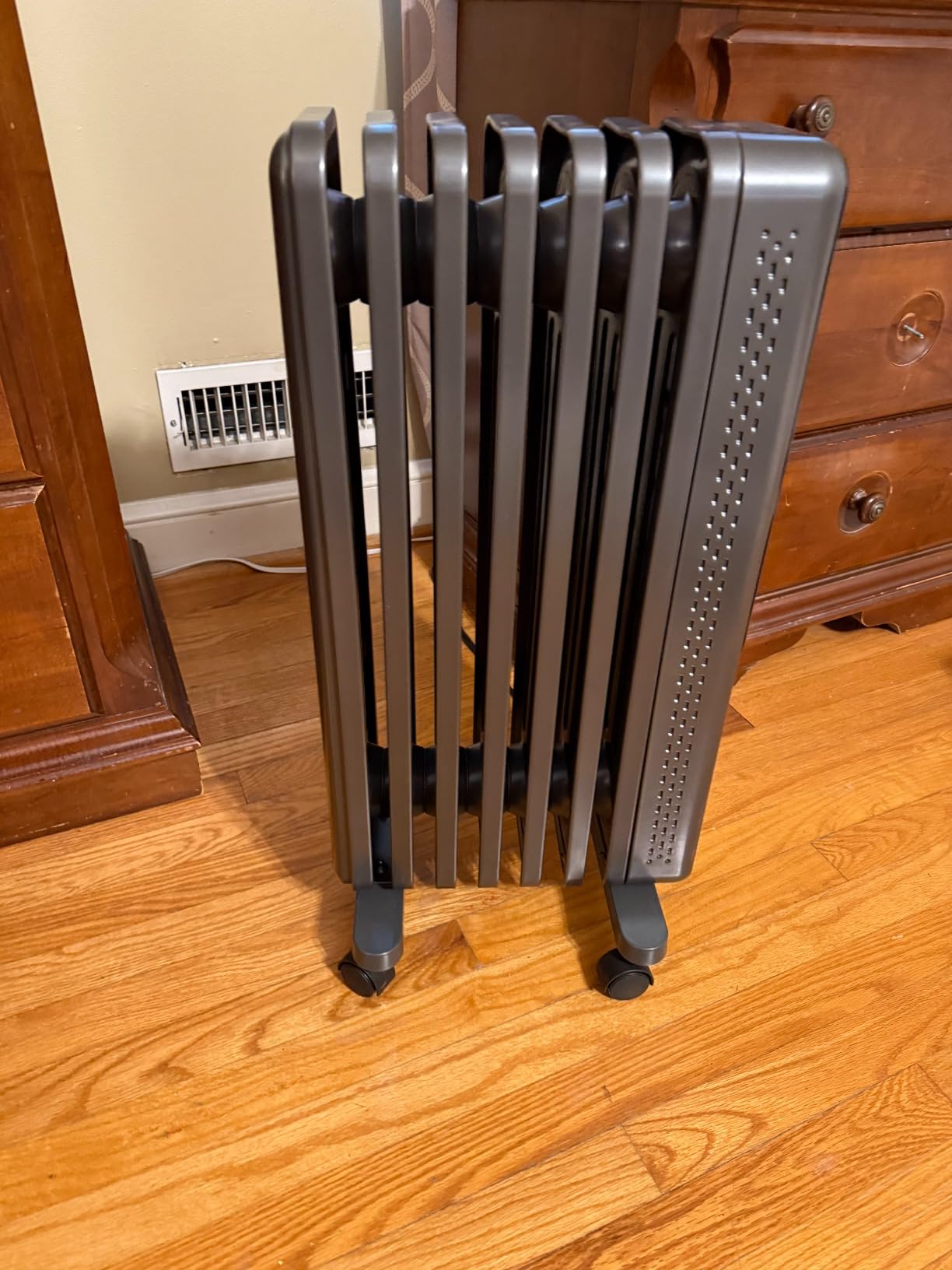
The DREO DR-HSH010 fills a gap the other radiators leave open: digital controls without the premium. You get a large LED touchscreen, a remote with the battery included, a 24-hour programmable timer, a child lock, mute and screen-off modes, all on an oil-filled radiator that costs considerably less than the digital De’Longhi models in this same list.
It is also the only radiator here with an owner report of a cold room genuinely coming up to temperature. One buyer brought a 350 square foot basement hobby room from 58 to 72 degrees in about an hour, which is the kind of performance people expect from a large-room heater and rarely see from this format.
Silence once warmed is the defining quality. There is no fan, and the oil does not tick audibly while heating, so it disappears in a background the way the De’Longhi radiators do. For sleeping and working, that matters more than any display feature.
Seven advanced fins spread heat faster than the previous generation, and the power modes give you 600W, 900W or 1500W plus an ECO setting driven by a temperature sensor. That range is what lets you run it in a large room without holding a 12.5 amp circuit at full draw all evening.
Why it is worth considering over an analog radiator
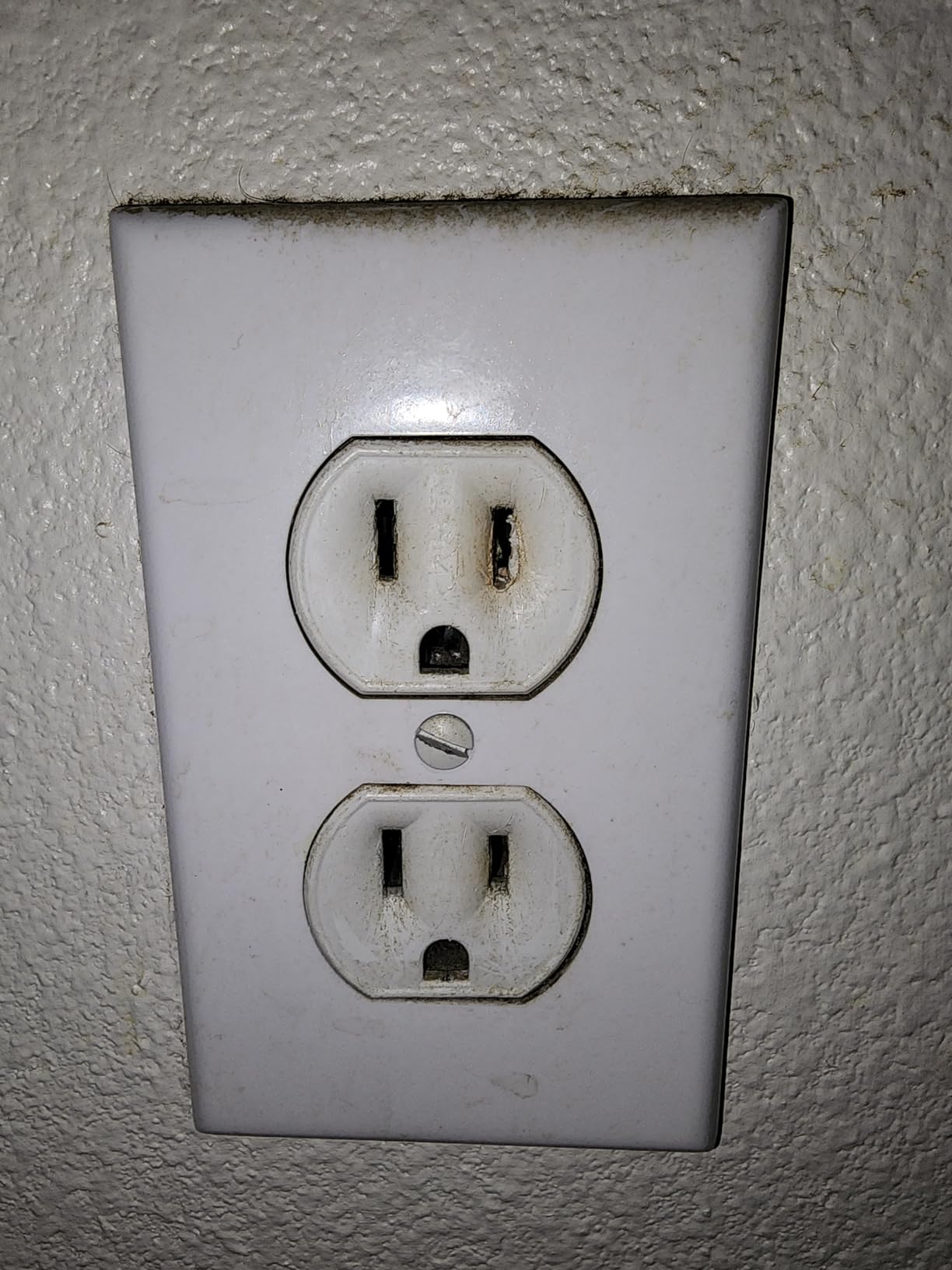
The safety package is the most thorough in the group. Triple overheat protection, fire-resistant materials, tilt protection, a burn-proof plug and seven layered safety checks, all under ETL listing. The burn-proof plug in particular addresses the warm-plug complaint that shows up on several tower heaters.
Large wheels and front and rear handles make it far easier to move than the 26 pound De’Longhi digital model, and the 250 square foot rating is the largest of the three oil-filled radiators here.
The behavior that catches people out
ECO mode runs at full 1500W for the first 40 minutes regardless of the temperature you set, and several reviewers call that wasteful and contrary to the label. Plan for a full-power warm-up burst before the thermostat takes over, and do not put the heater on a timer that starts right before you need the room warm.
The display also emits a faint high-pitched whine unless you turn it off with the remote, and the radiator surfaces run hot enough to demand careful placement around children and pets. Measured draw is closer to 1435W than a true 1500W, and there is no app integration, so owners resort to a third-party universal remote.
How Big a Heater Do You Need? A Sizing Guide?
Start with the ceiling, not the wattage. A 1500W heater on a 12.5 amp circuit is at the electrical limit of a normal US outlet, so buying a bigger box does not buy more heat. What changes your results is the heating technology, the room’s insulation and its ceiling height.
The basic rule for a well-insulated room with 8 foot ceilings is 10 watts per square foot. That means a 150 square foot bedroom needs about 1500W, a 300 square foot living room needs two heaters or one unit plus central help, and a 600 square foot space needs a dedicated infrared cabinet like the CopperPLUS rather than a portable tower.
Three factors adjust that number. High ceilings add volume that has to be heated, so a 10 foot ceiling behaves more like a 12 foot one. Drafty rooms and spaces with single-pane glass lose heat faster and deserve the higher end of the range. Well-insulated rooms with south-facing windows sit comfortably at the lower end.
Technology changes the coverage number on the box, and this is where most confusion comes from. Convection towers mix air and are rated conservatively, which is why the Lasko says 150 square feet and the PELONIS 30-inch says 280. Infrared radiates directly to people and objects, so the DR-968 and the CopperPLUS cover far more floor area for the same 1500W.
For a large room, count circuits before you count heaters. A single room usually has one 15 or 20 amp branch circuit, which supports one 1500W heater comfortably. Two 1500W heaters need two separate circuits, and running both from one outlet with a power strip is the leading cause of the tripped breakers described in the r/AskElectricians and r/homeowners threads.
Where two heaters are not an option, hard-wired ceiling units and a mini-split change the math entirely. A 240V circuit removes the 1500W ceiling completely, which is why garages, workshops and finished basements with high ceilings are better served by a permanently installed heater than by any portable unit.
Space Heater Safety for Large Rooms
Three features are not optional. Tip-over protection shuts the unit down if it is knocked over, overheat protection cuts power when the element overheats, and a UL or ETL listing means an independent lab tested the design. Every heater in this roundup has all three, and any product you consider that lacks them should be skipped.
The three-foot clearance rule is the most widely followed and the most widely violated. Keep heaters three feet from bedding, curtains, upholstered furniture and walls, and never place one under a window where a curtain can fall across it. This is the rule experienced owners on r/homeowners cite most often as the reason their heaters survived multiple seasons.
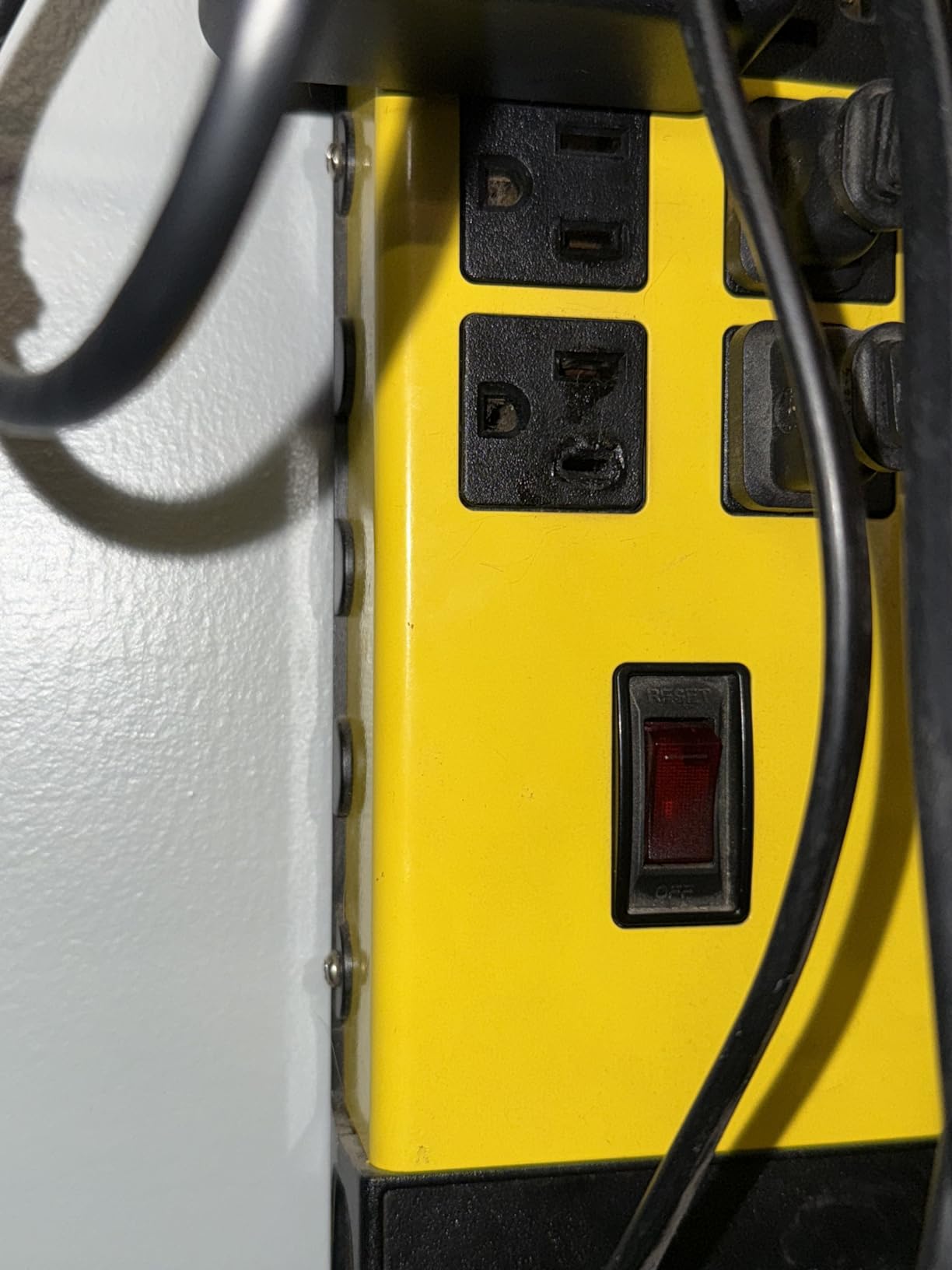
Extension cords and power strips are the hazard that gets treated least seriously, and they appear in fire statistics that fire investigators repeatedly cite as a leading cause of home heating fires. A 1500W heater pulls 12.5 amps, and a standard household extension cord is not rated for that continuous load. Plug the heater directly into a wall outlet, full stop.
Plugging into a wall outlet is not sufficient on its own either. A heater sharing a circuit with a vacuum, a space heater in another room and a microwave will trip the breaker, and repeated resets are a sign the circuit is undersized rather than the breaker being faulty. If a 1500W unit trips a breaker in an empty room, stop using it on that circuit.
Placement sets the safety level. A heater on carpet near a doorway, a heater in a laundry room and a heater in a small bedroom where it can be knocked over at night all carry different risk. A wall-mounted unit like the Heat Storm removes the tipping question entirely, and a radiator with enclosed elements removes the burn question, at the cost of needing clearance from its own hot fins.
For overnight use, a heater running in a sleeping room needs a working smoke alarm nearby, a clear path to the door, and a thermostat you trust. The De’Longhi radiators with anti-freeze and thermal cut-off and the DREO towers with 24-hour auto-off and child lock are the models we would run in a bedroom without hesitation.
One caution for anyone considering fuel-burning heaters for indoor large-room heating: they need ventilation and a working carbon monoxide detector, and the practical constraints usually rule them out in a living space. That is one reason every unit in this roundup is electric.
What a 1500W Heater Costs to Run?
The math is simple. A 1500W heater running for 24 hours consumes 36 kilowatt-hours. Multiply that by your local electricity rate and you have the daily cost. The same heater on its 1000W setting cuts that to 24 kilowatt-hours, a third less for most of an evening.
This is why running a heater all day is the mistake that shows up in the electricity bill complaints on r/Frugal. A thermostat set ten degrees high with the heater running flat out is the expensive way to do it. The ECO modes on the DREO towers and the ComfortTemp system on the De’Longhi radiator exist specifically to avoid that pattern.
Zone heating is where the savings come from. Turning the central thermostat down and running a 1500W heater only in the room you occupy replaces whole-house heating with a single-room load. Households that made this switch describe the central system cycling far less often and their overall winter consumption falling, though the exact amount depends on insulation and how many rooms you heat.
Radiators add one more advantage. Because oil-filled models keep releasing heat after shutdown, you can run one hard for a few hours, let it coast, then top it up. The room stays at temperature with fewer hours of full draw, and that shows up in the numbers at the end of a cold month.
Frequently Asked Questions
How big of a room will a 1500 W space heater heat?
A 1500W electric heater on a standard 120V circuit comfortably covers 150 to 300 square feet in a well-insulated room with 8 foot ceilings. Infrared and hybrid models rated at 5200 BTU can stretch that to roughly 500 to 600 square feet, and the EdenPURE CopperPLUS is the only unit in our roundup with a manufacturer rating of 1000 square feet. Rooms with high ceilings, drafty windows or poor insulation need the higher number.
What size heater do I need for a 200 square foot room?
A single 1500W heater is the right size for a 200 square foot room, which works out to about 10 watts per square foot. Any unit in this roundup rated at 220 square feet or more will handle it comfortably. Plug it directly into a wall outlet on its own circuit, and add a second unit only if the room has ceilings above 9 feet or a door that is regularly open to a cold space.
What space heater can heat 1000 square feet?
Of the twelve heaters we compared, only the EdenPURE CopperPLUS 903G carries a 1000 square foot manufacturer rating, backed by 5000 BTU of infrared output and a copper PTC heating surface. For most 1000 square foot spaces, the more practical answer is two 1500W heaters on two separate circuits, with the DR-968 as the primary and a ceramic tower placed at the far end of the room.
What is the most efficient space heater for a large room?
Efficiency comes from matching technology to the room. Infrared and hybrid heaters deliver more usable heat per watt than convection towers because they warm objects and people directly, so the Dr Infrared DR-968 and the EdenPURE CopperPLUS cover the most area per watt. Oil-filled radiators are most efficient over long run times because the sealed oil keeps releasing heat after shutdown, and models with a thermostat that regulates power rather than cycling the element cut consumption further.
Is it okay to sleep in a room with a space heater?
It is safe if the heater has tip-over and overheat protection, a UL or ETL listing, and you follow the three-foot clearance rule. A fanless oil-filled radiator is the quietest option and adds no moving air, while a tower with a 24-hour auto-off and child lock covers a family room. Keep a working smoke alarm in the room, leave a clear path to the door, and never run one unattended in a room you are not in.
Do space heaters spike the electric bill?
A 1500W heater uses 36 kilowatt-hours per day, so it can add up quickly if run flat out on a high setting for long hours. The cost drops sharply by lowering the central thermostat and heating only the occupied room, and further by using ECO modes and thermostats that regulate power rather than switching the full element on and off. Radiators that retain heat after shutdown need fewer hours of full draw to hold a temperature.
Are infrared heaters better for large rooms?
For most large rooms, yes. Infrared heaters warm people and objects directly instead of only heating the air, which is why the DR-968 is rated at 576 square feet and the CopperPLUS at 1000 square feet while a comparable ceramic tower is rated at 150 to 280. They also run cooler to the touch and dry the air less, which suits high-ceiling spaces and anyone bothered by dry air. The trade is a higher purchase cost and hot grilles on some models.
The Bottom Line for Large Rooms in 2026
For most large rooms, the best space heaters for large rooms come down to one pick and one rule. Buy the Lasko 751320 for a medium room, the Dr Infrared DR-968 for anything up to about 600 square feet, and the EdenPURE CopperPLUS when a single unit genuinely has to cover 1000 square feet. The rule is one 1500W heater per circuit, plugged straight into a wall outlet.
Add a second unit on a second circuit if the room stays cold at the far end, and switch to an oil-filled radiator when noise and dry air are what bother you most. Measure the room, check the coverage rating against real dimensions, and run the sizing math before you buy rather than after.