
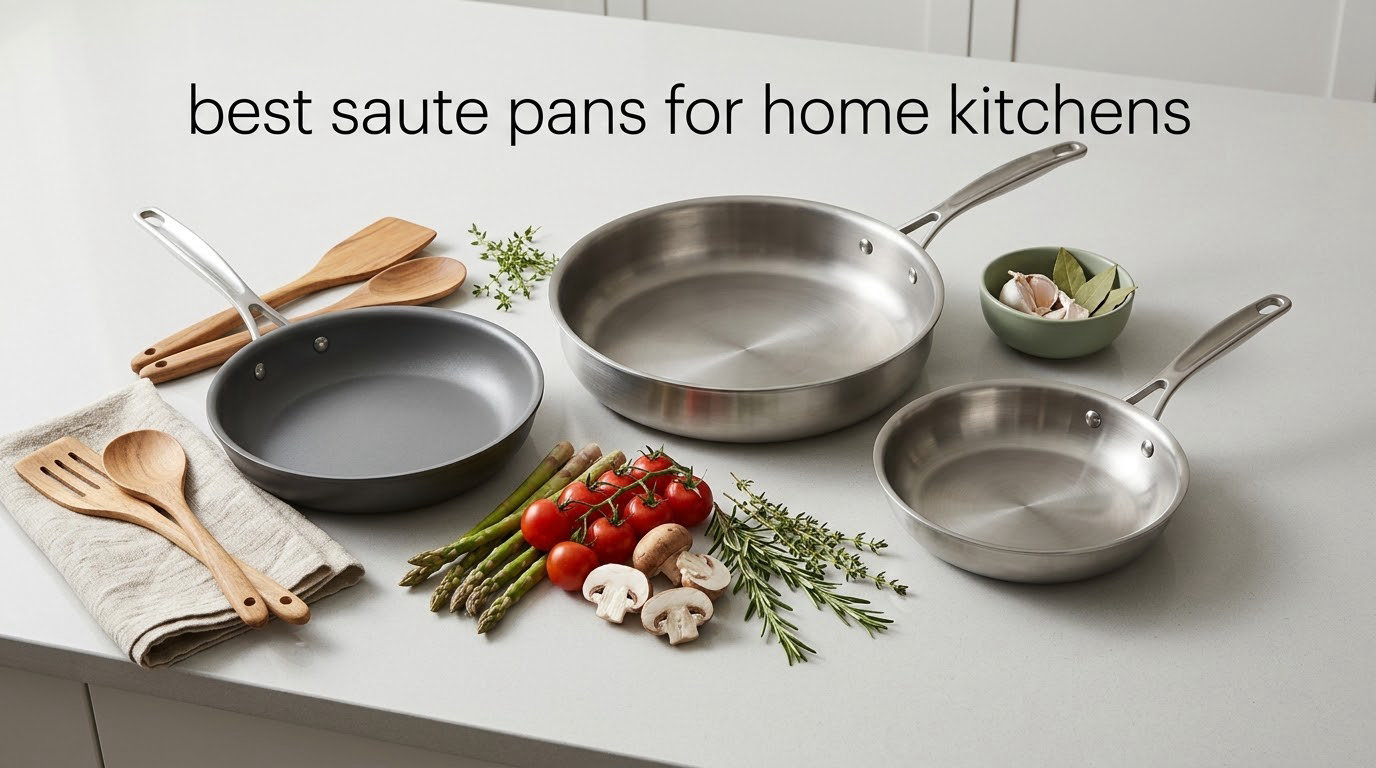
The best saute pans for a home kitchen are the ones that earn their counter space every week, and that usually means a straight-sided stainless or hard-anodized pan with a 4 to 5.5 quart capacity and a genuinely flat base. Across the ten pans in this roundup, the Farberware 6-Quart Jumbo Cooker is the most complete all-round pick, the Cuisinart 5.5-Quart is the value stainless workhorse, and the Blue Diamond 5-Quart ceramic pan is the one to buy if you want a coating with no PTFE in it.
A saute pan is the one piece of cookware that replaces three others. The tall straight walls contain splatter, the wide flat base gives you a real searing surface, and the depth is enough to hold liquid for simmering, braising and reducing a sauce without moving the food to a saucepan. Most weeknight dinners need exactly that: sear the chicken thighs, push them aside, deglaze the fond, and reduce the pan sauce in the same vessel.
We compared ten pans across the range that actually shows up in home kitchens, from a 6-quart nonstick jumbo cooker with a helper handle to a 4-quart fully bonded tri-ply stainless saute pan made in Pennsylvania. For every pick we tracked the same things: wall height, base flatness, induction compatibility, stated oven limit, empty weight, whether a lid is included, and what reviewers report after months of daily cooking rather than after one meal. This roundup was updated for 2026.
Table of Contents
What Is a Saute Pan and How Is It Different from a Skillet?
A saute pan is a wide, straight-sided skillet with walls roughly 2 to 4 inches high, typically 10 to 12 inches across and 3 to 6 quarts in capacity. It is built so you can saute, sear, simmer, braise and reduce a sauce in one pan without splattering across the cooktop.
The straight sides are the whole point. A skillet has sloped walls, which makes it fast to heat and easy to toss food from, but it also throws liquid everywhere the moment you splash. A braiser has walls in the same 2 to 3 inch range but usually a lid and a heavier base, so it wins at slow, covered braising rather than at a hard sear. A wok has sloped walls and a much smaller cooking surface relative to its depth, which suits high-heat stir-frying in small batches.
The trade-off is heat behavior. Deep walls trap more heat and steam than a shallow skillet, so browning happens on the base and the sides cook more gently than they would in a fry pan. That is a feature when you are reducing a sauce, because less liquid escapes, and a mild limitation when you are trying to char a lot of vegetables at once.
One more practical difference matters more than most buyers expect: a saute pan is heavy when full. A 5-quart pan of stock weighs several pounds before the pan itself, and the reason so many picks here ship with a helper handle is that you need two hands and a stable grip to move it off the burner.
Top 3 Saute Pans for Home Kitchens (October 2026)

Farberware 6-Qart Jumbo Cooker
- 6-quart capacity
- Helper handle for two-handed lifting
- Dishwasher safe with lifetime warranty

Cuisinart 5.5-Quart Saute Pan
- Encapsulated aluminum base
- Induction and gas compatible
- Limited lifetime warranty

Blue Diamond 5-Qart Ceramic…
- PFAS and PFOA free coating
- Oven and broiler safe to 600F
- Metal utensil safe surface
All 10 Saute Pans at a Glance in 2026
This is the short version for anyone who does not want to read ten full reviews. Every capacity, oven limit and induction answer below comes straight from the manufacturer specification and from what owners report after daily use.
| Product | Specs | Action |
|---|---|---|
| Farberware 6-Quart Jumbo Cooker |
|
Check Latest Price |
| Blue Diamond 5-Quart Ceramic |
|
Check Latest Price |
 SENSARTE 5-Quart Nonstick Skillet SENSARTE 5-Quart Nonstick Skillet |
|
Check Latest Price |
 HexClad 5.5-Qt Hybrid Deep Saute Pan HexClad 5.5-Qt Hybrid Deep Saute Pan |
|
Check Latest Price |
| Cuisinart 5.5-Quart Saute Pan |
|
Check Latest Price |
 T-Fal Ultimate 5-Quart Jumbo Cooker T-Fal Ultimate 5-Quart Jumbo Cooker |
|
Check Latest Price |
 Circulon A1 5-Quart Saute Pan Circulon A1 5-Quart Saute Pan |
|
Check Latest Price |
 Cooks Standard 4-Quart Stainless Cooks Standard 4-Quart Stainless |
|
Check Latest Price |
 SNOWCLAD 5-Quart Hybrid Pan SNOWCLAD 5-Quart Hybrid Pan |
|
Check Latest Price |
 All-Clad D3 4-Quart Saute Pan All-Clad D3 4-Quart Saute Pan |
|
Check Latest Price |
1. Farberware 6-Quart Jumbo Cooker: Best Overall for Batch Cooking
Farberware Nonstick Jumbo Cooker Chef’s Saute Pan with Lid, 6-Quart, Black
6 quart capacity
Aluminum nonstick
4.3 lb empty
Oven safe to 350F
Dishwasher safe
Lifetime warranty
Pros
- 6-quart capacity handles batch cooking and one-pan meals
- Helper handle makes the oversized pan manageable when full
- Nonstick interior wipes clean without soaking
- Dishwasher safe and backed by a lifetime warranty
Cons
- Oven safe only to 350F
- Bulky 22-inch footprint takes real cabinet space
This is the pan I would hand to someone building their first real kitchen kit. Six quarts is a lot of room, and it is the difference between searing four chicken thighs and cooking a whole tray of them plus potatoes in one vessel. The nonstick surface releases without a fight, so weeknight cooking stays weeknight easy.
What makes it work at that size is the helper handle. Farberware rivets both side handles and adds a third grip opposite the main handle, so a full pan can be moved from burner to counter with two hands instead of a risky one-handed tilt. At 4.3 pounds empty it is also lighter than most pans in this size class.
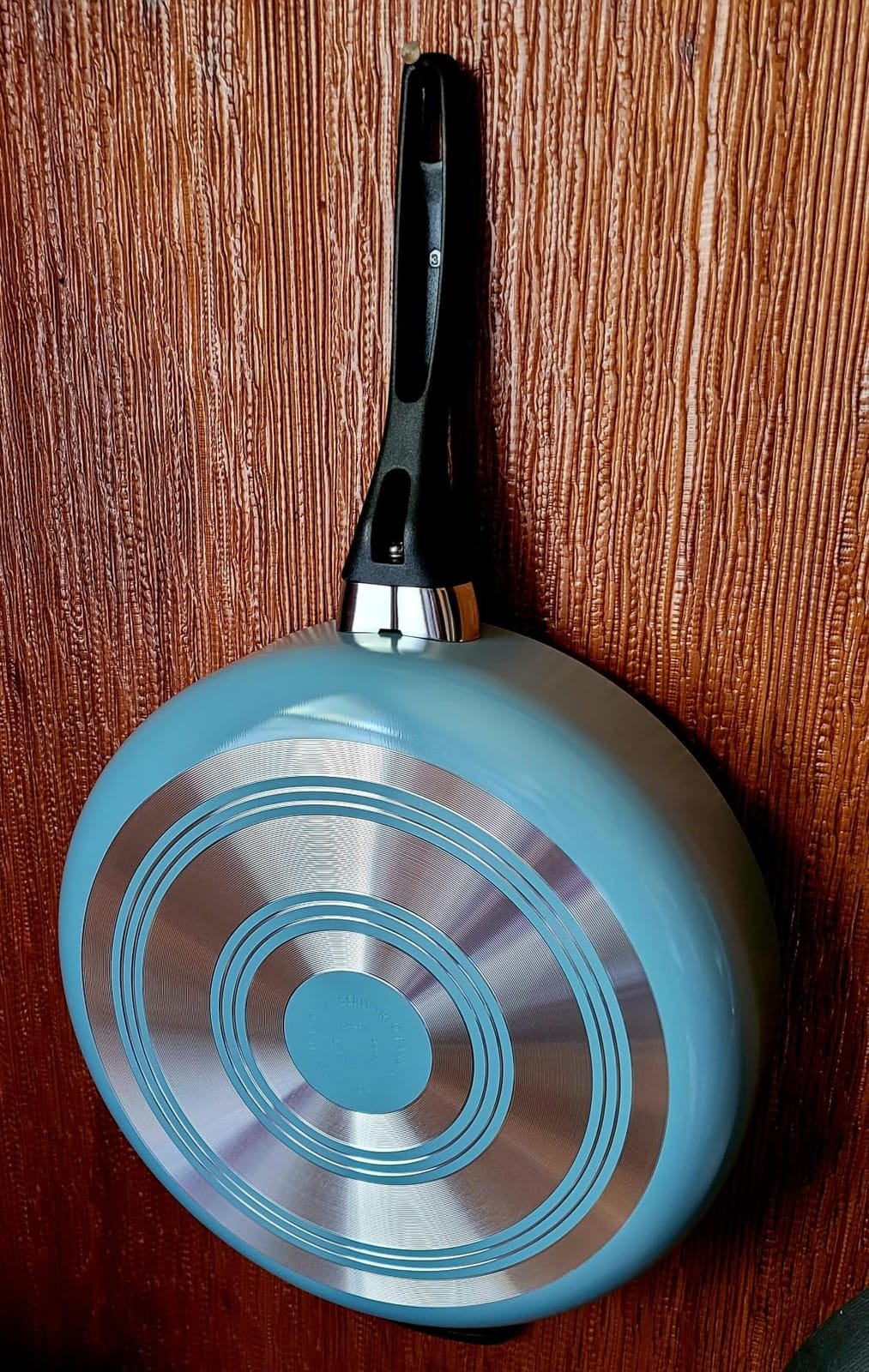
Farberware rates the base for even heat distribution, and the reviews describe a large, flat cooking surface that holds its contact with the burner on both gas and electric. Owners consistently describe the surface as roomy, which is what you want for a full sheet of vegetables rather than a crowded single layer.
The honest limit is the oven rating. Three hundred fifty degrees Fahrenheit is well below what a stainless pan will take, so finishing a dish under the broiler is not an option here. For a pan meant to go stovetop-to-oven, look at the All-Clad or the HexClad further down this list.
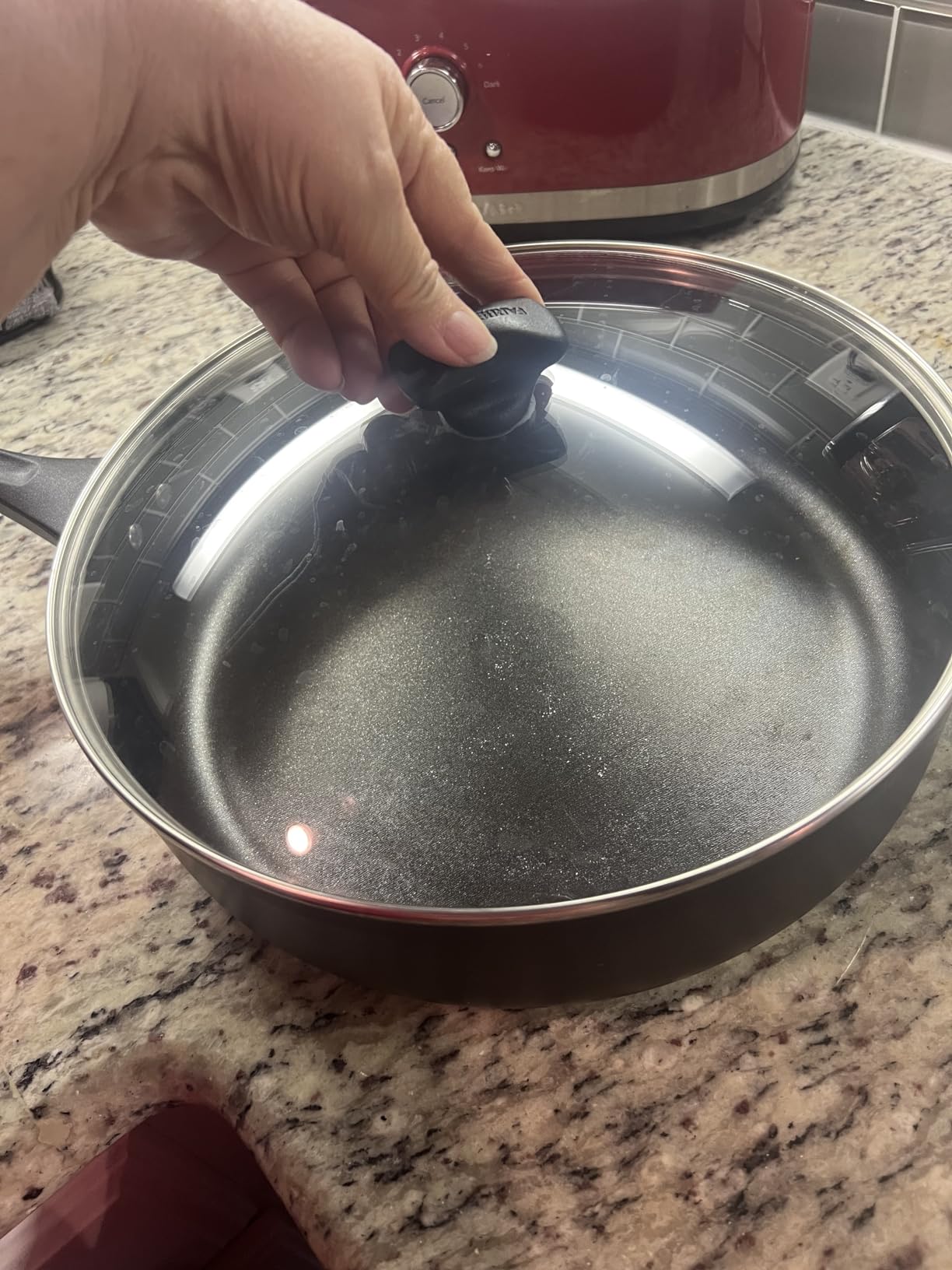
Best For: Batch Cooking on Sundays and Cooking for Five
If you are cooking for four or five, or you batch cook on Sundays, the 6-quart capacity is the reason to buy it. It also handles the jobs people buy a second small pan for: simmering lentils, reducing a sauce, and holding a large quantity of broth without reaching for a saucepan.
The dishwasher-safe finish and lifetime warranty also make it the least fussy choice in the list. Nobody has to maintain seasoning, and nobody has to think about what happens if a guest drops a fork into a pan of sauce.
Watch Out For: A 350-Degree Oven Ceiling and a 22-Inch Footprint
At 22 inches by 12 inches, this pan eats a full shelf, and that footprint is real. In a small kitchen with a two-burner range, a pan that wide means you cannot set anything else on the cooktop while it is in use.
The 350-degree oven ceiling is also lower than most coated competitors. If your cooking routine depends on finishing a gratin or roasting vegetables at high heat, that is a genuine limitation rather than a nitpick.
2. Blue Diamond 5-Quart Ceramic Saute Pan: Best for Cooking Without PTFE
Blue Diamond 5QT PFAS-Free Ceramic Nonstick Sauté Pan with Lid, Blue
5 quart ceramic nonstick
2.17 kg empty
Oven and broiler safe to 600F
Metal utensil safe
Not induction
Pros
- Coating is free of PFAS
- PFOA
- lead and cadmium
- Diamond-infused surface tolerates metal utensils
- Highest oven and broiler rating in the roundup at 600F
- Forged heavy-duty base resists warping
Cons
- Not induction compatible
- Some owners report coating wear after roughly 1.5 years
- A few reports of the base bowing on gas ranges
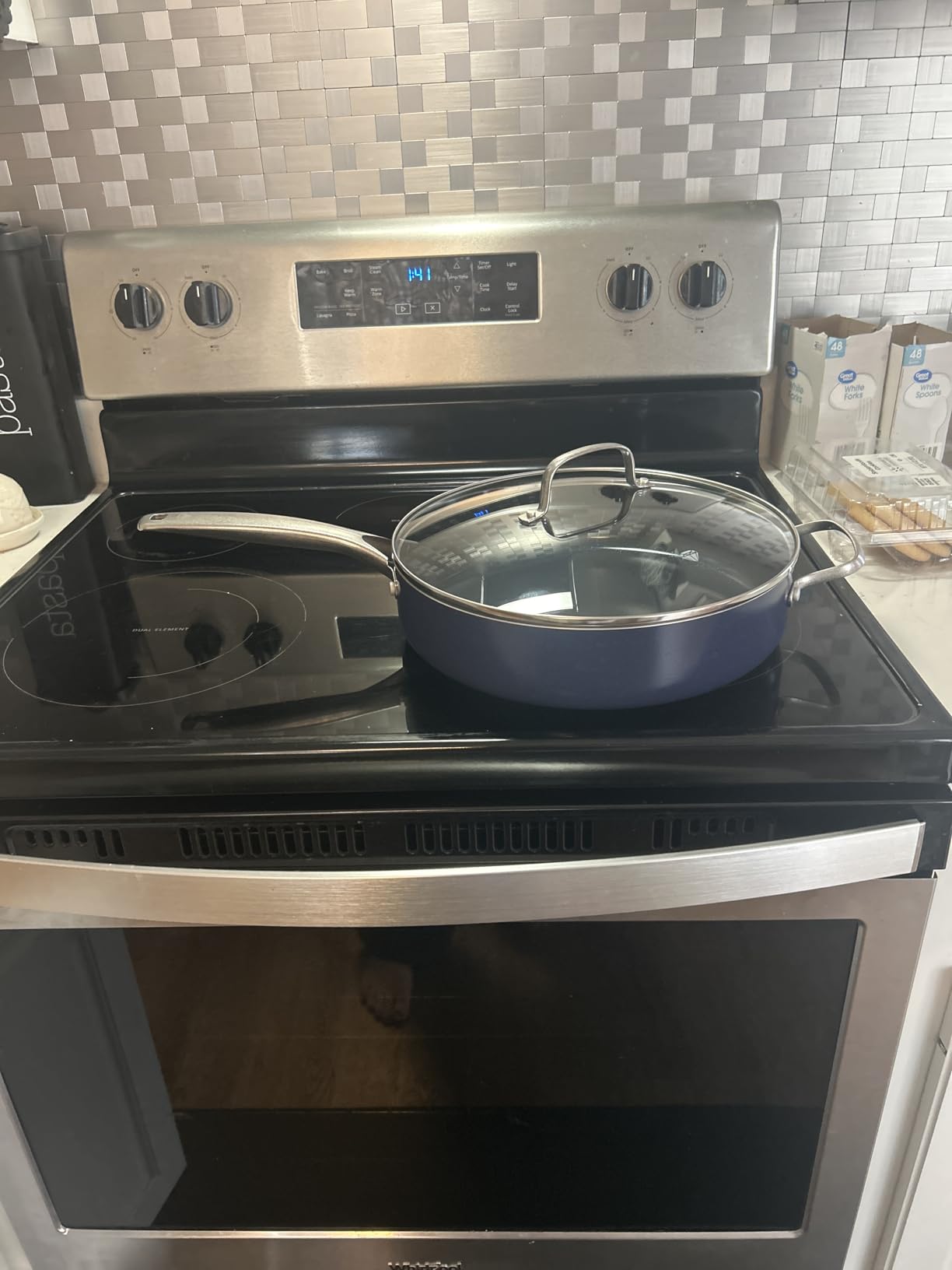
This is the pan people switch to when they decide they are done with traditional nonstick coatings. The Midnight Diamond ceramic surface is advertised as free of PFAS, PFOA, lead and cadmium, and owners report that they came to it from exactly that concern. The food release is close to conventional nonstick with little or no grease.
Two things stand out. First, the surface is metal utensil safe, which removes the single most common rule people get wrong on nonstick pans. Second, it is oven and broiler safe to 600 degrees Fahrenheit, the highest rating among the ceramic-coated pans here, which means a pan of vegetables can start on the burner and finish under the broiler in the same vessel.
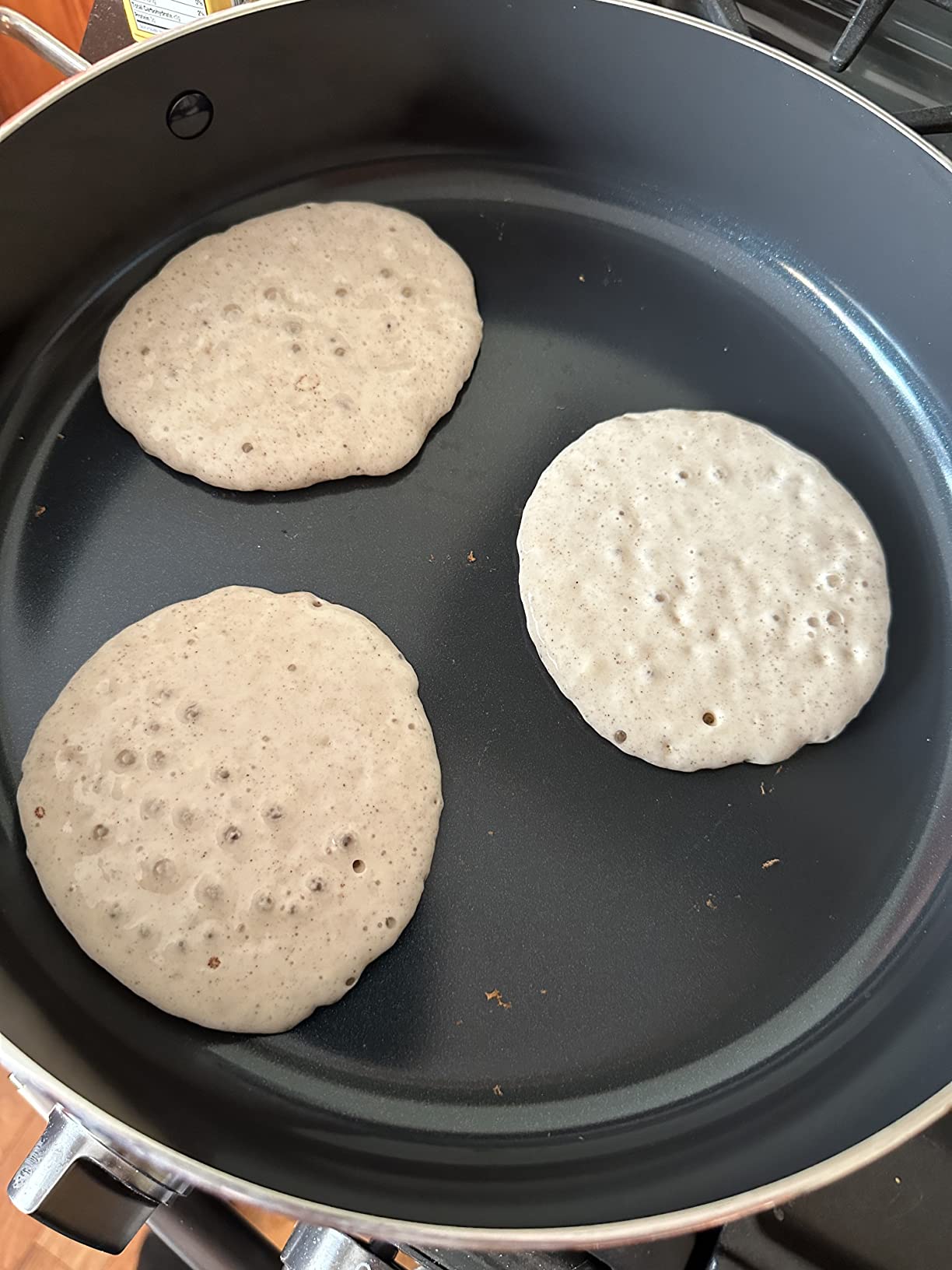
The construction is a forged heavy-duty base designed specifically to resist warping and wobbling, and it comes with a riveted stainless steel handle and a tempered glass lid. Reviewers frequently mention even heating, fast cooking and simple cleanup as the reasons this one becomes a daily driver rather than a specialty pan.
One important clarification, because it gets confused constantly: this is a ceramic-coated pan, not a pure ceramic pan. The coating is a hardened nonstick layer fired onto a metal body, which is what makes it induction-unfriendly in some builds and what allows it to be metal utensil safe. Pure ceramic cookware is a different category of product with different heat behavior.
Best For: Replacing a Worn Coating and Broiler Finishing
Buy this if the coating on your current nonstick pan is scratched, flaking, or simply makes you uneasy. It behaves like a normal nonstick pan in every other respect, so there is no technique change and no seasoning to maintain.
It is also the best pick here for finishing a dish under the broiler in a coated pan.
Watch Out For: Induction Cooktops and Coating Life After About a Year
It does not work on induction. That is a hard exclusion for anyone with an induction cooktop, and it is worth checking your stove before buying anything in this category.
Coating durability is the long-term question. A minority of owners report the surface scratching and losing release after roughly a year and a half, and a few mention the base bowing on gas ranges. Treat it as a pan you may replace in a few years rather than a lifetime piece.
3. SENSARTE 12-Inch 5-Quart Nonstick Skillet: Best Budget Pick for Induction
SENSARTE Nonstick Frying Pan Skillet with Lid, 12 Inch Large Deep Frying Pan, 5 Qt Non Stick Saute Pan with Cover, Induction Pan, Healthy Non Toxic Cooking Pan with Helper Handle, PFOA PFOS Free
5 quart capacity
12 inch diameter
5.3 lb empty
ILAG nonstick
Induction base
Hand wash
Pros
- Induction-suitable cast aluminum base that resists warping
- ILAG nonstick surface free of PFOA
- PFOS
- lead and cadmium
- Rivetless interior wipes clean in seconds
- Bakelite handle stays cool and glass lid has a steam vent
Cons
- Hand wash only to protect the coating
- Handle needs screw-on assembly and occasional tightening
- Some reports of fine scratches after a few months
This is the highest-volume deep pan in its category on Amazon right now, and the reason is simple: it does almost everything a coated saute pan should do, and it is the easiest entry point on this list. The cast aluminum body is induction-suitable, which eliminates the most common disqualifier in the coated cookware aisle.
At 12 inches across and 5 quarts, it has enough surface for a serious batch of vegetables and enough depth for a real braise. The rounded rectangular shape gives you a long side for stirring and two short sides for gripping, which is a better geometry than a pure cylinder for most stovetop work.
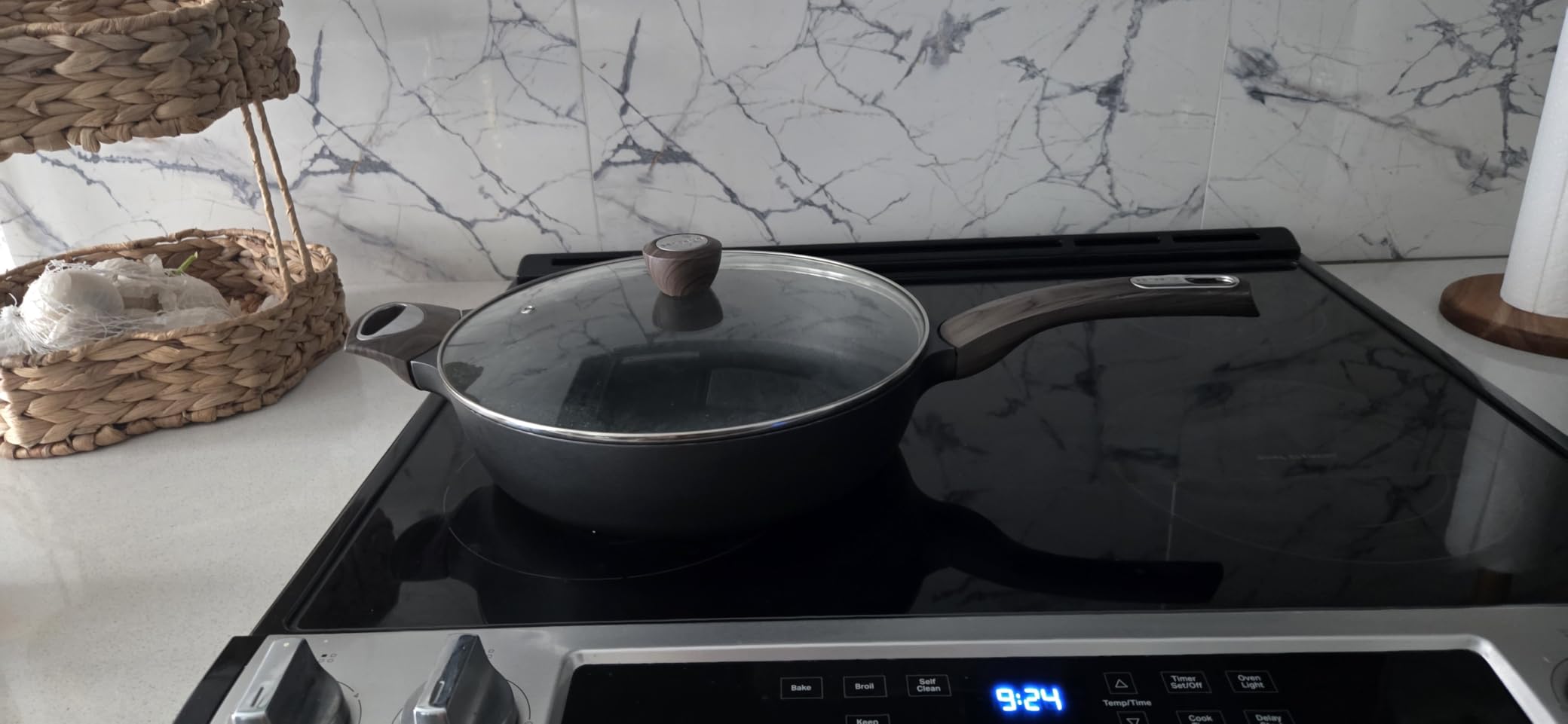
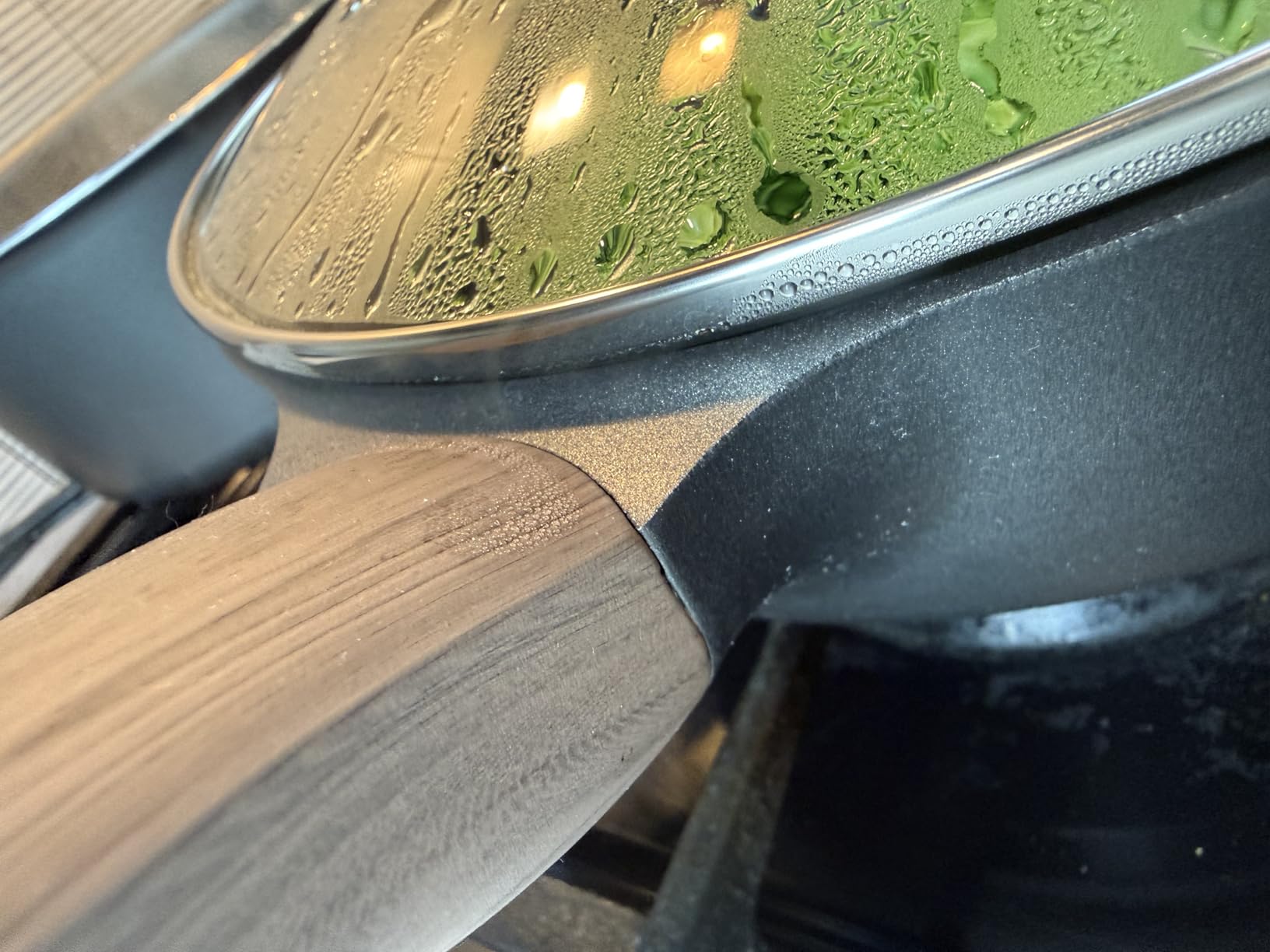
Daily users highlight the release quality and the even heating more than anything else, and the anti-scald bakelite handle stays cool during normal cooking. The explosion-proof tempered glass lid has a steam vent, which matters more than it sounds on a deep pan where condensation otherwise runs down the sides and drips back into the food.
The rivetless interior is a quiet design win. There are no rivet heads to trap residue or create a weak point that could eventually break through the coating, and the surface wipes clean with a towel, soap and warm water in seconds.
Best For: Induction Kitchens Shopping on a Budget
It is the right pick if you have an induction cooktop and you do not want to spend money to find out whether a cheaper non-induction pan will work. The base is explicitly induction-ready and the manufacturer rates it for gas, electric and induction alike.
It also suits anyone who cooks a lot of eggs, pancakes or delicate fish and does not want to think about heat control to keep food from bonding. The ILAG coating is designed for exactly that kind of low-stress release.
Watch Out For: Hand Washing and a Screw-On Handle
Hand washing only. That is the price of keeping the coating intact, and it is the single habit that separates a coated pan that lasts five years from one that flakes in eighteen months.
The handle is screw-on, and owners mention needing to tighten it periodically. At 5.3 pounds empty it is heavier than several pans in this list, so it is not the pan to buy if you lift a full load one-handed while doing something else at the sink.
4. HexClad 5.5-Qt Hybrid Deep Saute Pan: Best for High-Heat Finishing
HexClad 5.5 Qt Hybrid Nonstick Deep Sauté Frying Pan & Lid, Induction Ready
5.5 quart capacity
3.5 lb empty
Tri-ply with aluminum core
Induction ready
Oven safe to 900F
Pros
- Oven safe to 900F which no other pan here matches
- Laser-etched hybrid surface is metal utensil safe and dishwasher friendly
- Tri-ply aluminum core heats fast and evenly
- Light among the large-capacity pans here at 3.5 pounds
Cons
- Glass lid is only oven safe to 400F
- Highest share of one-star reviews of any pan here
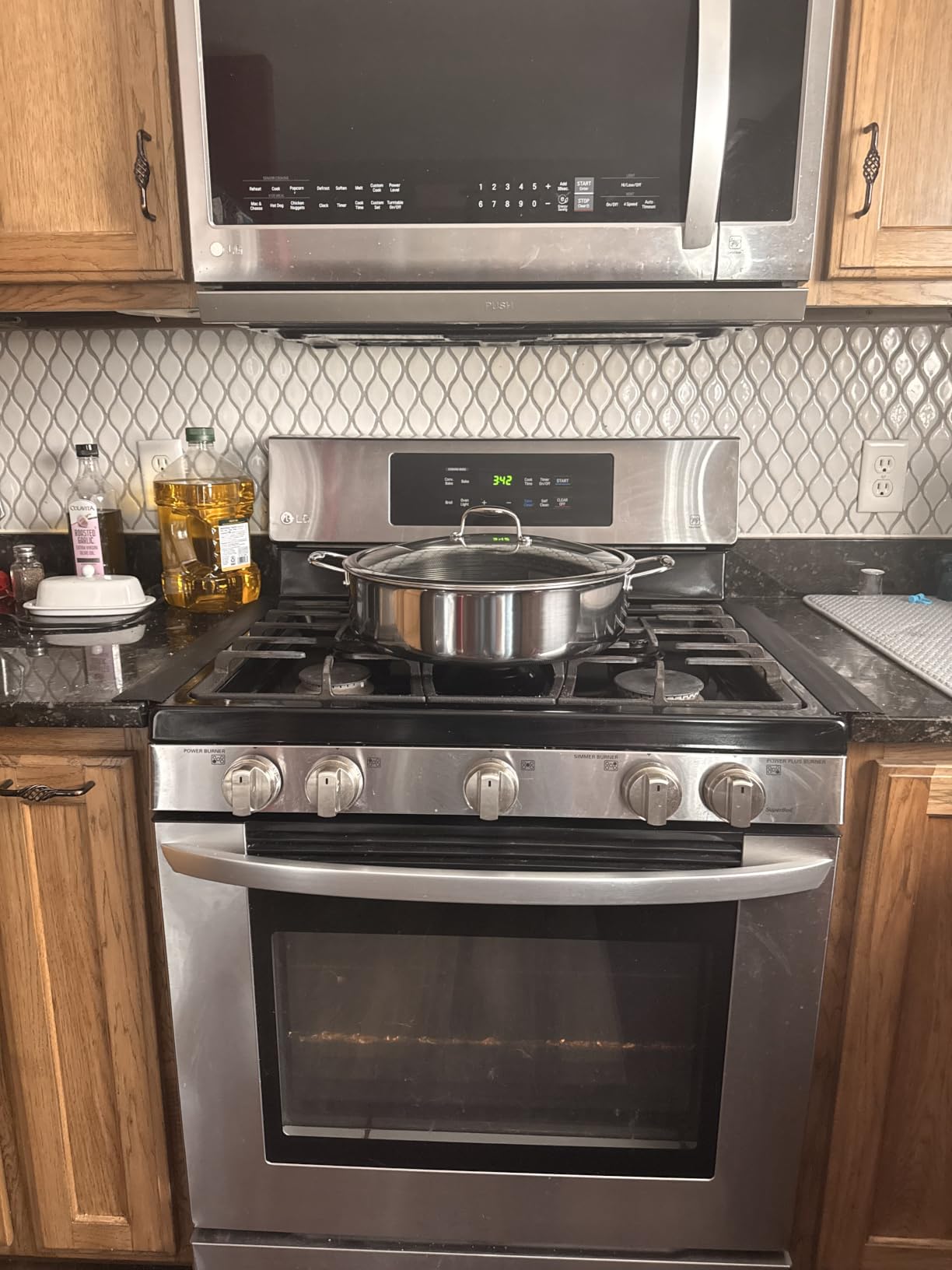
HexClad gets argued about more than any pan in this roundup, so here is the factual version. The cooking surface is laser-etched with a hexagonal pattern that combines stainless steel with a TerraBond ceramic coating, and the pan body is tri-ply with an aluminum core. It is induction ready, metal utensil safe, dishwasher friendly and rated oven safe to 900 degrees Fahrenheit.
That combination of a 900-degree pan body and a light 3.5-pound weight is genuinely rare. At roughly 11 inches across and 3.5 inches tall with 5.5-quart capacity, it is the one pick here rated that high, and it is light enough to handle comfortably while full.
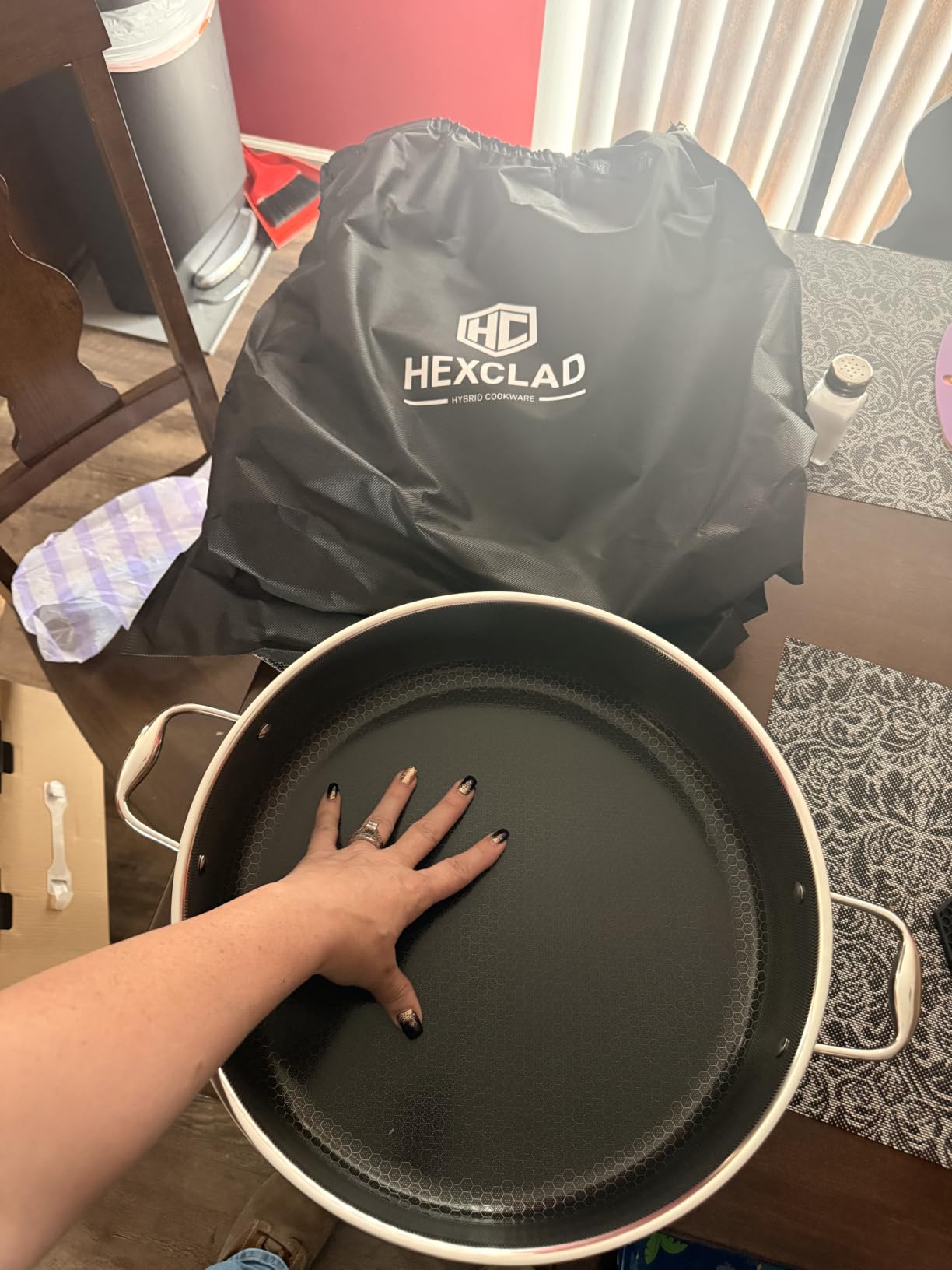
Owners call it a workhorse for searing, braising and one-pot cooking with fast, even heating, and about 82 percent give five stars. The pattern traps a small amount of oil in the raised hexes, which is what produces browning without a huge amount of added fat, and the flat areas between the hexes still release food reasonably well once the pan is properly preheated.
We want to address the skepticism head-on, because it is a real and repeated objection. On r/Cooking, one of the most upvoted replies on a pan recommendation thread describes HexClad as the worst of both worlds, the durability of nonstick with the price of stainless. That is a fair description of the hybrid category in general, and it is worth weighing before you buy.
Best For: One-Pan Cooking That Ends in a Hot Oven
It fits a cook who wants one deep pan that does everything, including oven finishing at temperatures no other coated pan here can take. If you roast a whole pan of vegetables after searing them, that rating alone is worth a lot.
It is also the easiest large pan in this roundup to lift, at 3.5 pounds empty, noticeably lighter than the Cuisinart or the T-Fal.
Watch Out For: A 400-Degree Lid Limit and the Highest Price Here
The glass lid caps out at 400 degrees Fahrenheit, so a high-heat finish means taking the lid off. That is an easy workaround, but it is worth knowing before you plan an oven step.
It is the most expensive pan in this roundup by a wide margin, and it carries the largest visible share of one-star reviews, with owners citing the premium cost as the main reason. Paying up for a hybrid surface is a bet on the coating holding up; if that is not a bet you want to make, the Cuisinart or the Cooks Standard stainless pans carry no coating risk at all.
5. Cuisinart 5.5-Quart Stainless Saute Pan: Best Value Stainless Steel
Cuisinart 5.5 Quart Sauté Pan w/ Cover, Stainless Steel Pan with Lid, Large Kitchen Pan, Dishwasher Safe, Compatible with Induction, Electric, Gas Cooktops, Oven Safe Saucepan, Cool Grip Handles
5.5 quart capacity
11.8 inch diameter
6.2 lb empty
Encapsulated aluminum base
Induction compatible
Pros
- Encapsulated aluminum base spreads heat evenly with no hot spots
- No coating to scratch
- flake or replace
- Helper handle plus riveted cool-grip handles
- Limited lifetime warranty and BPA free
Cons
- Stainless steel is not nonstick and needs proper preheating and oil
- Bulky and heavy at 6.2 pounds
- Some owners report a slightly convex base
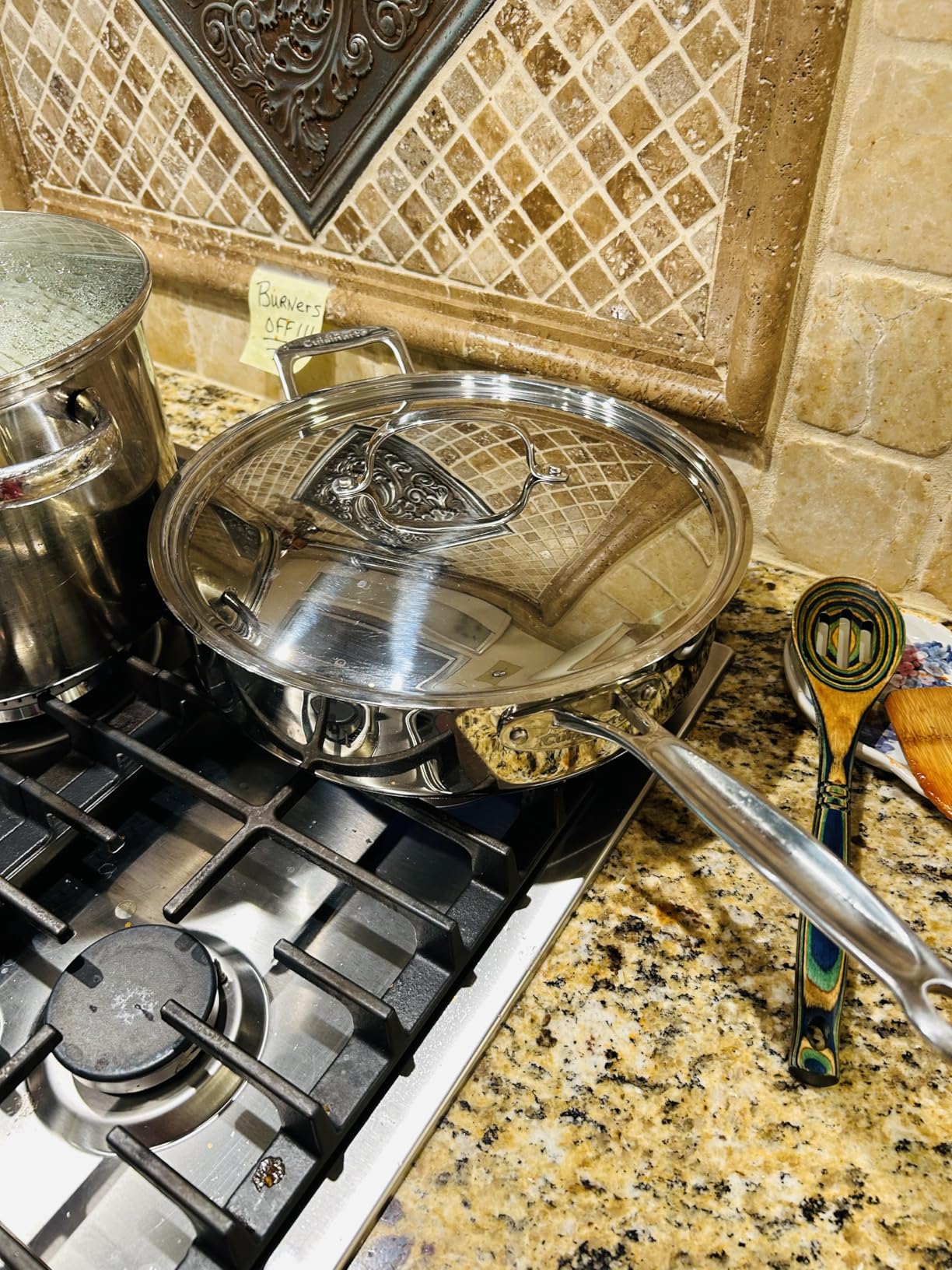
This is the pan that comes up most often as the sensible first stainless buy, and r/Cooking threads about first saute pans keep pointing at Cuisinart for the same reason. It is a stainless body with an aluminum encapsulated base, which means fast, even heat with no hot spots and nothing to flake off into your food.
The straight high sides and flat cooking surface with measurement markings are genuinely useful details. The markings let you reduce a sauce to a target volume without a separate measure, and the flared pouring edge drips cleanly, which matters when you are reducing a pan sauce after deglazing.
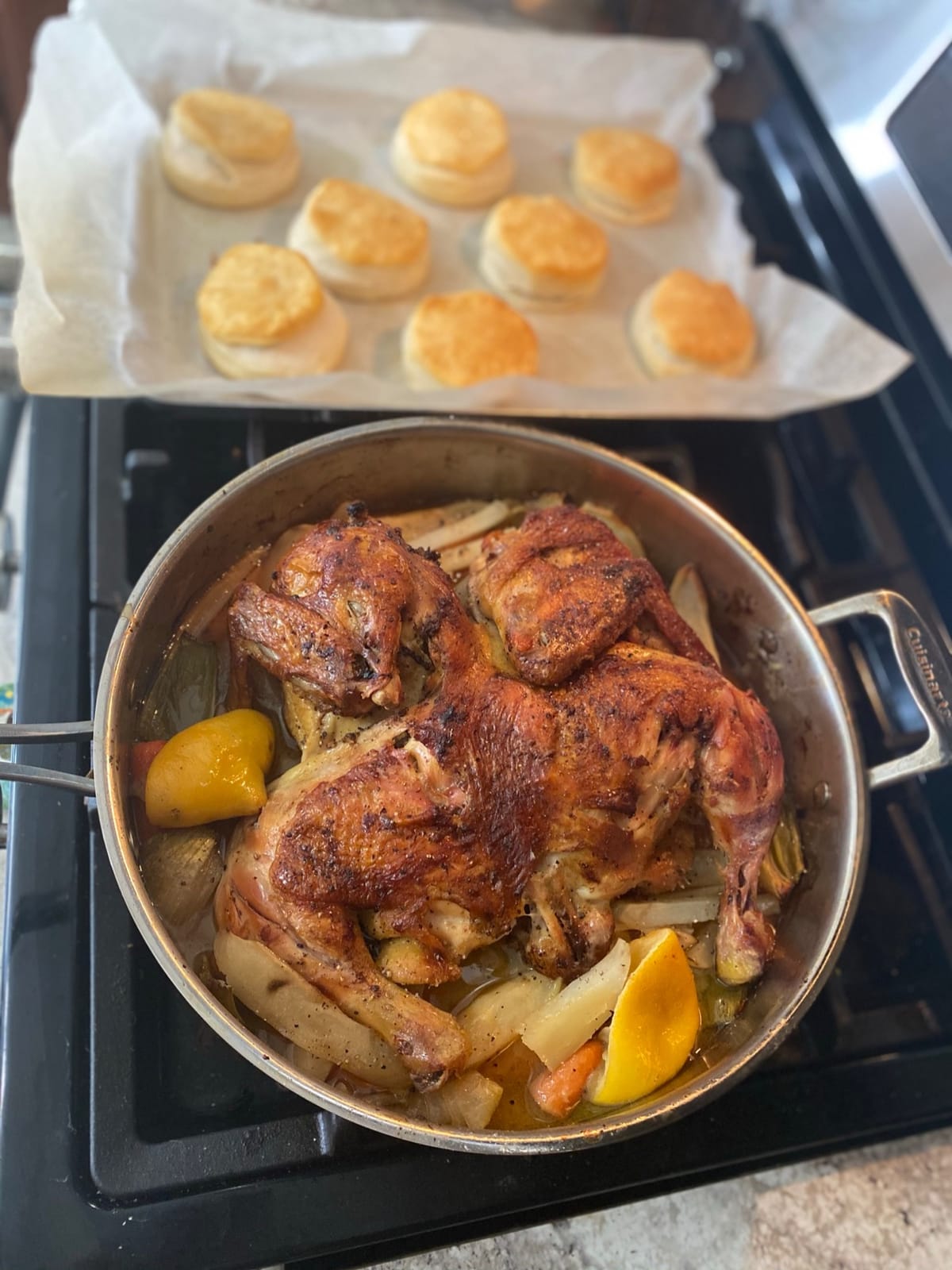
The Cool Grip handles are solid stainless steel riveted handles that stay cool on the stovetop, which is unusual at this capacity and removes the need for a towel every time you reach for the pan. Owners praise the large flat surface for searing fish, steaks and patties, and the fact that the surface never discolors or reacts with acidic sauces.
It is also fully dishwasher safe and BPA free, backed by a limited lifetime warranty. For a pan you might keep for a decade, the arithmetic of buying once is difficult to argue with.
Best For: Home Cooks Moving to Stainless for the First Time
Buy this if you sear meat often and want a pan that will still work in fifteen years. It is the natural choice for anyone who wants pan sauces, fond deglazing and high-heat searing without maintaining a coating.
It suits households cooking for four or five, since 5.5 quarts with an 11.8-inch diameter gives you a wide searing surface at real depth. Induction, gas and electric all work with the encapsulated base.
Watch Out For: A 6.2-Pound Lift and the Sticking Learning Curve
At 6.2 pounds empty, this is the second-heaviest pan in the roundup, and a full 5.5 quarts makes that a two-handed job. The helper handle is what makes it manageable, and you should treat it as mandatory rather than optional.
It is not nonstick. Food sticks if the pan is not preheated properly and if you add food to a dry or cold surface, which is the most common complaint in the reviews and the most common reason people abandon stainless altogether.
6. T-Fal Ultimate 5-Quart Hard Anodized Jumbo Cooker: Best for Preheat Feedback
T-Fal Ultimate Non Stick Jumbo Cooker With Lid, 5-Quart, Onyx
5 quart capacity
6.7 lb empty
Hard anodized titanium coating
Thermo-Spot indicator
Oven safe to 400F
Pros
- Thermo-Spot indicator turns red when the pan is properly preheated
- Hard anodized exterior resists wear and scratches
- Vented tempered glass lid keeps visibility while trapping heat
- Riveted silicone handles stay comfortable
Cons
- Not induction compatible
- Heaviest pan in the roundup at 6.7 pounds
- Oven safe to 400F with a 350F lid limit
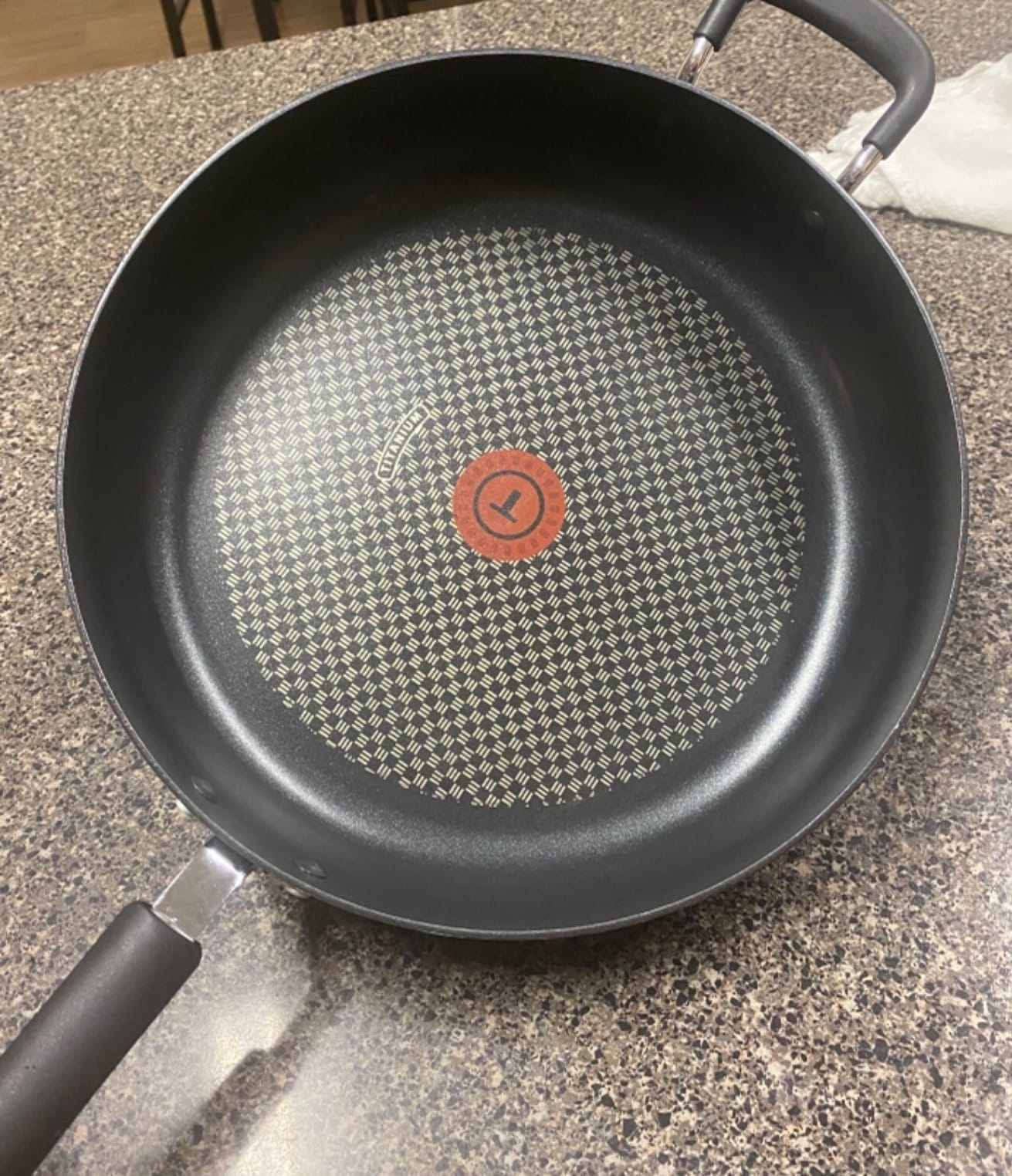
The single best feature in this pan is the Thermo-Spot heat indicator in the center of the cooking surface. It turns solid red once the pan is properly preheated, which removes the most common cooking mistake in home kitchens: adding food before the pan is hot enough to brown it.
The hard anodized exterior with a forged design is a more durable skin than a standard nonstick body, and it resists scratching in a way that painted aluminum does not. The titanium nonstick coating on top gives you the release you would expect, with about 86 percent of owners giving five stars.
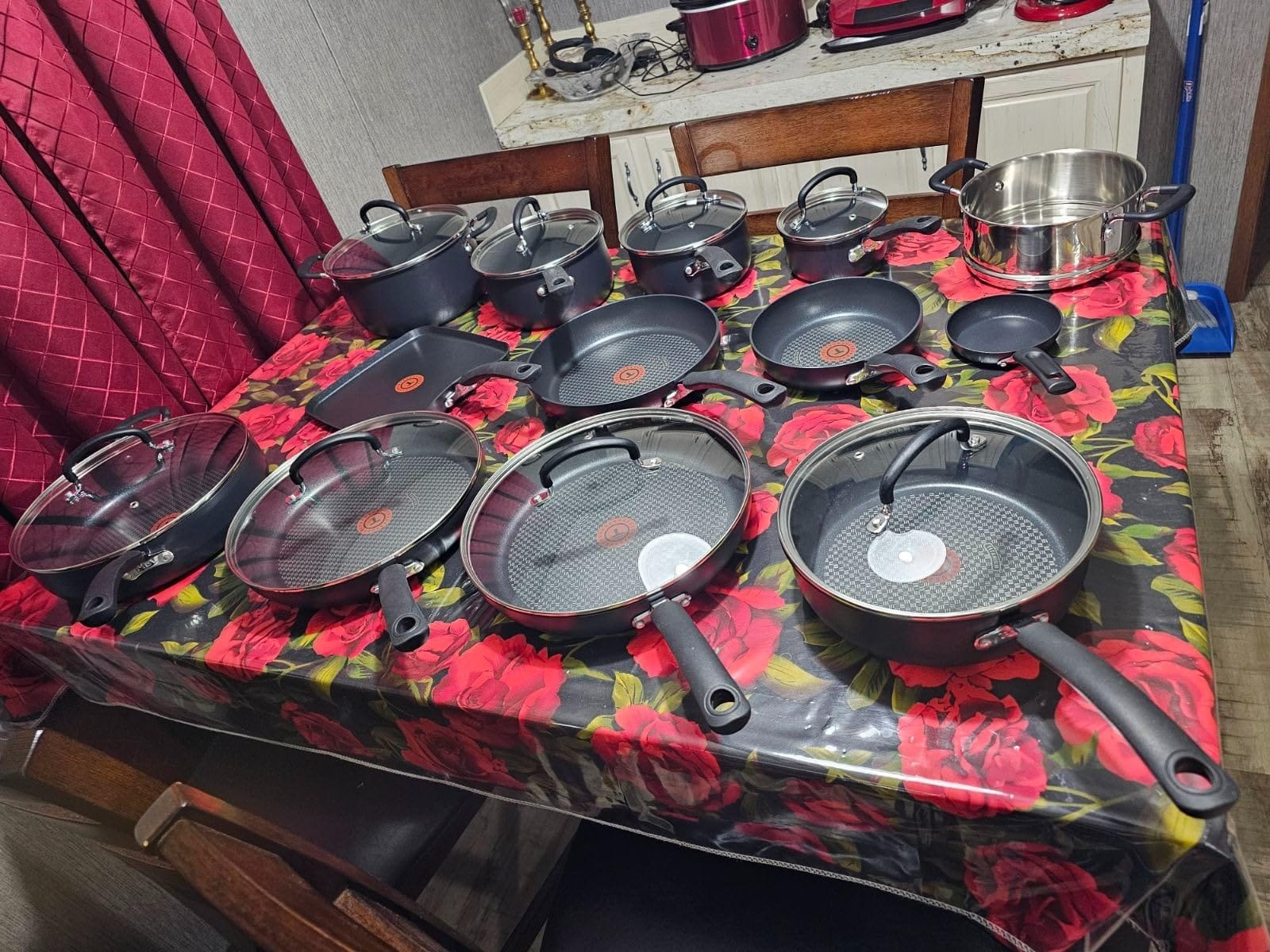
The riveted silicone handles and vented tempered glass lid are well-judged for a 5-quart pan. The lid is vented so steam escapes rather than condensing and dripping back into the food, and it is deep enough to actually cover the pan rather than sitting halfway up the wall.
The pan is rated for deep frying, stir-frying, simmering, braising and sauteing, which is the standard brief for a jumbo cooker. It is dishwasher safe and carries a limited lifetime warranty.
Best For: Cooks Who Want Preheat Feedback Instead of Guesswork
This is the pick for someone who has never had much luck with stainless and wants visual feedback instead of guesswork. If you have been blaming yourself for sticking, the heat indicator solves the underlying problem.
It also suits anyone who wants a harder-wearing nonstick surface than a painted one, because hard anodizing is a treated metal surface rather than a printed coating layer.
Watch Out For: The Heaviest Pan Here and No Induction
At 6.7 pounds empty, this is the heaviest pan we tested, and forum buyers of this model describe it as a workout when full. If you lift a hot, full pan regularly, look at the SENSARTE or the HexClad instead.
It is not induction compatible, and the oven limit of 400 degrees with a 350-degree lid limit rules out any high-heat finish. Induction kitchens and broiling cooks should skip it.
7. Circulon A1 Series 5-Quart Induction Saute Pan: Best Induction-Cooked Nonstick
Circulon A1 Series Nonstick Induction Sauté Pan with Lid, 5-Quart, Graphite
5 quart capacity
5.1 lb empty
Thick steel induction base
Oven safe to 400F
Dishwasher safe
Pros
- Thick edge-to-edge steel base is induction suitable and warp resistant
- Extreme Nonstick coating lab tested past 350000 scrapes
- Nonstick inside and out makes cleanup simple
- Genuinely dishwasher safe with limited lifetime warranty
Cons
- Oven safe to 400F with a 350F lid limit
- Not metal utensil safe despite the scratch-resistant claims
Most coated pans that claim induction compatibility get it by bolting a thin magnetic disc onto an aluminum body, and that disc is exactly what warps. Circulon takes a different approach with a thick edge-to-edge steel base, which is both induction suitable and substantially more warp resistant because the whole layer is steel, not a thin plate glued to a different metal.
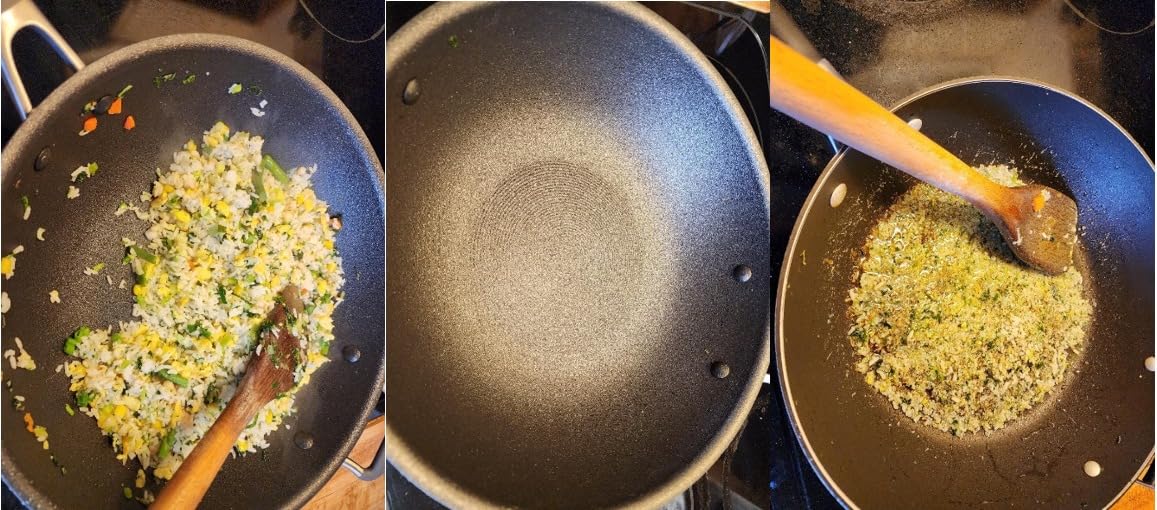
The coating is the selling point for anyone worried about scratch life. Extreme Nonstick with ScratchDefense technology is lab tested to survive more than 350,000 scrapes, and reviewers report a surface that resists scratching and staining well beyond what a budget coated pan typically manages.
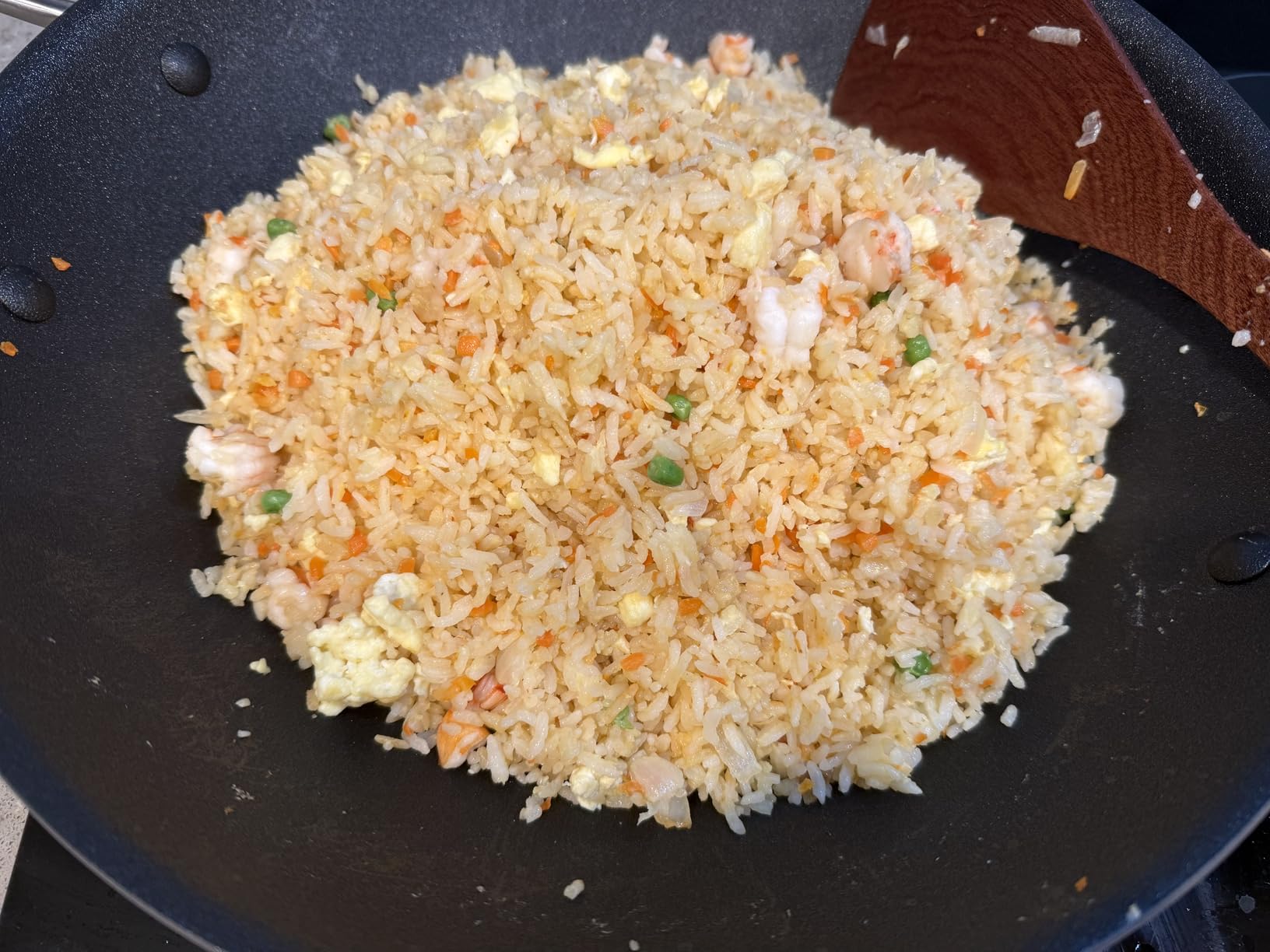
Cleanup is the other thing owners like. The nonstick goes on the inside and the outside of the pan, so the base does not discolor over time and the whole thing can go through a dishwasher cycle without anyone hovering over it.
The tempered glass lid seals in heat and moisture while you watch the food cook, and the cast stainless steel and silicone handles give you a solid grip on a pan that weighs about 5 pounds empty. The warranty is a limited lifetime warranty from the manufacturer.
Best For: Induction Kitchens That Still Want a Coated Pan
This is the induction kitchen answer for a cook who wants nonstick. Induction is where coated pans usually fall short, and a thick steel base is the correct engineering response rather than a workaround.
It also suits anyone who cooks daily, uses metal tools without thinking about it, and wants a surface documented to survive heavy scraping rather than one that merely claims to be scratch resistant.
Watch Out For: A 400-Degree Oven Limit and No Metal-Utensil Rating
The 400-degree oven limit and 350-degree lid limit are modest. It will not take a high-heat finish, so it is a stovetop pan with a lid rather than a stovetop-to-oven vessel.
Despite the scratch-resistant coating claims, the manufacturer does not rate it metal utensil safe. That is a contradiction worth noticing, and it means wooden or silicone tools remain the safer choice.
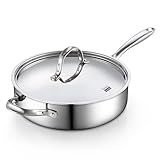
8. Cooks Standard 4-Quart Stainless Steel Saute Pan: Best for Smaller Kitchens
Cooks Standard Classic 4 Quart Stainless Steel Sauté Pan with Lid
4 quart capacity
10.5 inch diameter
4.9 lb empty
Aluminum disc base
Oven safe to 500F
Pros
- Aluminum disc sandwiched between steel layers for even conduction
- No coating
- so metal utensils and abrasives do no harm
- Induction compatible and oven safe to 500F
- Riveted helper handle for two-handed lifting and pouring
Cons
- Not nonstick
- requires preheating and fat to avoid sticking
- Heavy enough to need two hands when full
- A few buyers dislike the black logo stamped on the lid
Four quarts is the size most home cooks actually want, and this is the pan that delivers it without turning into a two-handed lift. At 10.5 inches across and 4.9 pounds empty, it is the most manageable stainless option in this roundup while still being genuinely deep.
The heat source is an aluminum disc sandwiched between stainless steel layers, which is a simpler version of the clad construction used in expensive pans. It gives even conduction across the base, which is what stops the hot spot that ruins a sear in cheaper single-ply stainless. The 18/10 stainless body has a brushed interior and polished exterior.
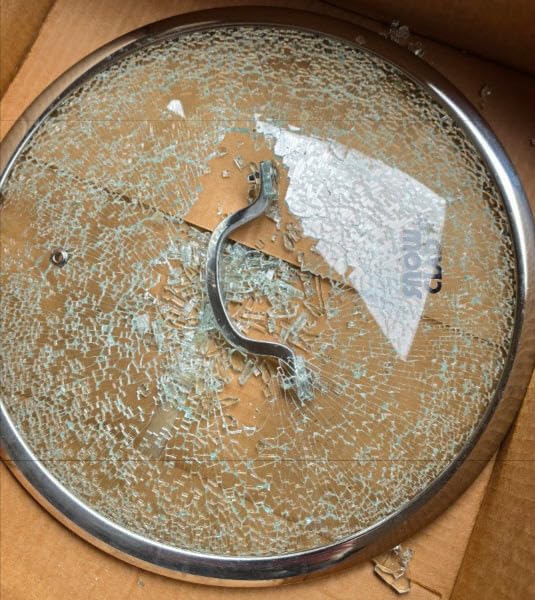
The sealed stainless steel lid is the sleeper feature. Because it is stainless rather than glass, it goes into the oven with the pan to 500 degrees, and it prevents overflow, retains moisture and speeds up cooking, which is exactly the behavior you want from a covered braise.
Owners who follow the standard stainless technique report excellent searing and easy cleanup, and the pan holds up well to daily use without any coating wear to worry about. It works on induction, gas, electric, glass, ceramic and halogen.
Best For: One or Two Person Kitchens and Smaller Portions
It fits a one or two person kitchen, or a family that cooks smaller portions most nights. Four quarts will sear a good number of chicken thighs and simmer a sauce without the storage and lifting problems of a 6-quart pan.
It is also the pick for anyone moving to stainless who wants zero coating rules: no seasoning, no special utensils, no hand-washing anxiety because the whole pan is dishwasher safe.
Watch Out For: Four-Quart Capacity and Stainless Technique
It is not nonstick. Expect to preheat properly and add fat before protein, or the food will bond, and the reviews make this caveat repeatedly.
Even at 4.9 pounds it needs two hands when full, which the riveted helper handle provides. And if you want a lid that also works in the oven, this one does, which is more than most coated pans in this roundup can say.
9. SNOWCLAD 5-Quart Hybrid Saute Pan: Best Lightweight Hybrid
SNOWCLAD Frying Pans Nonstick with Lid,Hybrid Non Stick 5 Quart Saute pan,PFOA Free Cookware,Stainless Steel skillet,12 inch Deep Saute Pan,Dishwasher&Oven Safe,Works on All Cooktops
5 quart capacity
12 inch diameter
3 lb empty
Laser-etched dual surface
Oven safe to 500F
Pros
- Lightest pan in the roundup at 3 pounds
- Metal utensil safe and PFOA free
- Multi-layer composite steel for quick even heat
- Double handles help with oven use
Cons
- Only partially nonstick
- oil or butter is still needed
- Some buyers report a curved base with oil pooling at the edges
- Glass lid handle gets hot and needs a mitt
Three pounds for a 5-quart pan is genuinely unusual, and it is the entire reason to look at this one. If weight is the reason you have been avoiding deep pans, this is a 12-inch deep saute pan that is closer to the weight of a coated skillet than to a stainless jumbo cooker.
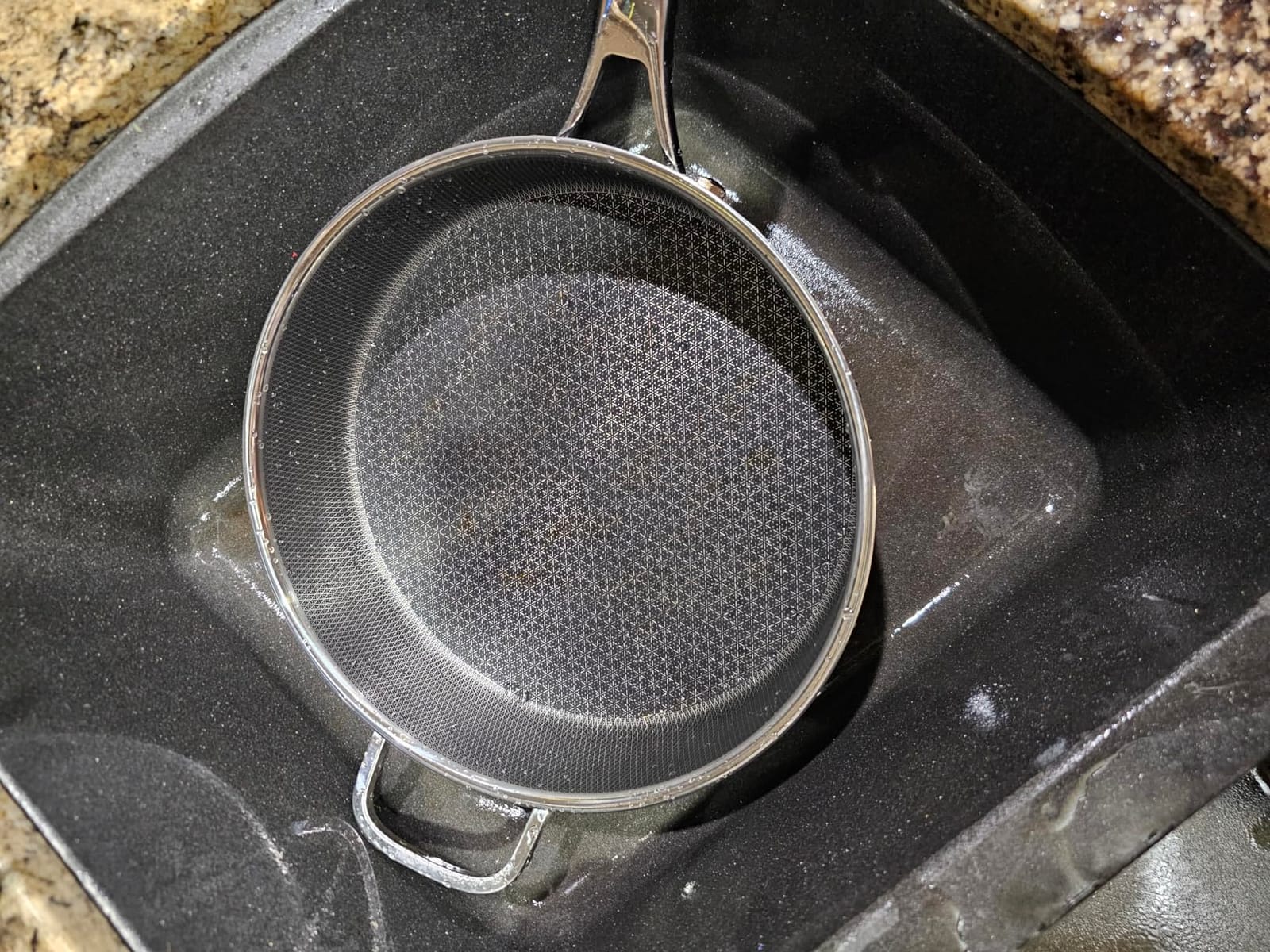
The surface is a laser-etched snowflake pattern that combines stainless steel with a nonstick layer, and the manufacturer claims a clad area about 50 percent larger than typical hex-surface pans of this type. Multi-layer composite steel underneath solves the conduction problem that pure steel would otherwise create.
It works on gas, electric, glass and halogen cooktops, is oven safe to 500 degrees and is metal utensil safe. Fans describe it as a well-built pan that cooks evenly and cleans up easily while staying well below the premium hybrid brands.
The realistic expectation is that it behaves like a seasoned stainless pan with a nonstick assist. Once it is seasoned, cooking at lower heat settings gives even heat, and it needs oil or butter in the pan like any other hybrid surface.
Best For: One-Handed Lifting of a Full 5-Quart Pan
It is the pick if you want a big pan you can lift with one hand, or if a family member does the cooking and cannot manage 5 pounds. Double handles, one long and one short u-shaped helper, help with oven use.
It also suits anyone who wants a metal utensil safe surface and is comfortable with a short seasoning routine before first use rather than a factory coating that degrades.
Watch Out For: A Curved Base and Only Partial Nonstick Release
It is not fully nonstick, so it will not behave like the SENSARTE or the Farberware for eggs and delicate fish without fat in the pan. It also does not work on induction.
Some buyers report a slightly curved base that lets oil pool at the edges, which is worth checking early. The glass lid handle also gets hot, so plan on a mitt whenever the lid is on.
10. All-Clad D3 4-Quart Saute Pan: Best for Searing and Pan Sauces
All-Clad D3® Stainless Steel 4 Qt Sauté Pan with Lid, Made in the USA
4 quart capacity
5 lb empty
Fully bonded tri-ply
Oven and broiler safe to 600F
Hand wash only
Pros
- Fully bonded tri-ply aluminum core delivers fast
- even heat and a strong sear
- Large searing surface with straight sides that reduce splatter
- Made in the USA in Pennsylvania since 1971 with a limited lifetime warranty
- Oven and broiler safe to 600F with induction compatibility
Cons
- Smallest capacity in the roundup at 4 quarts
- Hand wash only
- Not nonstick and requires proper preheating technique
If the single most important thing in a saute pan is a flat base that sears hard without warping, this is the reference answer. D3 is fully bonded tri-ply: an aluminum core sandwiched between stainless layers and bonded across the entire surface, which spreads heat evenly and holds it there rather than conducting straight up the wall.
In the r/Cooking thread that comes up repeatedly when people ask for a first saute pan, All-Clad tri-ply is the most common recommendation, with the usual caveat that it needs to fit the budget. That caveat is the honest part: this is the premium uncoated option in the roundup, and the value case is that you buy it once.
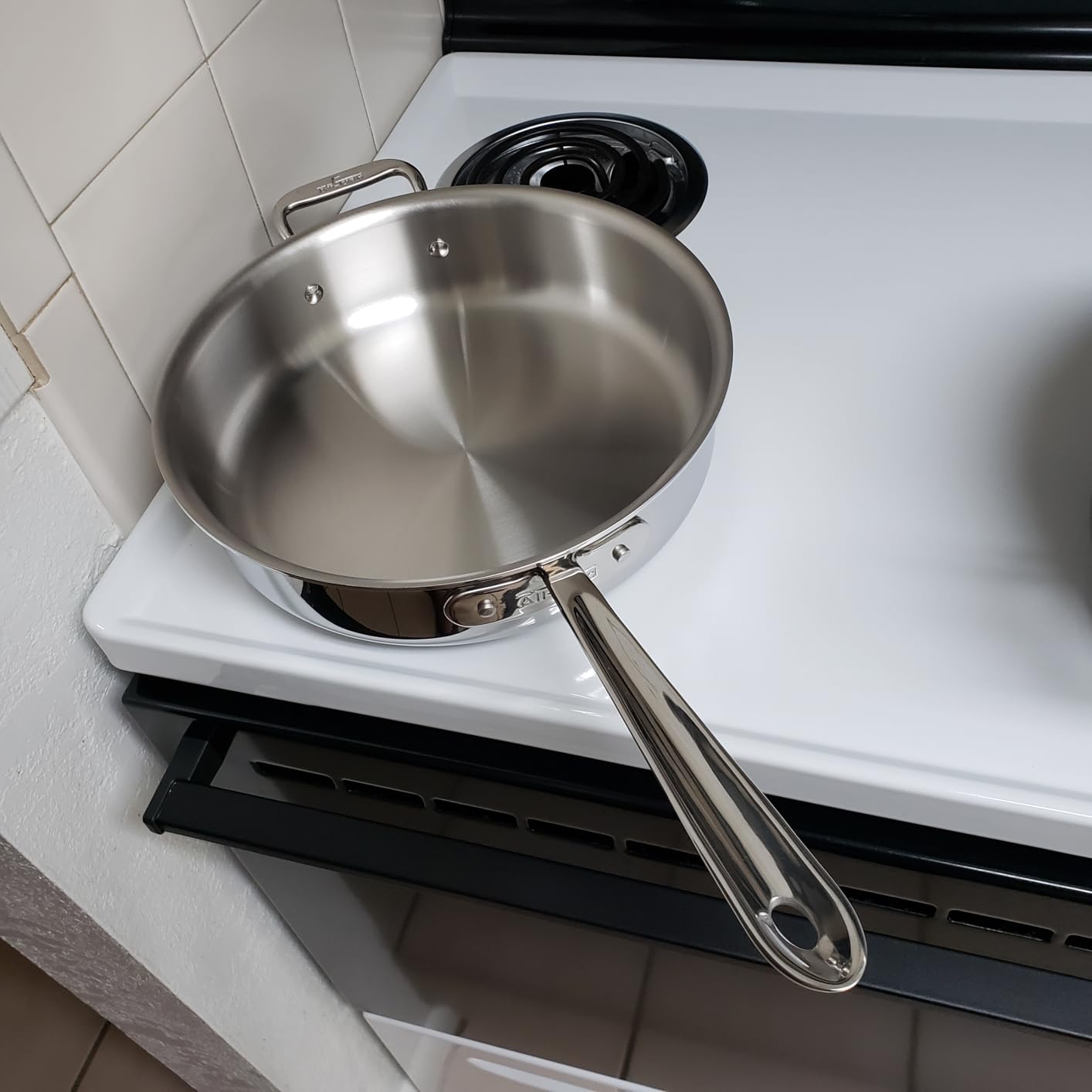
The straight sides reduce splatter while still giving you a large searing surface, which is the harder design problem to solve than it sounds. The riveted handle is shaped for a chef-style underhand grip, and the flared edge pours sauces cleanly without dribbling down the side of the pan.
Oven and broiler safe to 600 degrees, compatible with any stovetop including induction, and backed by a limited lifetime warranty. It is made in All-Clad’s Pennsylvania factory, which is the manufacturing story several buyers specifically mention as part of the value argument.
Best For: Hard Searing Followed by a Finished Pan Sauce
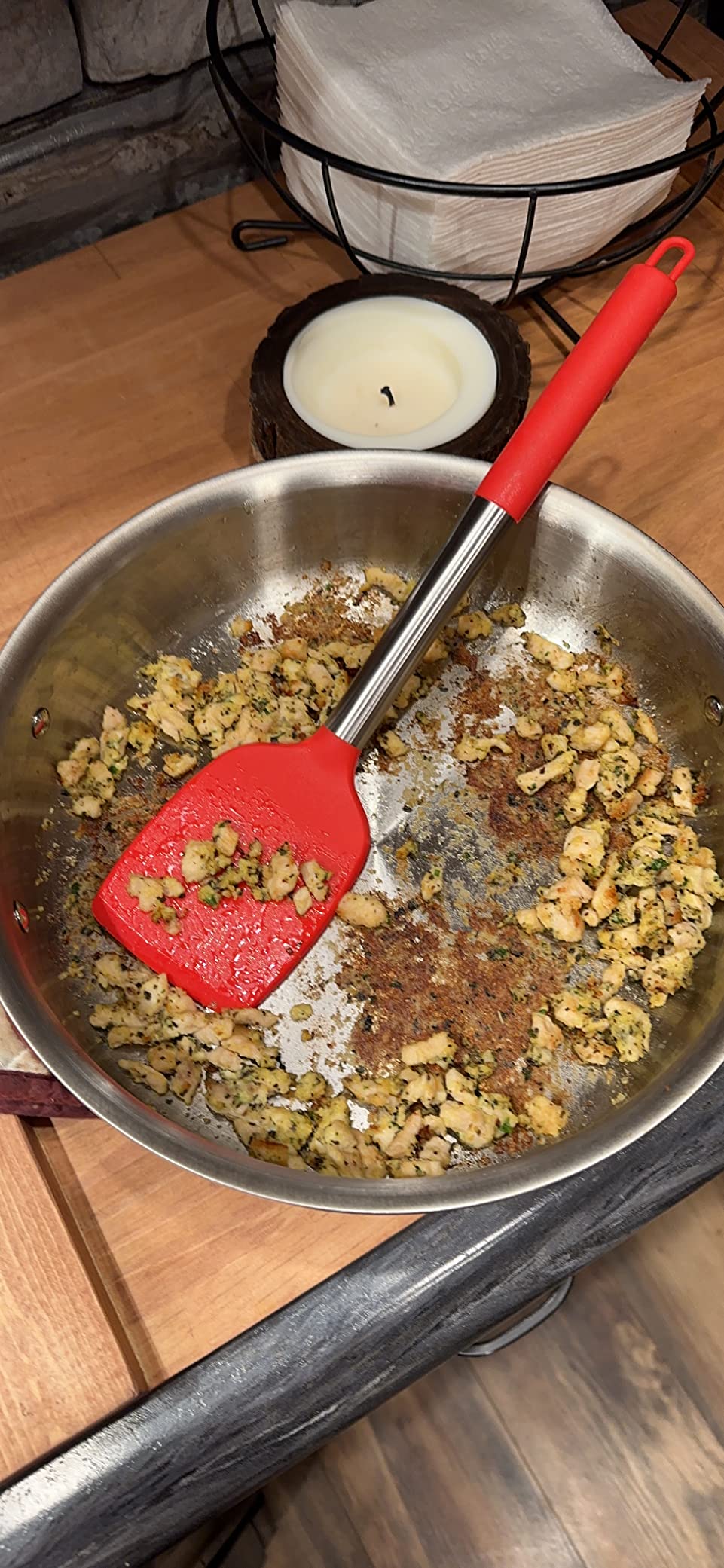
This is the pan for someone who sears and then makes a sauce in the same vessel. The tri-ply construction browns evenly, and the walls hold the deglazing liquid long enough to reduce into a finished sauce without the pan boiling dry.
It also suits anyone who cooks at high heat regularly, since 600-degree broiler capability and a fully bonded base are exactly what a hard sear needs.
Watch Out For: The Smallest Capacity Here and Hand Washing
Four quarts is the smallest capacity in this roundup. That is enough for a family meal, but it is tight if you are cooking for six or batching a broth.
It is hand wash only, and it is not nonstick. Everything else on this list is either lighter, cheaper or dishwasher safe, so the case for this pan is entirely about heat performance and longevity rather than convenience.
How to Choose a Saute Pan for Your Kitchen?
Start with capacity, not brand
Nobody online sizes a saute pan by how many people it actually feeds, which is why sizing questions generate so much confusion. The rule that works: measure the food you already cook, not the food you imagine cooking. Count the number of portions you actually plate on a normal Tuesday, and buy the pan that holds that with a little room to stir.
3 to 4 quarts: one or two people, or a family eating smaller evening meals. Enough for four chicken thighs and a pan of vegetables.
4.5 to 5.5 quarts: a family of four, and the sweet spot for most home kitchens. Handles a full skillet dinner plus a sauce in the same vessel.
6 quarts: a family of five or six, batch cooking, or anyone who regularly cooks for more than four. Requires a helper handle and a clear path to the sink.
Diameter matters more than most buyers expect. A 5-quart pan with a 12-inch cooking surface sears differently from a 5-quart pan with a 10-inch surface, because crowding the food drops the pan temperature and you get grey meat instead of browning. Where two pans share a capacity, prefer the wider one.
Decide between a skillet, a saute pan and a braiser
A skillet is for fast, high-heat, shallow cooking where you want to slide food out easily. A braiser is for slow, covered cooking with a lot of liquid, and it almost always comes with a lid and a heavier base. A saute pan sits between them: tall enough to hold liquid and reduce a sauce, wide enough to sear.
Most home cooks end up with a skillet for steak and eggs and a saute pan for everything with a sauce or a quantity of liquid in it. That is why a saute pan is the piece people replace first, and why the walls matter more than the brand badge.
Check the induction question before anything else
Induction is the most common disqualifier in this whole category, and it is worth answering first because it eliminates options immediately. Among these ten, the induction-compatible picks are the SENSARTE, the Cuisinart, the HexClad, the Circulon, the Cooks Standard and the All-Clad. The Blue Diamond, the T-Fal and the SNOWCLAD are not.
The reason is simple: induction needs a magnetic base, and ceramic-coated pans in this price range often use an aluminum body with a thin bonded plate that warps on a magnetic burner. A thick full-layer steel base, like the Circulon, is the version of induction compatibility that holds up over time.
Weigh the empty pan, then imagine it full
Weight in pounds is the number nobody puts on a listing, and it is the one that changes how you cook. The picks here run from 3 pounds for the SNOWCLAD to 6.7 pounds for the T-Fal. Add two to three pounds for a full load of liquid, and you have the real number.
Any pan at 6 pounds or above should have a helper handle, and you should plan to lift it with two hands. For a household with a single cook and a tight path from burner to sink, staying under 5 pounds is worth more than an extra quart of capacity.
Look for a stated oven limit and a lid
Every pan here states an oven rating, and they range from 350 to 900 degrees Fahrenheit. The difference decides whether you can finish a dish under the broiler or move from stovetop to oven in one vessel. If oven finishing matters, the stated limit is more important than the coating marketing.
On the lid question, a deep pan used for simmering and braising needs one, and a pan used for searing does not. Most picks here include a lid, but note that a glass lid often has a much lower oven rating than the pan itself, which is the single most common disappointment we found in the reviews.
Understand the material trade-offs
Stainless tri-ply and clad stainless sear hardest and last longest, but they are not nonstick and they reward a hot pan and a little fat. Hard-anodized aluminum keeps a real coating that outlasts a standard nonstick and can handle more heat before the coating is stressed. Ceramic-coated pans release like nonstick and are free of PTFE in the advertised formulation, but the coating is the part that ages.
Carbon steel is worth mentioning even though no carbon steel pan made this list, because enthusiasts ask for it constantly. Carbon steel is lighter than stainless, heats faster and sears superbly once seasoned, and it is the first choice for people who want a pan that improves with age. It is also not induction compatible, it is not nonstick until it is seasoned, and it is unforgiving during the first few cooks. For a beginner buying one pan, that learning curve is the reason stainless and hard-anodized options dominate the recommendation threads.
Understand what the coating claims mean
PFAS, PTFE and PFOA all come up, and the terms get tangled fast. PTFE is the polymer used in traditional nonstick coatings. PFAS is the broader chemical family that includes PTFE. PFOA was one compound in that family that was phased out of nonstick manufacturing years ago, so a pan claiming to be PFOA-free does not necessarily claim to be PTFE-free.
Ceramic-coated is not the same as pure ceramic. A ceramic-coated pan has a fired nonstick layer on a metal body, which is why it is metal utensil safe and why some of them will not work on induction. Pure ceramic is an all-ceramic body with a very different heat profile: slow to heat, excellent at holding heat, and never truly nonstick. If a listing says ceramic-coated and PFAS-free, that is a coating claim. If it says pure ceramic, that is a body material, and you should expect different cooking behavior.
Think in years, not purchases
The honest cost comparison is not sticker price. A coated pan in this roundup that lasts two to three years and gets replaced costs more over a decade than a stainless pan bought once, and it means storing a replacement pan every time. Uncoated stainless and carbon steel cost more upfront and spread that cost over a lifetime.
The reverse argument is real too. If you cook twice a week and the pan sits in a cupboard most months, a well-made coated pan is the lower-stress choice, because you will actually use it. The mistake is buying the cheapest coated pan and expecting a fifteen-year service life from it.
How to Clean and Maintain a Saute Pan
Maintenance is where most pans fail, and the rules differ sharply by material. These steps cover the ten pans in this roundup; uncoated stainless is the least demanding.
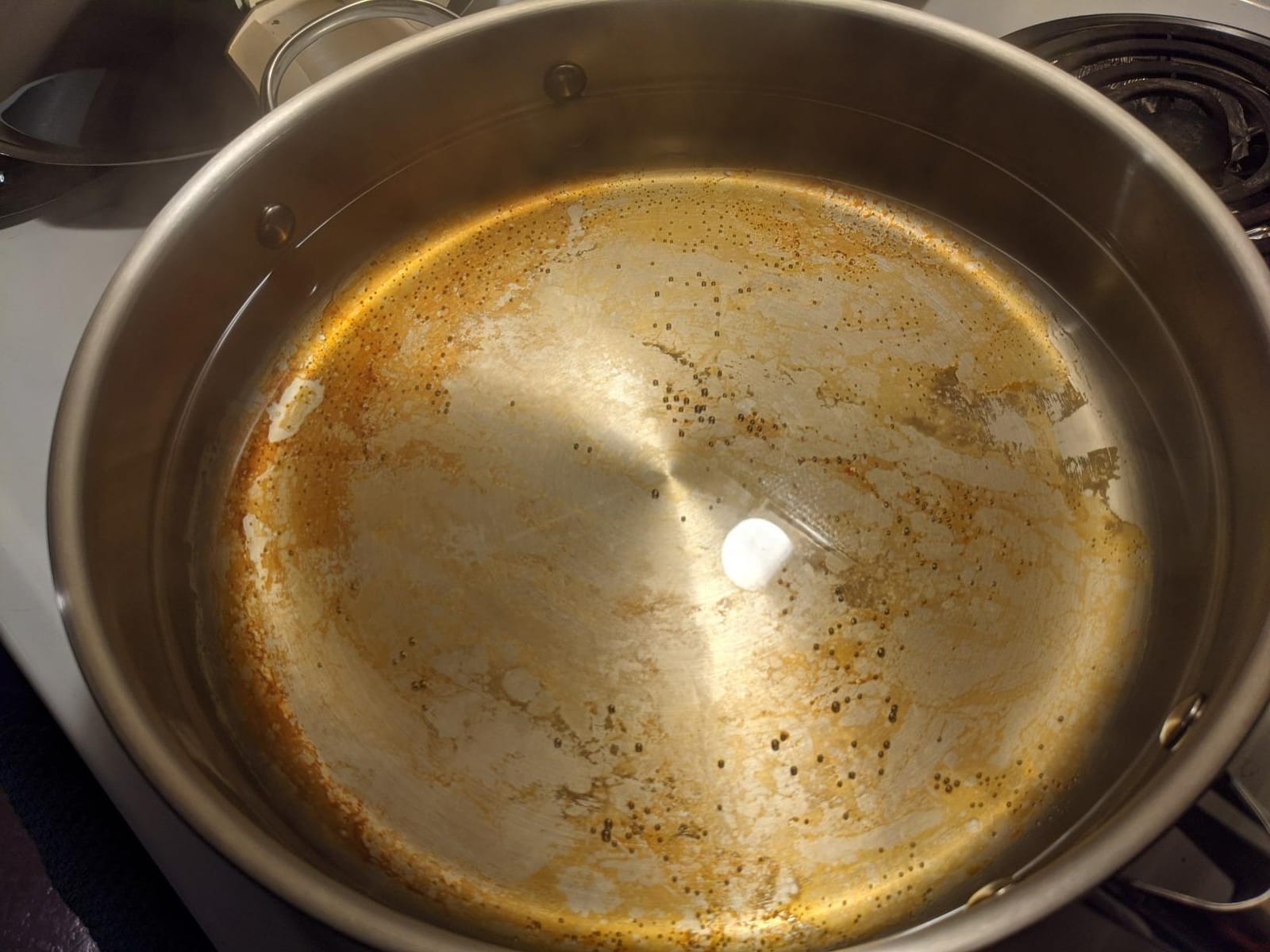
Let it cool before washing. A hot pan hit with cold water warps the base and can crack a glass lid. Ten minutes on the counter is enough.
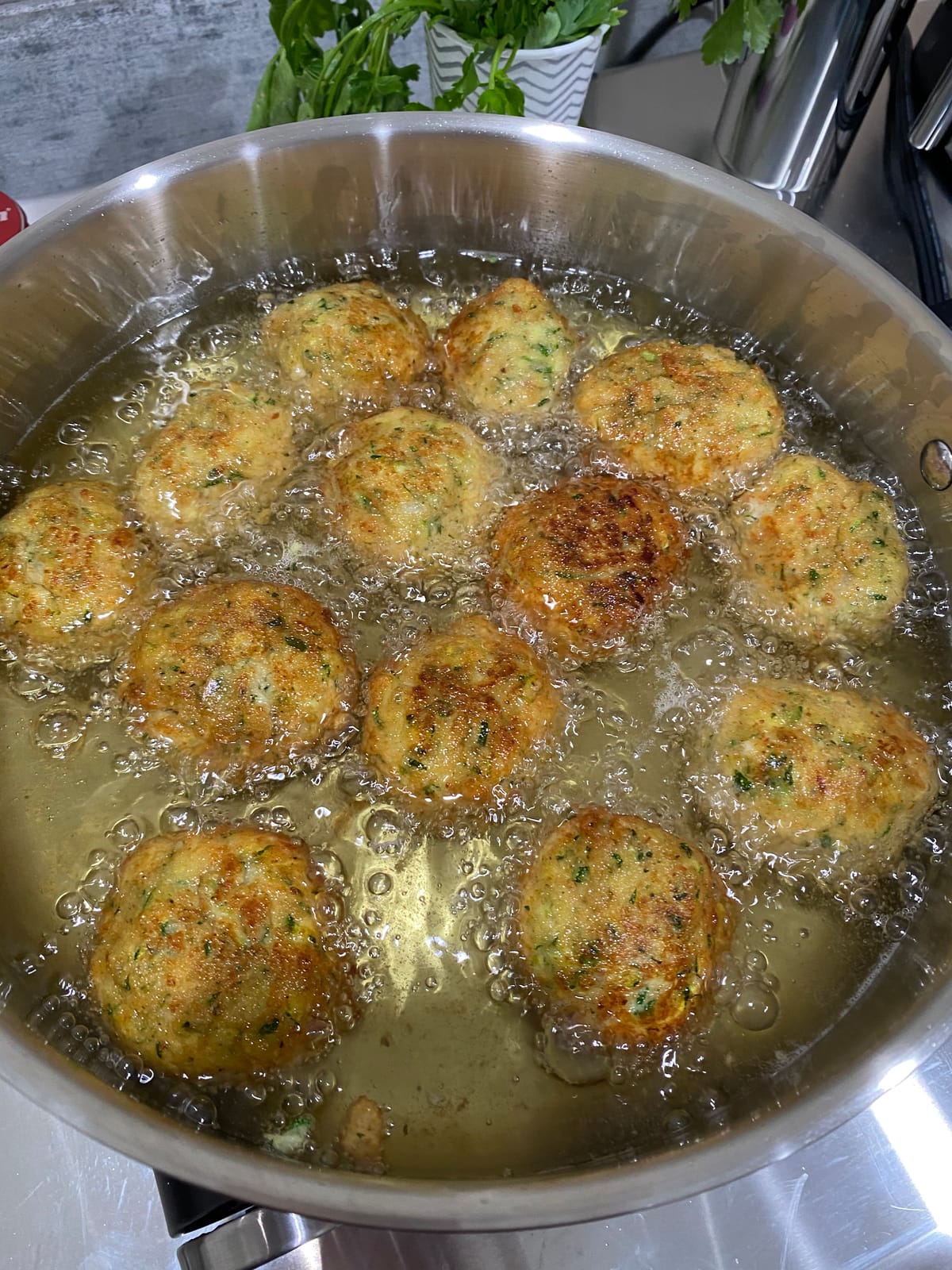
Wash stainless with hot soapy water and a non-scratch pad. A burnt stainless saute pan comes back with a stainless scrubber and a little coarse salt, or a product made for it. Never use steel wool on a coated or ceramic surface.
Hand wash coated pans even when they say dishwasher safe. Dishwasher heat and detergent strip coating faster than stovetop use. Use a wooden or silicone utensil and a soft sponge.
Dry coated and stainless pans on the burner. A minute of low heat evaporates the water that causes spotting and rust.
Oil hybrid and carbon steel lightly after every use. A thin wipe of neutral oil protects the seasoning layer and keeps food release improving rather than degrading.
Do not put a hot pan under cold water, and do not thermal shock ceramic. The coated pans in this roundup are rated for heat, not for shock.
Store coated pans with a layer between them. A cloth or paper towel liner stops scratches from nesting.
Hand wash the All-Clad D3. It is rated hand wash only, along with the SENSARTE, and the tri-ply bonded layers deserve the gentler treatment.
Which Saute Pans to Stay Away From
Most buyers are choosing between good pans, so this section is about the specific failure patterns we saw in reviews rather than bad brands.
Coating with no stated oven limit. If a listing does not tell you the temperature, assume it is lower than you want. Undisclosed limits are the reason people return nonstick pans.
Thin bonded induction plates. A coated aluminum pan with a thin magnetic disc will warp on an induction burner. Look for a thick edge-to-edge steel base instead.
Deep pans with no lid. A 4-inch wall pan without a lid is a simmering pan with a splash problem. Every pick here includes a lid except where noted.
Hybrid coating marketed as fully nonstick. Pans like the SNOWCLAD are only partially nonstick and need fat in the pan. Buying one expecting Teflon behavior ends in disappointment.
Ceramic-coated pans sold as pure ceramic. They are different products with different heat behavior, and the confusion leads to wrong cooking temperatures.
Short handles on a 6-quart pan. If there is no helper handle and no way to grip the opposite wall, a full pan is a burn risk.
Frequently Asked Questions
What is the best saute pan on the market?
For most home kitchens, the best all-around saute pan is the Farberware 6-Quart Jumbo Cooker: 6-quart capacity, a helper handle for lifting when full, a dishwasher-safe nonstick interior and a lifetime warranty. Cooks who want an uncoated pan that lasts decades should look at the Cuisinart 5.5-Quart stainless saute pan, which uses an encapsulated aluminum base and works on induction, gas and electric.
What is the difference between a frying pan and a saute pan?
A frying pan, or skillet, has low sloped sides: it heats fast, releases food easily and is designed so you can slide or toss contents out. A saute pan has straight walls roughly 2 to 4 inches high, which contain splatter and hold liquid for simmering, braising and reducing a sauce. The wide flat base still gives you a full searing surface.
What type of pan is best for sauteing?
For searing specifically, fully clad or bonded tri-ply stainless steel is best, because the aluminum core spreads heat evenly and stays stable at high heat. For gentle sauteing of vegetables or delicate fish, a nonstick or ceramic-coated pan gives easier release with less oil. A hybrid surface such as the HexClad or SNOWCLAD sits between the two.
Should I get stainless steel or carbon steel pans?
Choose stainless steel if you want a pan that works immediately with no seasoning step and tolerates any cleaning method. Choose carbon steel if you want a lighter pan that heats faster and improves with age through seasoning, and you are willing to maintain that patina. Carbon steel is generally not induction compatible and has a steeper learning curve for a first cook.
What is the safest material for a saute pan?
Uncoated stainless steel, cast iron and carbon steel contain no applied coating at all, so they carry no resin or coating ingredients. Among coated pans, look at what is disclosed: the Blue Diamond 5-Quart ceramic pan is advertised as free of PFAS, PFOA, lead and cadmium, and the SENSARTE ILAG surface is free of PFOA, PFOS, lead and cadmium. Avoid heating any coated pan past its stated oven limit.
What size saute pan is best for family meals?
For a family of four, a 4.5 to 5.5 quart pan with a 12-inch cooking surface is the sweet spot: enough depth to simmer and reduce a sauce, and enough width to sear without crowding. One or two people are better served by 3 to 4 quarts. Families of five or six, or anyone who batch cooks, generally want 6 quarts with a helper handle.
Can you use metal utensils on nonstick saute pans?
Only when the manufacturer says so. The Blue Diamond ceramic surface and the HexClad hybrid surface are both rated metal utensil safe, while the Circulon A1 is not metal utensil safe despite its scratch-resistant coating claims. On any other coated pan, use wood, silicone or nylon, since a stray fork or spatula is the fastest way to ruin a coating.
The Verdict: Which Saute Pan Should You Buy in 2026
The best saute pans for home kitchens in 2026 come down to capacity and heat discipline. The Farberware 6-Quart Jumbo Cooker is the pick for most households, because 6 quarts, a helper handle and a lifetime warranty solve the batch-cooking problem without any technique change. The Cuisinart 5.5-Quart stainless pan is the better value over a decade, since there is no coating to wear out and it works on induction. The Blue Diamond 5-Quart ceramic pan is the choice if you want a PTFE-free coating that still releases like nonstick.
Check your cooktop before you commit, weigh the empty pan against your own lifting comfort, and read the stated oven limit rather than the marketing. Those three checks eliminate almost every bad purchase in this category, and any of the ten pans here will serve you well once they pass.