

Most window air conditioner roundups stop at 10,000 BTU and call a 450 square foot living room large. That advice leaves a real gap, because the rooms people actually fight to cool in July are the 600, 900 and 1,200 square foot ones with tall ceilings, west-facing glass and a couch parked thirty feet from the outlet. This roundup covers ten large-room window units, from a 10,000 BTU U-shaped model rated for 450 square feet to a 24,000 BTU 230V inverter rated for 1,500, and it sorts them by the room they are actually built to cool.
The core problem with an undersized window AC is not that it fails. It is that it half-works, blasting freezing air at the wall it is bolted to while the far corner of the room stays warm and damp. Owners on r/AirConditioners describe exactly this pattern repeatedly: the compressor runs nonstop, the bill climbs, and nobody in the room is comfortable. A unit that is right for the space reaches temperature, then idles, and the far side of the room comes along with the rest.
The other half of the failure is over-sizing. A unit with far more capacity than the room needs cools the air fast but cycles it off before enough moisture has been pulled out, which is why oversized rooms often end up cool and clammy rather than cool and dry. Getting between those two mistakes is what the buying guide below is for: a 20 BTU per square foot starting point, adjustments for sun and ceiling height, and a plain look at whether your window and your electrical circuit can take the unit you want.
We worked through every spec sheet below rather than trusting the marketing line. That means the rated square footage, the noise figure, the voltage, the seasonal efficiency rating and the shipping weight, all taken as published, and the customer reviews read for the failure patterns that do not show up in a brochure. Where reviewers report a real problem, such as units that run without cooling, we say so. If you want the short version, the top three picks are below; if you want the reasoning, the full breakdowns follow in size order.
Table of Contents
Top 3 Picks for Large Rooms (October 2026)
The Midea U-shaped inverter takes the top spot because it is the only unit in this group that solves three large-room problems at once: it runs at about 32 dBA so the far end of the room is not competing with compressor noise, its U-shaped chassis lets the sash close instead of leaving a wide gap of outside air, and its variable-speed compressor ramps down instead of hard cycling. It is not the biggest unit here. It is the one most rooms do not have to work around.
The Windmill 10,000 BTU earns the premium slot on efficiency and airflow design rather than on ratings. Its SEER of 17 is the highest figure in this roundup, and its dual intake directs air upward at roughly 45 degrees so the cold stream travels across the ceiling and down instead of blasting the nearest chair. It also carries by far the largest review base at 1,725 ratings, which makes its warranty and reliability complaints easier to read clearly.
The Della 12,000 BTU is the value pick for anyone whose room lands between 500 and 550 square feet. It adds Wi-Fi, Alexa control, a dry mode and a sleep mode at a lower entry point than the premium brands, and reviewers consistently report it cooling the full rated area.
Best Window Air Conditioners for Large Rooms in 2026: Quick Comparison
The table below is the fastest way to match a room to a unit. The right-hand column is ordered the same way as the full reviews, from the quietest general-purpose pick down to the only whole-floor model here. Every figure is the manufacturer’s published rating, so you can compare the numbers directly instead of comparing brand names.
| Product | Specs | Action |
|---|---|---|
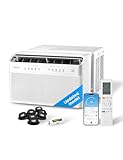 Midea 10,000 BTU U-Shaped Smart Inverter Midea 10,000 BTU U-Shaped Smart Inverter |
|
Check Latest Price |
 ROVSUN 12,000 BTU with Heat, 230V ROVSUN 12,000 BTU with Heat, 230V |
|
Check Latest Price |
 Della 12,000 BTU Smart Window AC Della 12,000 BTU Smart Window AC |
|
Check Latest Price |
 GE 10,000 BTU Wi-Fi Window AC GE 10,000 BTU Wi-Fi Window AC |
|
Check Latest Price |
 Midea 12,000 BTU with Heat Midea 12,000 BTU with Heat |
|
Check Latest Price |
 LG 10,000 BTU Wi-Fi Window AC LG 10,000 BTU Wi-Fi Window AC |
|
Check Latest Price |
 GE 12,000 BTU Wi-Fi Window AC GE 12,000 BTU Wi-Fi Window AC |
|
Check Latest Price |
 ROVSUN 10,000 BTU Inverter ROVSUN 10,000 BTU Inverter |
|
Check Latest Price |
 Windmill 10,000 BTU WhisperTech Windmill 10,000 BTU WhisperTech |
|
Check Latest Price |
 Midea 24,000 BTU Smart Inverter 230V Midea 24,000 BTU Smart Inverter 230V |
|
Check Latest Price |
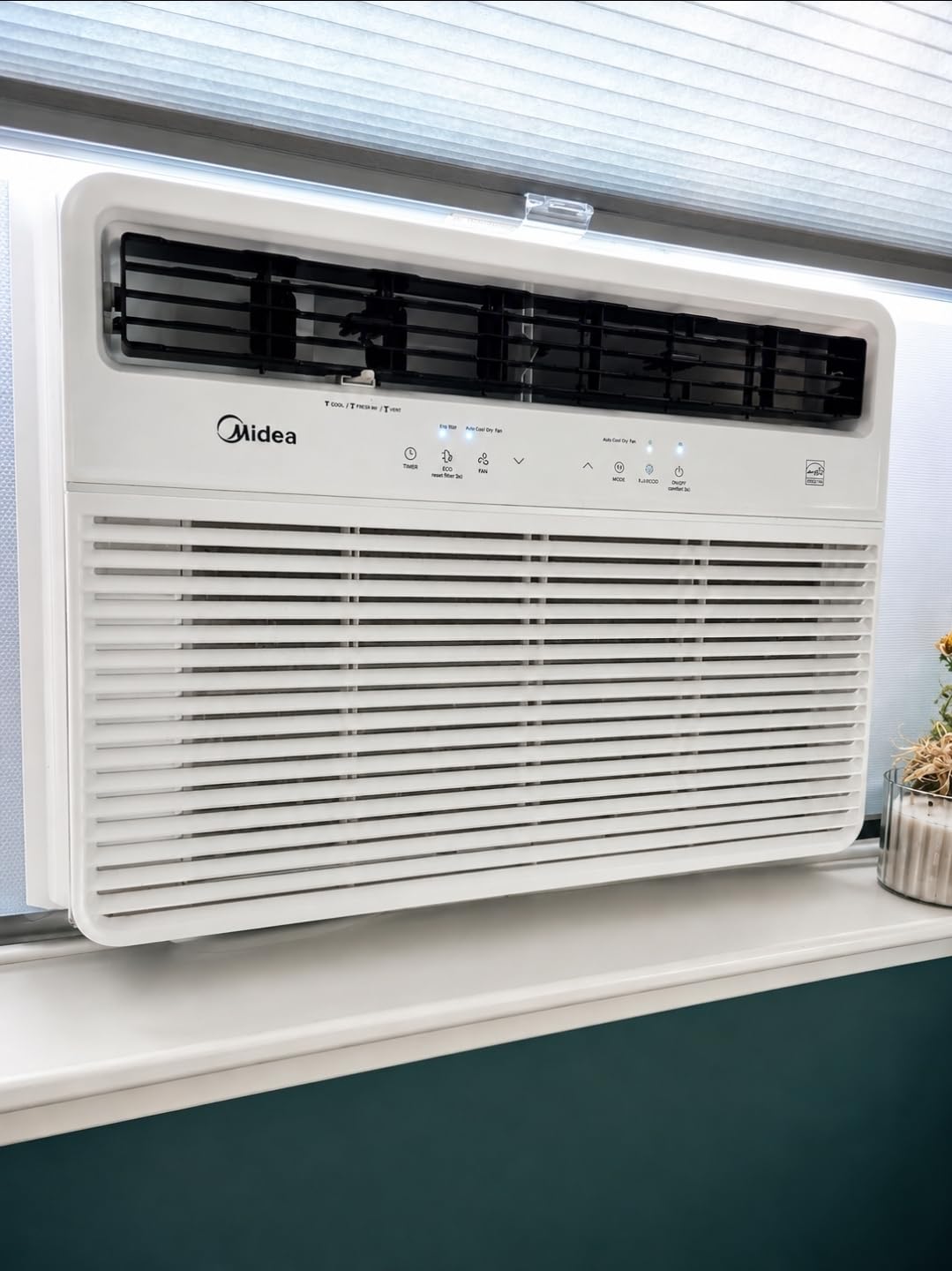
1. Midea 10,000 BTU U-Shaped Smart Inverter (MAW10V1QWT) – Best Overall for Large Rooms
Midea 10,000 BTU U-Shaped Smart Inverter Window AC, Cools 450 Sq Ft, Ultra Quiet, Alexa/Google Compatible, 35% Energy Savings
10000 BTU
450 sq ft
32 dBA
115V
SEER 15
56.9 lb
Pros
- Quietest running unit in the roundup at about 32 dBA
- U-shaped chassis lets the window stay open
- Inverter compressor ramps down instead of hard cycling
- ENERGY STAR certified with SEER of 15
- Window bracket and remote included
Cons
- Heaviest handling burden relative to size at about 57 lb
- Finicky in side-sliding or older sash windows
- Minority of owners report startup rattle
This is the unit we keep coming back to, and the reason is not raw capacity. It is the 32 dBA figure, which is far below anything else in this group and low enough that the compressor is not the loudest thing in a large room. Buyers describe it as silent rather than quiet, and the SEER of 15 with an ENERGY STAR certification means the running cost sits well below the conventional units here.
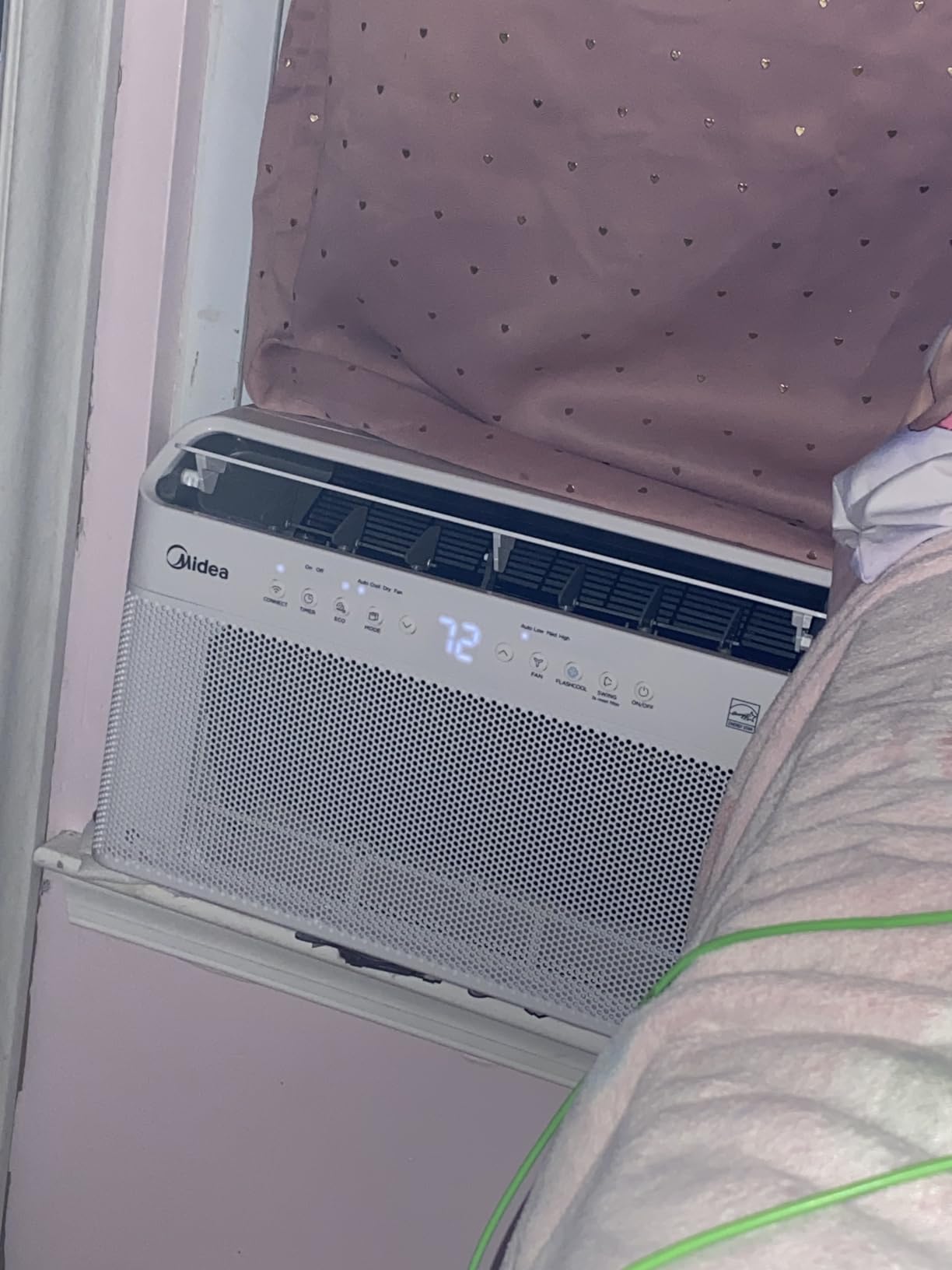
The U-shaped chassis is the feature that matters most in a big room, and it is a design decision rather than a gimmick. A conventional window unit leaves the sash propped open on a wide gap, which pulls in hot outside air and lets street noise in. The side-hung design lets the window close down over the unit, so the sealed gap is much narrower. On r/AirConditioners, Midea’s U-shaped line is widely treated as the reference window AC for exactly this reason: comparable power and design quality to models costing far more.
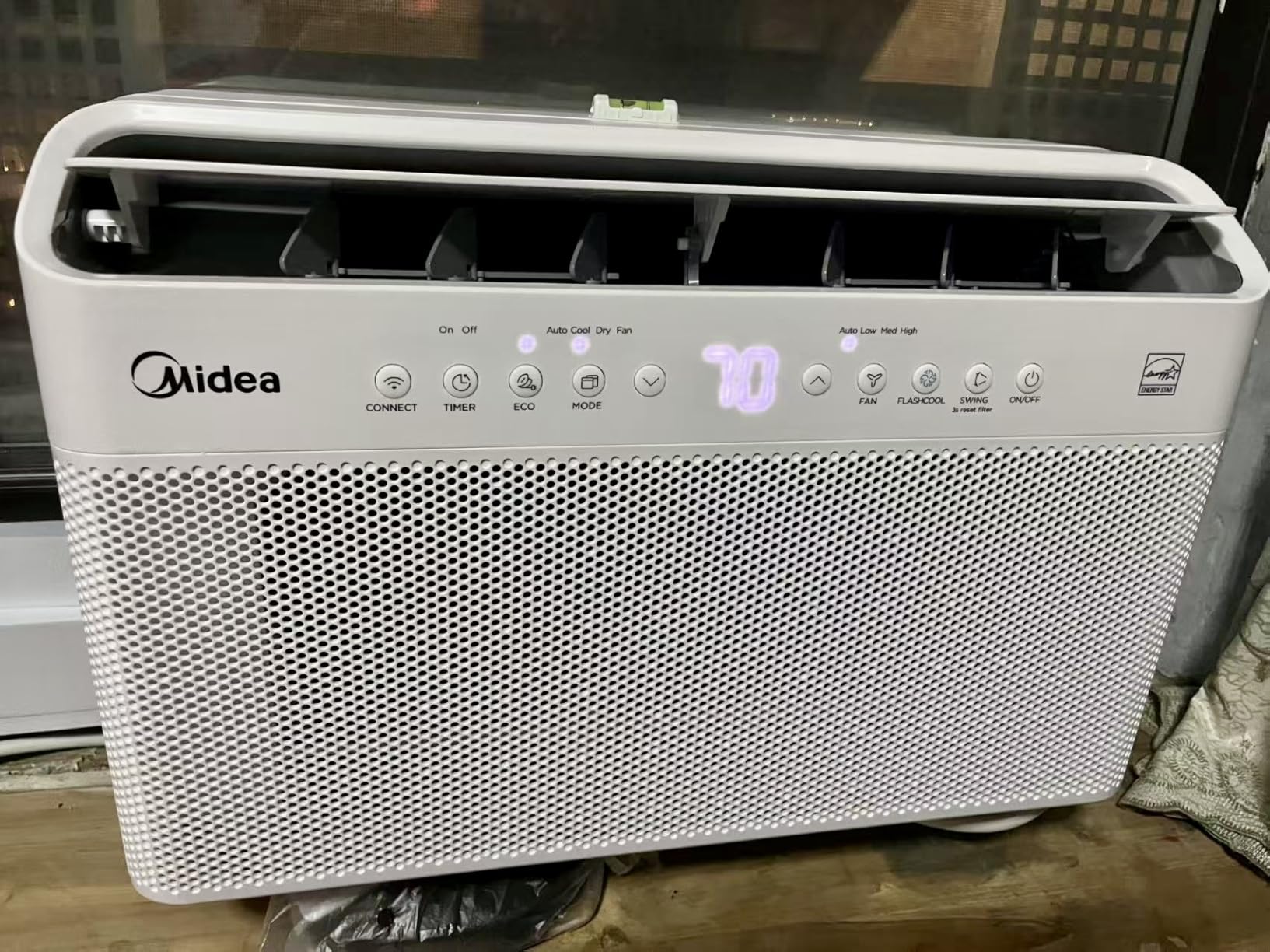
Cooling output is steady rather than aggressive, and that is a feature in a shared space. Several owners report it cooling rooms larger than the rated 450 square feet, particularly open-plan rooms where the living and dining areas are one volume. The inverter compressor is the reason it can do that without running continuously, since it modulates output rather than switching fully on and off.
Control options cover the bases: app, remote, touch panel and voice assistants. The window opening range is generous at a 22 inch minimum width and a 13.75 inch minimum height, with a maximum of 36 by 36 inches, so it fits more window types than most conventional chassis in this class. The warranty is two limited years, which is longer than the one-year term most competitors in this roundup carry.
What to check before you buy the Midea U-Shaped
Measure your window first. The unit needs a 22 inch wide opening at minimum and 13.75 inches of clear height, and side-sliding or historic sash windows sometimes need custom spacers to make the U-shape sit square. Owners of older homes report the install takes more patience here than with a conventional box, so budget extra time or a second person.
Plan for two people on install day. At 56.9 pounds the unit is manageable solo, but it has to be held level in the opening while the bracket is fitted, and the bracket is what stops it falling later. Anything above the ground floor should be bracketed without exception, and that is a fifteen-minute job compared with the cost of a unit dropping several storeys.
Where the Midea U-Shaped falls short
It is rated for 450 square feet, so a 700 square foot room needs one of the 12,000 BTU models further down this list. It is also the wrong choice if you want heat, since this chassis is cooling only. And a small but persistent group of owners report an intermittent rattle after startup that appears on some production runs.
Earlier production units of the U-shape were affected by a recall involving the drain kit, and reviewers still flag drain plug removal as a required install step. If you buy today, check that the unit ships with the drainage fix rather than assuming every run is identical.
2. ROVSUN 12,000 BTU 4-in-1 with Heat, 230V – Best for Heating and Cooling on a 230V Circuit
ROVSUN 12000 BTU Air Conditioner Window Unit with Heat, 4-in-1 Window AC Unit Cooler, Heater, Dehumidifier & Fan with Timer, Remote Control & Installation Kit for Rooms up to 550 Sq. Ft, 208/230V
12000 BTU
550 sq ft
63 dB
208/230V
82.6 lb
SEER 10.9
Pros
- Cools up to 550 sq ft and adds supplemental heat for shoulder seasons
- Four functions in one cabinet covering cooling heating dehumidify and fan
- Remote plus LED digital panel with 24-hour timer and ECO mode
- Side panels and mounting hardware included
Cons
- Requires a 208/230V circuit rather than a standard household outlet
- About 83 lb makes it one of the heavier 12000 BTU boxes
- SEER of 10.9 is the lowest efficiency here
- Louder than the inverter alternatives
This is the only unit in the roundup that heats as well as cools at 12,000 BTU, rated at 11,000 BTU of heating capacity with a lower 9,000 BTU setting. For a room used in the shoulder seasons, that single feature can justify the whole purchase, and it covers a full 550 square feet on the cooling side.
The 4-in-1 layout bundles cooling, heating, dehumidification and fan into one cabinet, with a temperature range of 61 to 88 degrees Fahrenheit. Modes include auto, fan, ECO and a 24-hour timer, all reachable from the remote. Buyers frequently single out the included side panels and mounting hardware as the reason assembly took less time than expected.
There is a real cost to the versatility, and it comes on the electrical side. This unit runs on 208/230V, which in most homes means a dedicated circuit and possibly an electrician, and it is not a standard household plug situation. The 10.9 SEER is the lowest in this group, so a full summer of daily use costs more than an inverter of similar capacity.
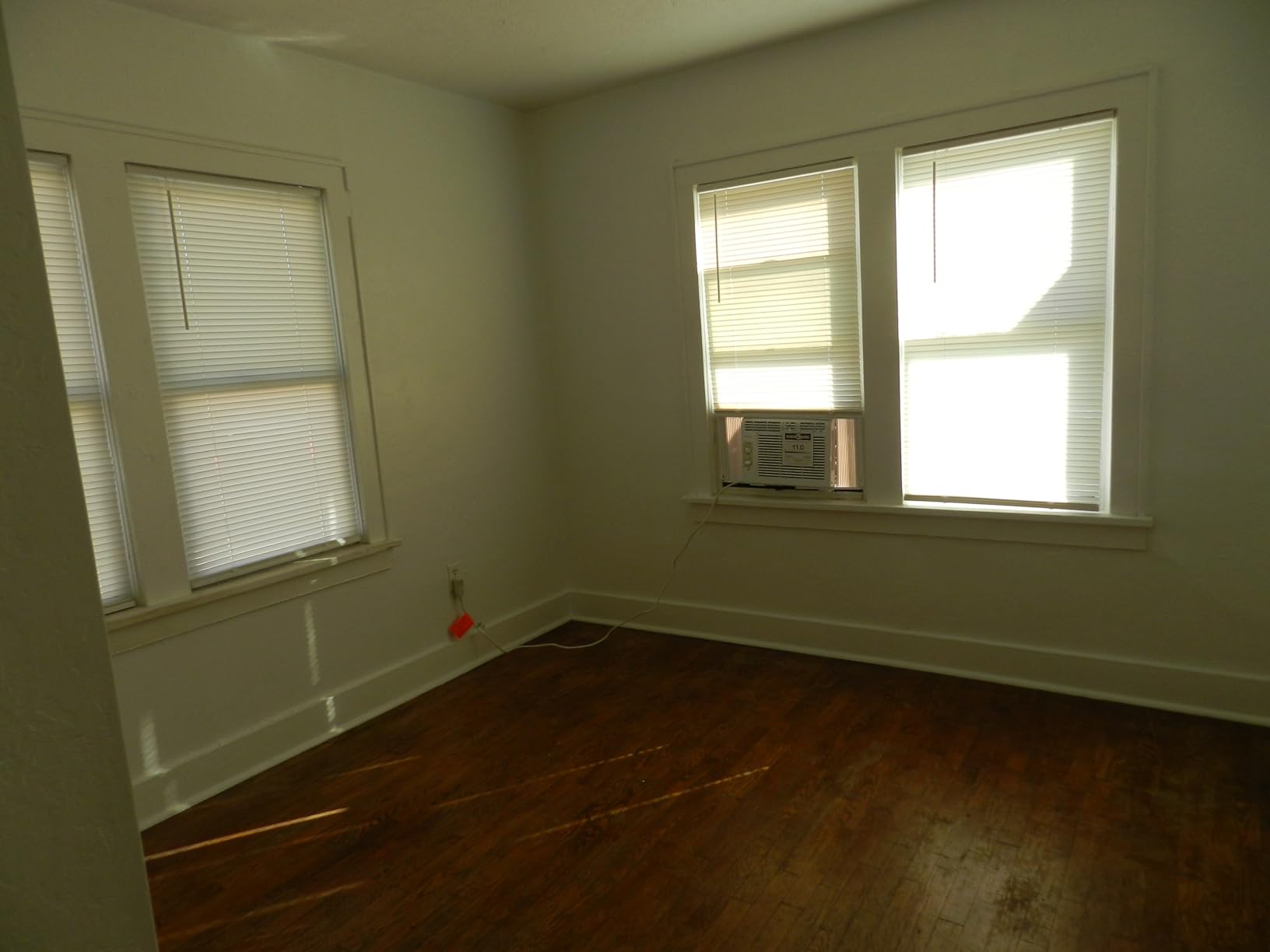
At 82.6 pounds it is one of the heavier boxes here, and installation is a genuine two-person job. Window fit needs 23 inches of width and 14.5 inches of height at minimum, with a maximum of 34 by 16 inches, so the vertical clearance is tighter than the width allowance suggests. On an upper floor, bracket first, then the unit.
What to check before you buy the ROVSUN 12,000
Confirm you have a 208/230V circuit before anything else, because this is the one requirement that can stop the project. If your electrical panel cannot take it, the honest alternative is the Midea 12,000 further down, which cools the same 550 square feet on a 115V plug. Check the window height too, since 14.5 inches of clear opening is the real constraint in older homes.
Weigh the heat function honestly. This is supplemental heat, not a primary system, and it is intended for the weeks in spring and autumn when a full furnace is overkill. Anyone planning to use it as the only heat source through winter will be disappointed.
Where the ROVSUN 12,000 falls short
The 63 dB rating is loud, and it is the kind of loud you notice in a quiet room at night. If the bedroom is the target rather than a living area, the 45 dB and 42 dB models below are better choices. The 10.9 SEER also means it works harder for the same cooling, which shows up on a monthly bill.
Its non-inverter compressor cycles rather than modulates, so you will hear it start and stop during a long afternoon. That cycling is also what makes it less efficient than the inverter units at the same capacity.
3. Della 12,000 BTU Smart Window AC (048-TL-W12KWD) – Best Value for 500-550 Square Feet
DELLA 12000 BTU Smart Window Air Conditioner, Works with Alexa and WiFi, Cools Up to 550 Sq. Ft, GEO Location, Energy Saving AC Unit with Smart Controls, Remote, Dehumidifier, Reusable Filter
12000 BTU
550 sq ft
56 dB
115V
CEER 10.9
63.7 lb
Pros
- 12000 BTU on a standard 115V household plug
- Built-in Wi-Fi with Della+ app and Alexa voice control
- Dry mode for humid rooms plus sleep mode and ECO mode
- Reusable filter and full installation kit in the box
- Quieter than most 12000 BTU units at about 56 dB
Cons
- CEER of 10.9 is modest for the 12000 BTU class
- Less established brand with thinner brand recognition
- Window fit limited to 26-36 inches wide and 16 inches tall
- Smart features add setup steps
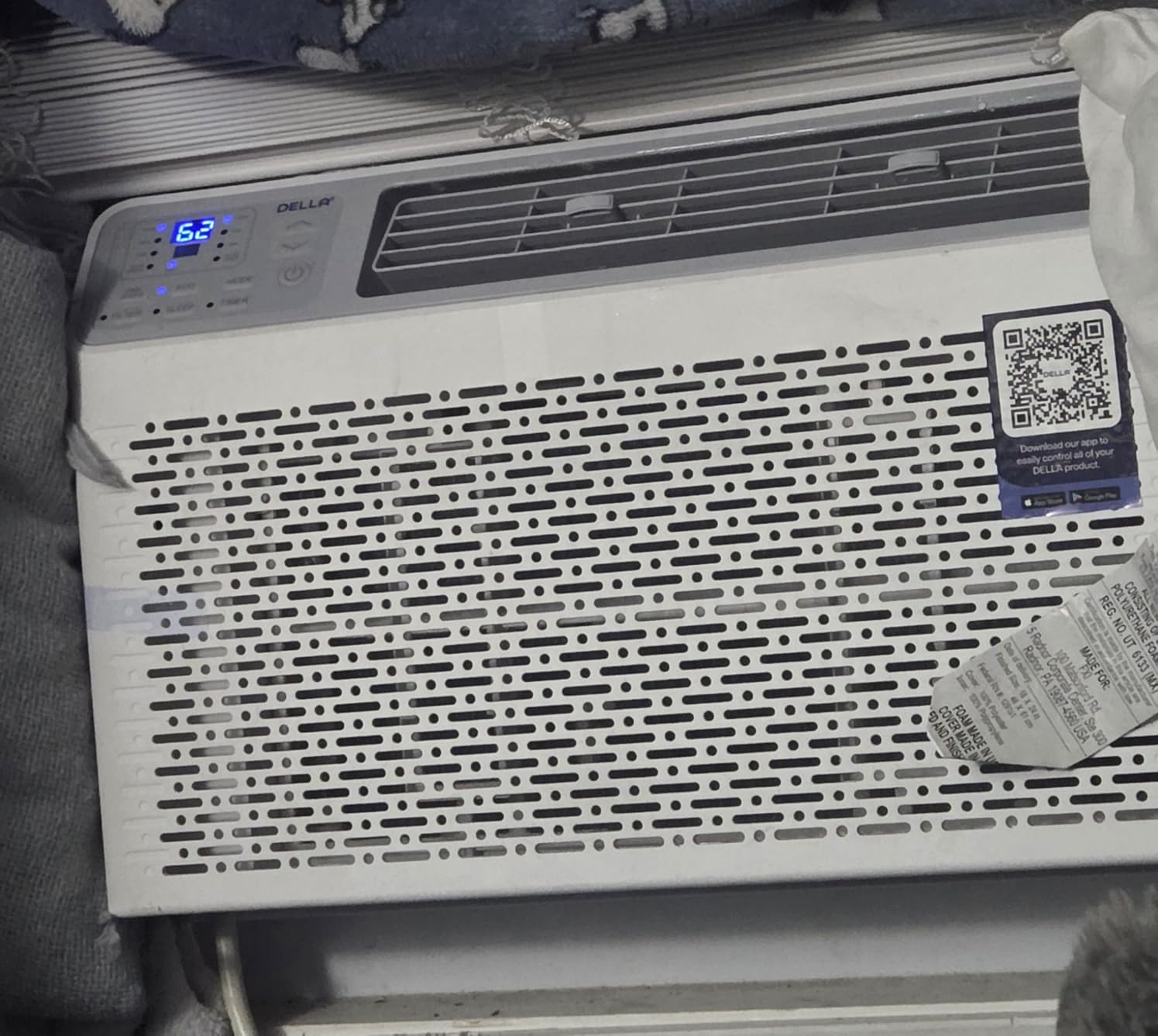
The Della is the value pick because it puts 12,000 BTU on a standard 115V outlet with app control attached, and reviewers generally confirm it cools the full rated 550 square feet. That combination is not cheap, but it is lower than the premium-brand alternatives at the same capacity, and the feature list is longer than the price would suggest.
At 56 dB it runs noticeably quieter than most 12,000 BTU units, including several from brands with larger names. Three fan speeds sit alongside auto, cool, fan and dry modes, plus a 24-hour timer, sleep mode and an ECO setting. The dry mode is the feature humid-climate buyers mention most, since it pulls moisture without dropping the room temperature as far as cooling does.
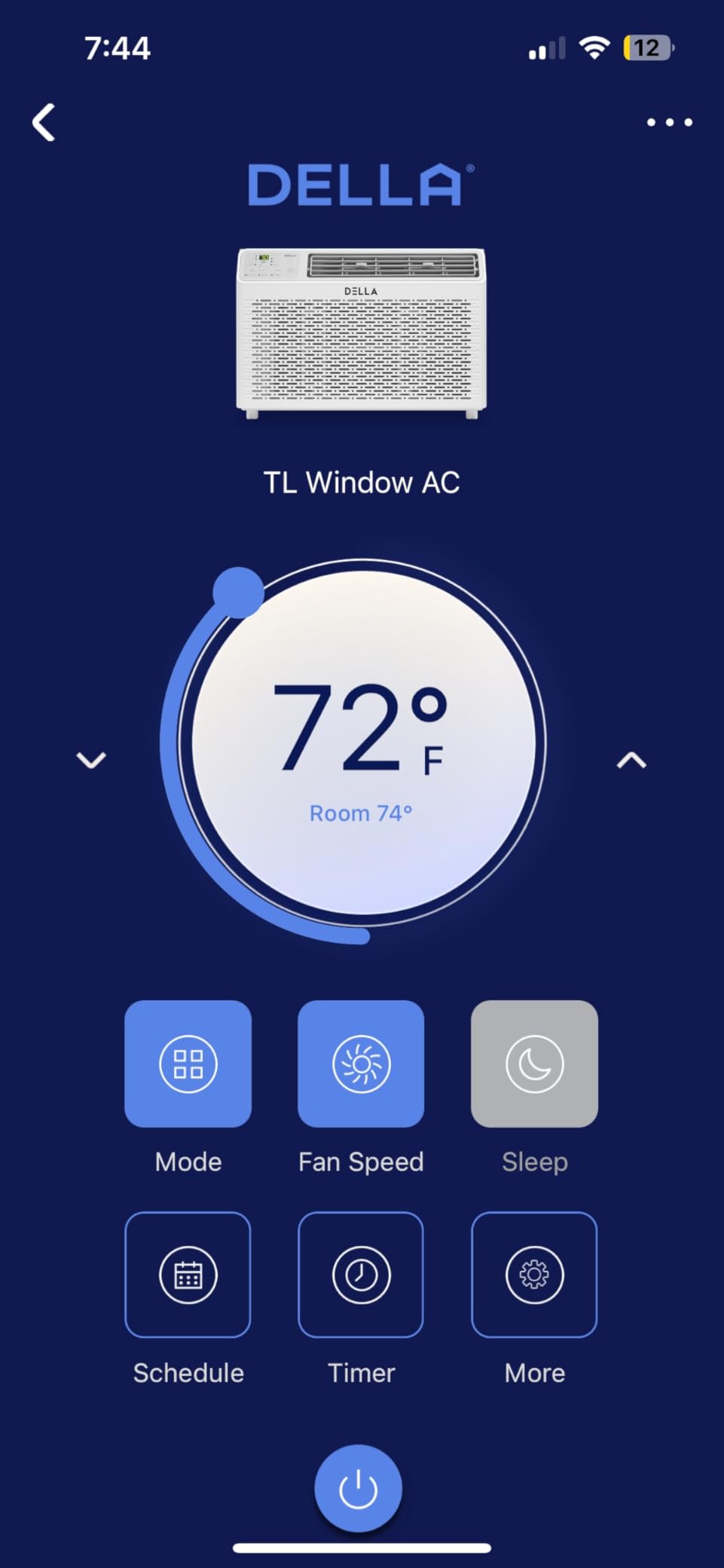
Smart control covers Wi-Fi, the Della+ app and Alexa, with GEO location that switches modes automatically when you leave. Installation kit and reusable filter are both in the box, which removes the most common reason a first window unit install goes wrong. The compressor is a rotary scroll with R-32 refrigerant, and the unit is UL listed.
The trade-offs are efficiency and window tolerance. CEER of 10.9 is a modest number that puts running cost in the middle of this group rather than the bottom. The fit requirement is also restrictive: 26 to 36 inches of window width and a minimum height of 16 inches, which rules out plenty of shorter windows that a conventional 12,000 BTU box would accept.
What to check before you buy the Della 12,000
Measure the window opening carefully against the 26 inch minimum width and 16 inch minimum height. This is the single most common reason a unit gets returned, and it is a hard limit rather than a guideline. If your window is narrower, the 10,000 BTU models in this roundup will fit where this one will not.
Decide how much the app matters to you. Smart control is genuinely useful for a room you use on a schedule, and r/Apartmentliving threads show plenty of people weighing auto mode against fixed settings precisely because scheduling changes the running cost. If you would rather press a button, the remote covers every function and the app is optional.
Where the Della 12,000 falls short
CEER of 10.9 means higher summer energy use than the inverter models here, and the difference shows up over weeks of daily running. Build quality and brand recognition trail the major appliance names, which matters mainly when something goes wrong and you need a part or a service answer.
Setup adds steps. The app pairing and voice assistant configuration are reported as a fiddly first afternoon, and the physical controls are functional rather than refined. Anyone who wants the smoothest smart-home experience should look at the Midea or GE models instead.
4. GE 10,000 BTU Wi-Fi Window AC (AHEK10AC) – Best for Big-Brand Support
GE Window Air Conditioner 10000 BTU, Wi-Fi Enabled, Energy-Efficient Cooling for Medium Rooms, 10K BTU Window AC Unit with Easy Install Kit, Control Using Remote or Smartphone App
10000 BTU
450 sq ft
63 dB
115V
58 lb
3 speeds and ECO
Pros
- Major brand with broad service-part availability
- Slide-out washable filter with a simple 30-day cleaning habit
- EZ Mount kit fits standard double-hung windows
- Remote has large readable buttons
- ECO mode genuinely cuts compressor runtime
Cons
- SmartHQ app can lose the set temperature and revert to 68F
- Limited smart-home integration with no HomeKit support
- Internal foam glow is visible at night
- 63 dB is loud against premium inverter units
The GE wins on one thing that never shows up in a spec sheet: if the unit needs a part in five years, GE is a company that will still be there. That matters more than most buyers expect for an appliance installed through a window and left in place for a decade, and it is the reason this model earns a place in a large-room roundup despite being a 10,000 BTU unit.
It covers 450 square feet, which suits a large bedroom, a den or the middle of an open plan where a second unit will handle the rest. The slide-out washable filter is a genuinely good design choice, with a 30-day cleaning interval that is easy to keep, and the remote has oversized buttons that reviewers with arthritic hands single out as unusually easy to use.
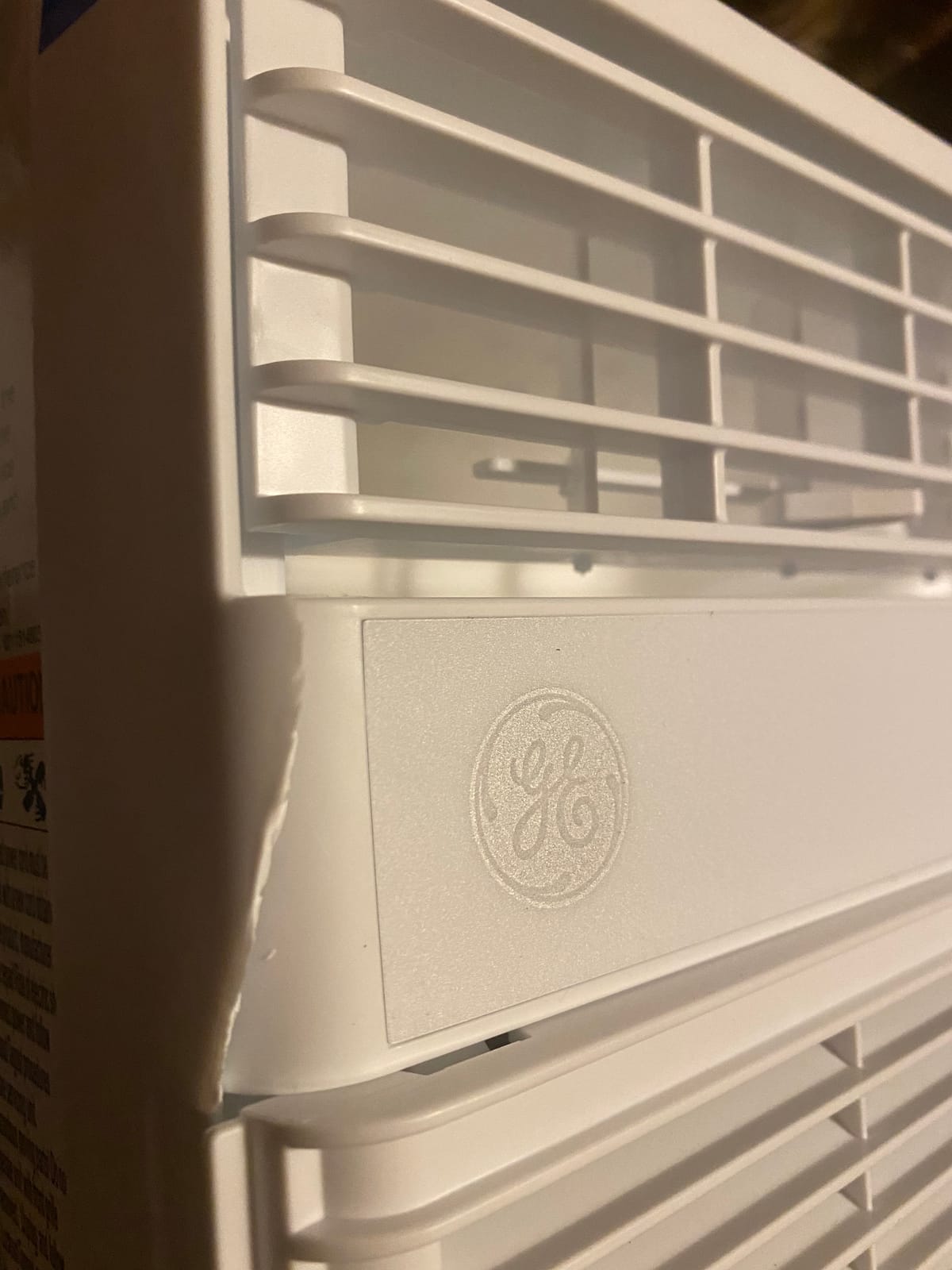
Control runs through the SmartHQ app, Alexa or Google Assistant, with scheduling and monitoring, and the unit runs on a standard 115V outlet at 865 watts. The EZ Mount installation kit targets double-hung windows 25 to 36.625 inches wide with a 14.563 inch height, which covers a lot of standard housing stock. At 58 pounds it is a comfortable two-person lift.
Two details work against it. The compressor is conventional rather than inverter, so it cycles on and off and runs at 63 dB, which is loud beside the Midea U-shaped and the Windmill. And the app has a well-documented problem where it drops the set temperature and reverts to 68 degrees, which is annoying enough that a fair number of owners simply use the remote.

What to check before you buy the GE 10,000
Check the window width against the 25 inch minimum and the 14.563 inch height requirement. Because this is a fixed chassis rather than a U-shape, older or unusual sash windows are more forgiving, but vertical clearance is still the constraint. Measuring before you order saves a return.
Decide whether you will use the app at all. If smart control is a headline feature for you, the app reliability issue matters. If you mainly want scheduling and occasionally a temperature change, the remote handles it and you lose nothing by ignoring the Wi-Fi setup.
Where the GE 10,000 falls short
At 63 dB it is not a bedroom unit. In a sleeping room the compressor is loud enough to interrupt rest, and the non-inverter cycling means it starts and stops audibly through the night if left on low.
The smart-home integration is thin. There is no HomeKit support and the IFTTT integration is described as very restricted, so anyone with an Apple home or an established automation setup will find it limiting. The bright internal glow from the white foam insulation is also reported as distracting in a dark room.
5. Midea 12,000 BTU with Heat (MAW12HV1CWT-A) – Best for 115V Heating and Cooling Together
Midea 12,000 BTU Window Air Conditioner with Heat, 550 Sq Ft
12000 BTU
550 sq ft
45 dB
115V
CEER 13.3
58 lb
Pros
- Cools 550 sq ft and adds a heat pump for fall and spring
- 45 dBA inverter operation suits bedrooms and calls
- ENERGY STAR certified with CEER of 13.3
- Standard 5-15P household plug with app remote touch and voice control
- App remote and touch panel all supported
Cons
- Heat pump stops working below about 41-45F outdoor
- Heavy enough that solo installation is difficult
- Wi-Fi setup can be fussy with flashing error codes
- Manual has no error code list
This is the unit we would put in a large bedroom or a home office, because 45 dBA at 12,000 BTU is a combination nothing else in this roundup matches. It cools the full rated 550 square feet, runs quietly enough to sleep beside, and adds a heat pump function so the room is usable in the shoulder months without a separate space heater.
The efficiency numbers are strong. CEER of 13.3 with an ENERGY STAR certification and an annual consumption figure of 676.7 kWh put running cost well below the conventional 12,000 BTU units in this list, and the inverter compressor is what delivers it. Modes cover five settings with three speeds, a 24-hour timer, an ECO energy saver and a swing louver.
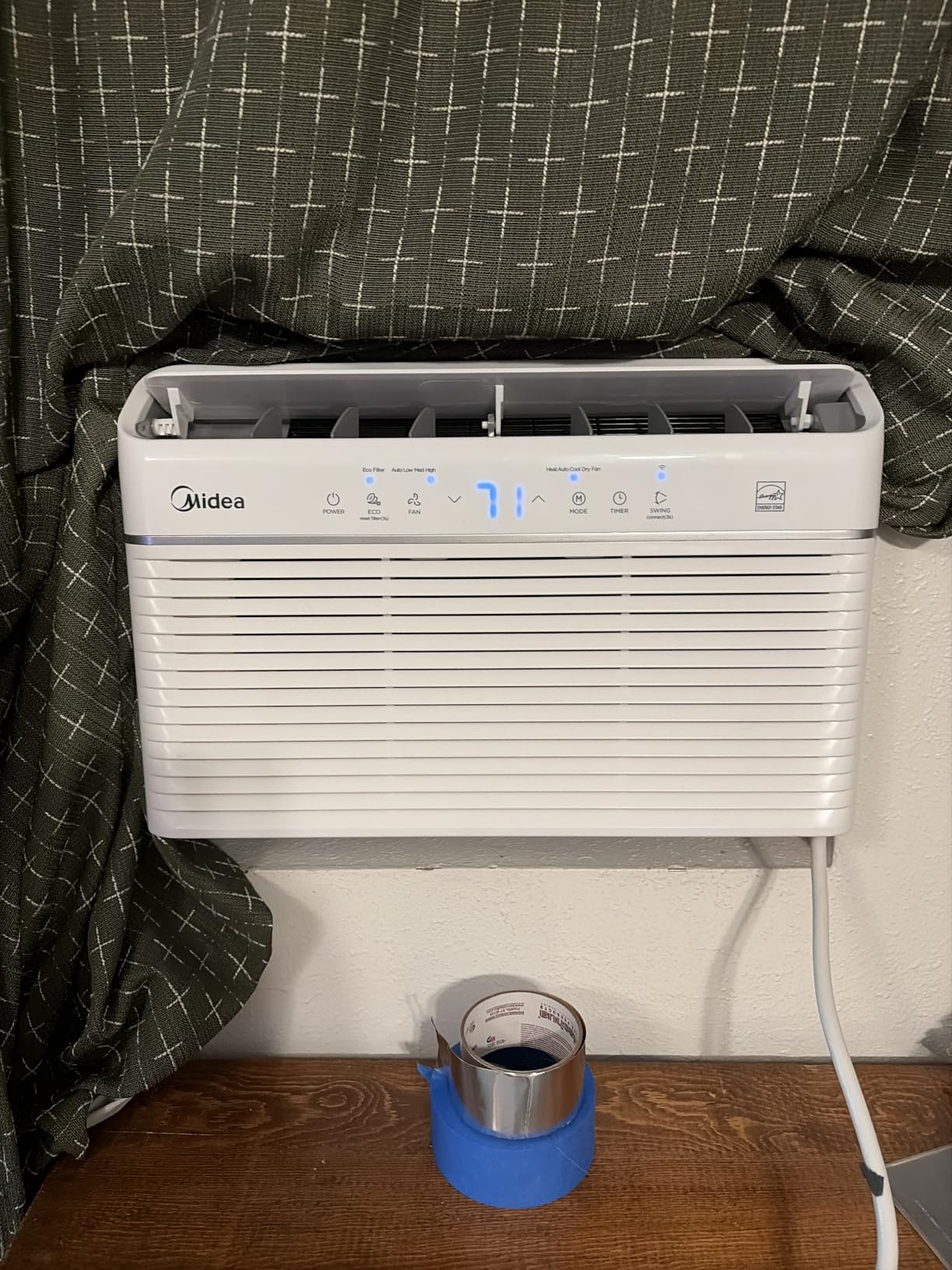
It fits double-hung windows 24 to 38.5 inches wide with a 14.5 inch clear vertical opening, which is one of the more generous width ranges here, and it uses a standard household plug rather than a 230V circuit. That last point is why it outranks the ROVSUN 12,000 for most people: the same cooling capacity without the electrical upgrade.
The heat function has a genuine limit. It does not operate below roughly 41 to 45 degrees Fahrenheit, so it is not a cold-weather heater by any stretch. Owners also report that Wi-Fi pairing can fail with flashing error codes and that the manual contains no error code list, which is a bad combination when something stops responding.
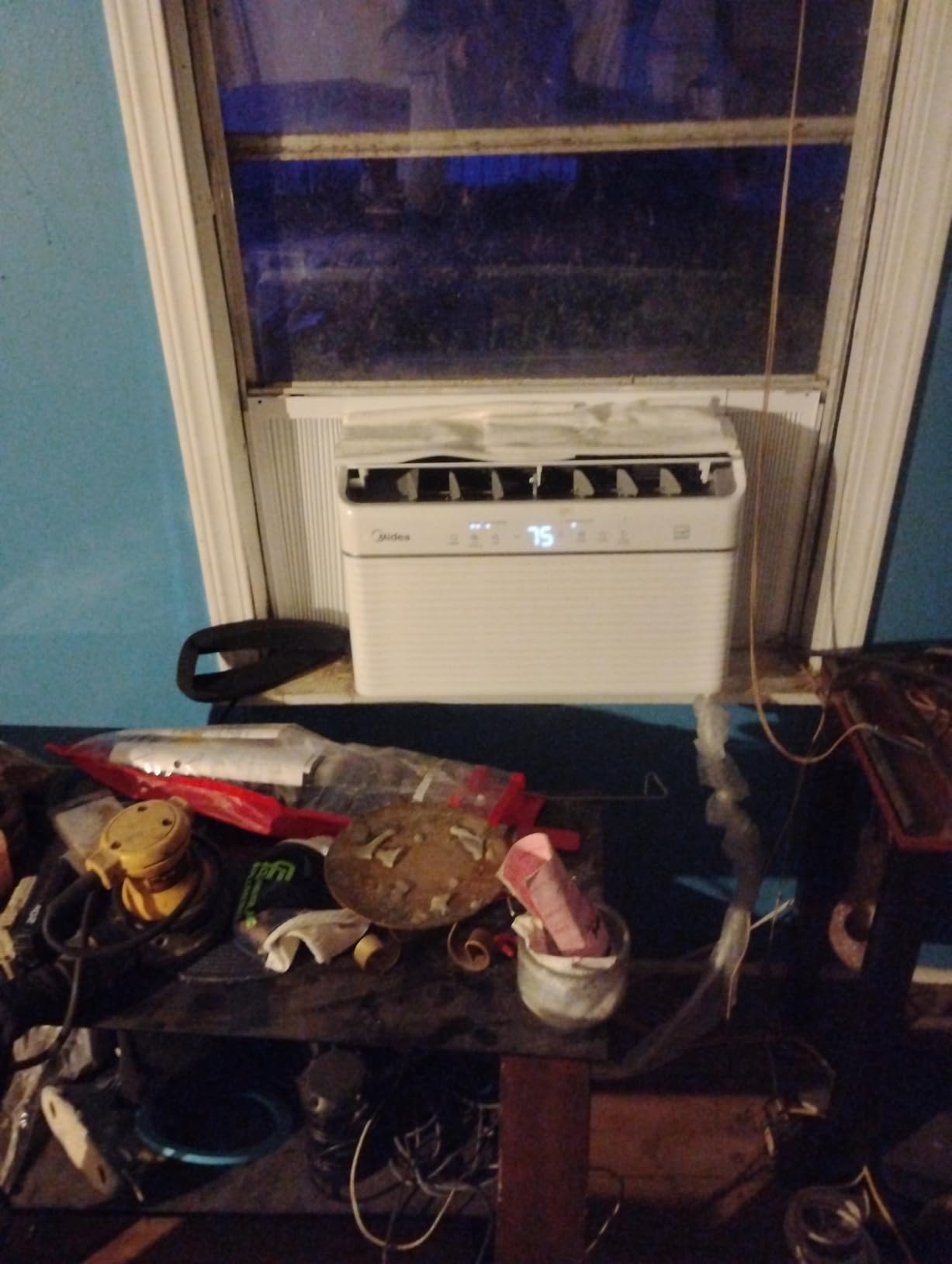
What to check before you buy the Midea 12,000
Confirm your window gives you 14.5 inches of clear vertical opening and 24 inches of width at minimum. The 38.5 inch maximum width is unusually accommodating, so this unit fits more double-hung windows than most of its capacity class, which makes it a safer pick in a house with unusual sash sizes.
Plan the install for two people. At 58 pounds with a fixed chassis, the lift is manageable but the timing of the bracket matters. A support bracket rated for the weight is the single most useful thing you can add on an upper floor, and it should go in before the unit rather than after.
Where the Midea 12,000 falls short
Buyers buying it primarily for heat are likely to be disappointed in deep winter, because the heat pump cuts out below about 41 degrees. Treat the heating function as a shoulder-season bonus, not a heating system, and size your primary heat accordingly.
The app is the weak point. Pairing failures, flashing error codes and a manual with no troubleshooting list mean that when the smart features misbehave, you are left searching online. Budget an hour for setup and keep the remote as your fallback.
6. LG 10,000 BTU Wi-Fi Window AC (LW1017ERSM1) – Best Budget Pick
LG 10000 BTU Window Air Conditioners [2023] Remote Control WiFi App Ultra-Quiet Washable Filter Cools 450Sq.Ft for Medium & Large Room AC Unit air conditioner Easy Install White LW1017ERSM1
10000 BTU
450 sq ft
52 dB
115V
SEER 11.4
57.3 lb
Pros
- Lowest entry cost among the 10 units in this roundup
- 52 dB is quiet for a conventional 10000 BTU compressor
- LG ThinQ app with Google Assistant and Alexa
- Full installation kit including locking bracket and sill supports
- Check-filter alert with a removable washable filter
Cons
- Non-inverter compressor cycles on and off rather than ramping
- SEER of 11.4 is the lowest efficiency figure here
- Washable dust filter only with no carbon filtration
- Physical control panel is basic
The LG is the cheapest way into this roundup by a wide margin, and for a 450 square foot room with moderate sun exposure it does the job. Buyers consistently name the brand name itself as part of the reason for buying, which is not a trivial factor for an appliance that will sit in a window for a decade.
At 52 dB it is quiet for a non-inverter compressor, and 10,000 BTU covers 450 square feet. The ThinQ app handles scheduling and remote control, with Google Assistant and Alexa alongside, and the included installation kit is unusually complete, containing foam seals, curtain panels, frame guides, a locking bracket and sill supports.
![LG 10000 BTU Window Air Conditioners [2023] Remote Control WiFi App Ultra-Quiet Washable Filter Cools 450Sq.Ft for Medium & Large Room AC Unit air conditioner Easy Install White LW1017ERSM1 customer photo 1](https://www.phpmybackuppro.net/wp-content/uploads/2026/10/B0BM58WBMP_customer_1.jpg)
Filter maintenance is handled with a check-filter alert tied to a removable washable dust filter, so you are prompted rather than guessing. The unit runs on 115 volts at 820 watts and fits double-hung windows 22 to 36 inches wide with a 13 inch height, which is the most accommodating minimum height of the conventional chassis here.
The efficiency figure is the honest weakness. SEER of 11.4 is the lowest in the group, and it follows from a scroll compressor that cycles rather than modulates. Over a summer of daily use, that gap between this and a 15 to 17 SEER inverter is money you can see on a bill.
![LG 10000 BTU Window Air Conditioners [2023] Remote Control WiFi App Ultra-Quiet Washable Filter Cools 450Sq.Ft for Medium & Large Room AC Unit air conditioner Easy Install White LW1017ERSM1 customer photo 2](https://www.phpmybackuppro.net/wp-content/uploads/2026/10/B0BM58WBMP_customer_2.jpg)
What to check before you buy the LG 10,000
Check the 13 inch minimum window height. This is a low-profile fixed chassis, so it fits more short windows than the taller boxes in this roundup, and that can be the deciding factor in an older home where the sill is low. The 22 to 36 inch width range is standard.
Run the numbers on summer energy use. A 10.9 to 11.4 SEER unit is fine for a room used a few hours a day, and expensive for a room that runs eight hours a day through a heat wave. Usage pattern matters more here than it does for a bigger inverter unit.
Where the LG 10,000 falls short
The non-inverter cycling is audible. The compressor starts and stops rather than holding a steady output, and in a quiet room that transition is noticeable at night. Anyone sleeping beside it should look at an inverter model instead.
Filtration is basic. The washable dust filter catches particulate but offers no activated carbon, so odors, dust and outdoor allergens arriving with the intake air are not addressed. The control panel is also plain compared with the touch panels on the models above.
7. GE 12,000 BTU Wi-Fi Window AC (AWCS12WWA) – Best for Garages, Basements and Workshops
GE 12,000 BTU Smart Window Air Conditioner, Cools Large Rooms up to 550 Sq Ft, Energy Efficient, Wi‑Fi, Alexa/Google, Quick Install Kit, White
12000 BTU
550 sq ft
59 dB
115V
SEER 11.4
63.6 lb
Pros
- Strong cooling for the size with reports of 700 sq ft spaces with high ceilings
- Large front grille pulls temperature down quickly
- Installation kit included and app setup is straightforward once registered
- Works well as a main-floor or whole-floor cooler
Cons
- Lowest average rating in the roundup with a cluster of units that run without cooling
- Very small vertical louvers cannot be aimed across a room
- 59 dB is loud up close
- Non-inverter compressor at SEER 11.4
This model earns its place for spaces a living room does not cover: a garage, a finished basement, a workshop or a sunroom. When it works, the cooling power is genuinely strong for the size, with owners reporting it cooling a 700 square foot garage with 10 foot ceilings. The large front grille is what pulls the temperature down quickly from a hot start.
It runs on a standard 115V outlet at 1,030 watts, covers the same 550 square feet as the Della and the Midea 12,000, and fits double-hung windows 25 to 36.625 inches wide with a 14.563 inch height. The EZ Mount kit and slide-out washable filter are included, and app registration is reported as straightforward once you get past registration.
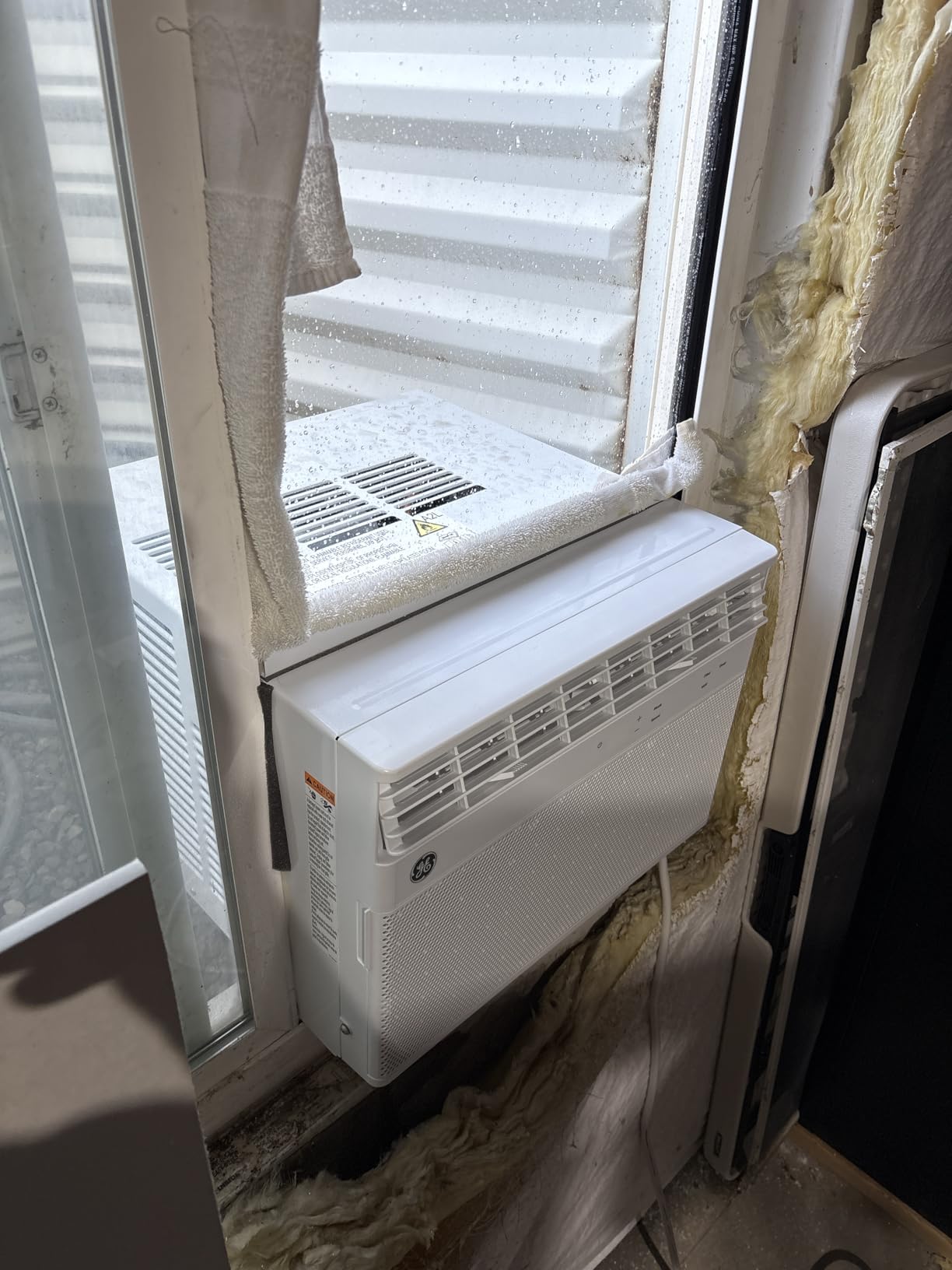
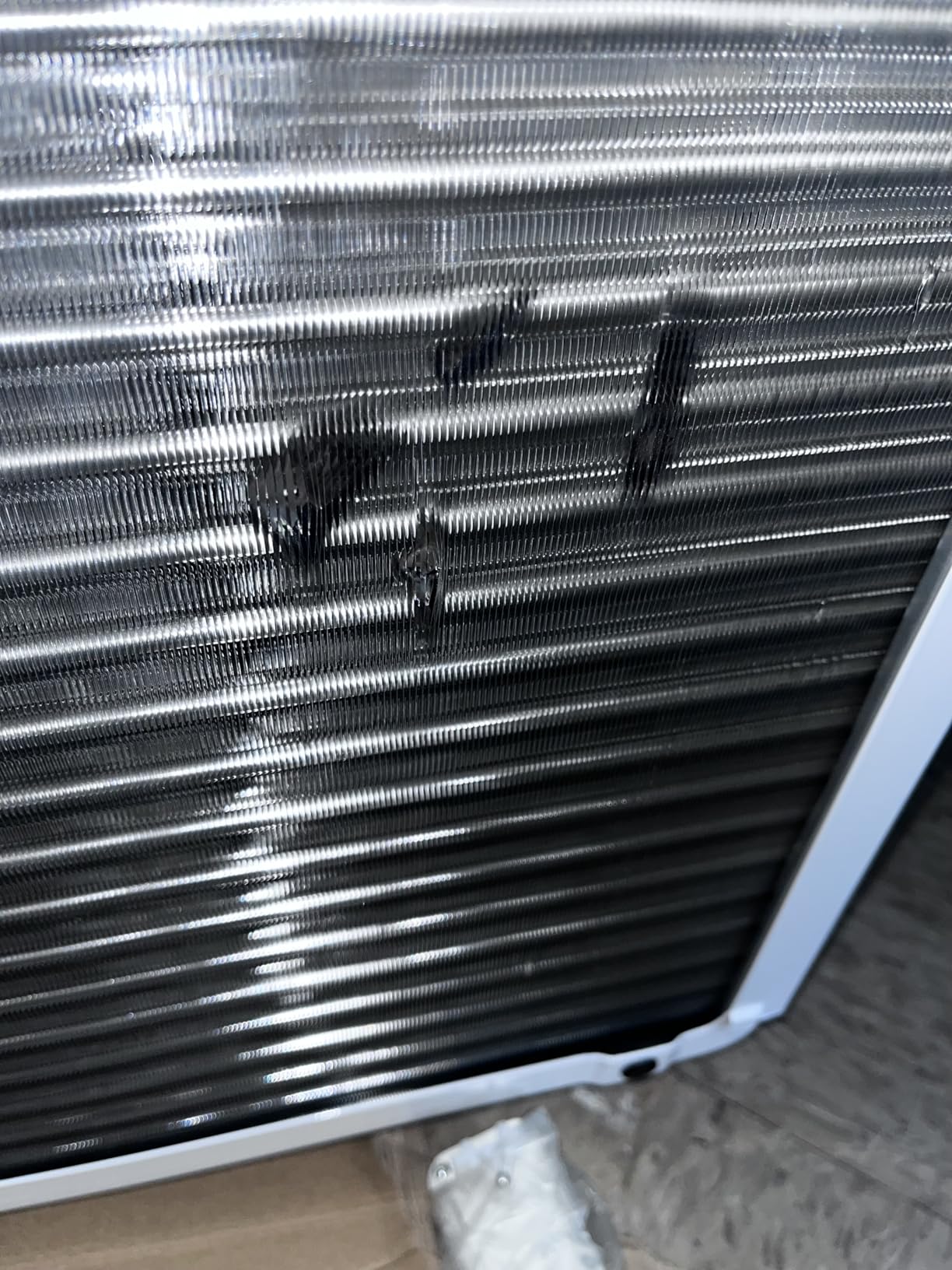
The reason this model sits low in the ranking is the reviews, not the specification. The average rating of 3.8 is the lowest in this roundup, and the cause is a meaningful cluster of buyers who received units that ran and blew air without cooling, which points to a refrigerant or quality control issue rather than a sizing problem. Add 59 dB operation and very small vertical louvers that push air straight forward with no way to aim it across a room, and it becomes hard to recommend for a space where you sit.
SEER of 11.4 reflects a conventional compressor, so it cycles rather than modulates. It is also the loudest of the three 12,000 BTU units here, which is a fair trade for raw output in a garage but a poor one for a living area.
What to check before you buy the GE 12,000
Read the failure reports before ordering, and keep the packaging until you have run it for a full day. A unit that does not cool is usually obvious within the first hour, and the return window matters more here than on any other model in this roundup. Confirm the window fits the 25 inch width minimum and 14.563 inch height.
Think about where the air goes. The small louvers direct output forward and downward rather than across the room, so plan the window position to suit a space where air movement near the unit is enough, rather than one where you sit far from it.
Where the GE 12,000 falls short
The run-without-cooling cluster is the deal breaker for most people. A 3.8 average with 21 percent one-star reviews is a lot worse than a mediocre unit, and it reflects a manufacturing consistency problem rather than a design flaw.
Louvers, noise and efficiency compound the problem. At 59 dB with no airflow direction control, and SEER of 11.4, this unit is workable in a utility space and frustrating anywhere you intend to sit for hours.
8. ROVSUN 10,000 BTU Inverter (Window AC-inverter-10K) – Best for Quiet Sleep
ROVSUN 10000 BTU Window Air Conditioner with Inverter Compressor, AC Unit for Window with Remote Control, Timer Function & Pre-Installed Side Panels for Easy Operation & Installation, 115V/60Hz
10000 BTU
520 sq ft
42 dBA
115V
CEER 15.0
57.8 lb
Pros
- Sleep mode at 42 dBA is among the quietest figures in the roundup
- CEER of 15.0 with an inverter compressor cuts running cost
- Pre-assembled side panels cut roughly 30 percent of install time
- 4-way swing and ECO mode with a 24-hour timer
- Drawer draws about 5.5 amps so an ordinary household circuit works
Cons
- A minority of buyers report units that do not cool at all
- No condensate drain elbow included
- Less established brand with a much lower sales rank than the majors
- Brief startup buzz on first run reported by some
The number that matters here is 42 dBA in sleep mode, and it is what makes this the sleeper’s pick. For a large bedroom or a home office where you need cooling without background noise, this is the quietest conventional-capacity option in the roundup, and buyers describe it as able to run all night without becoming the thing that wakes you.
Efficiency is excellent alongside the quietness. A CEER of 15.0 from an inverter compressor with a claimed 35 percent energy saving versus traditional units, running on 115V, and the drawer pulls about 5.5 amps, which means an ordinary household circuit is fine. No electrician, no 230V upgrade, no dedicated line.
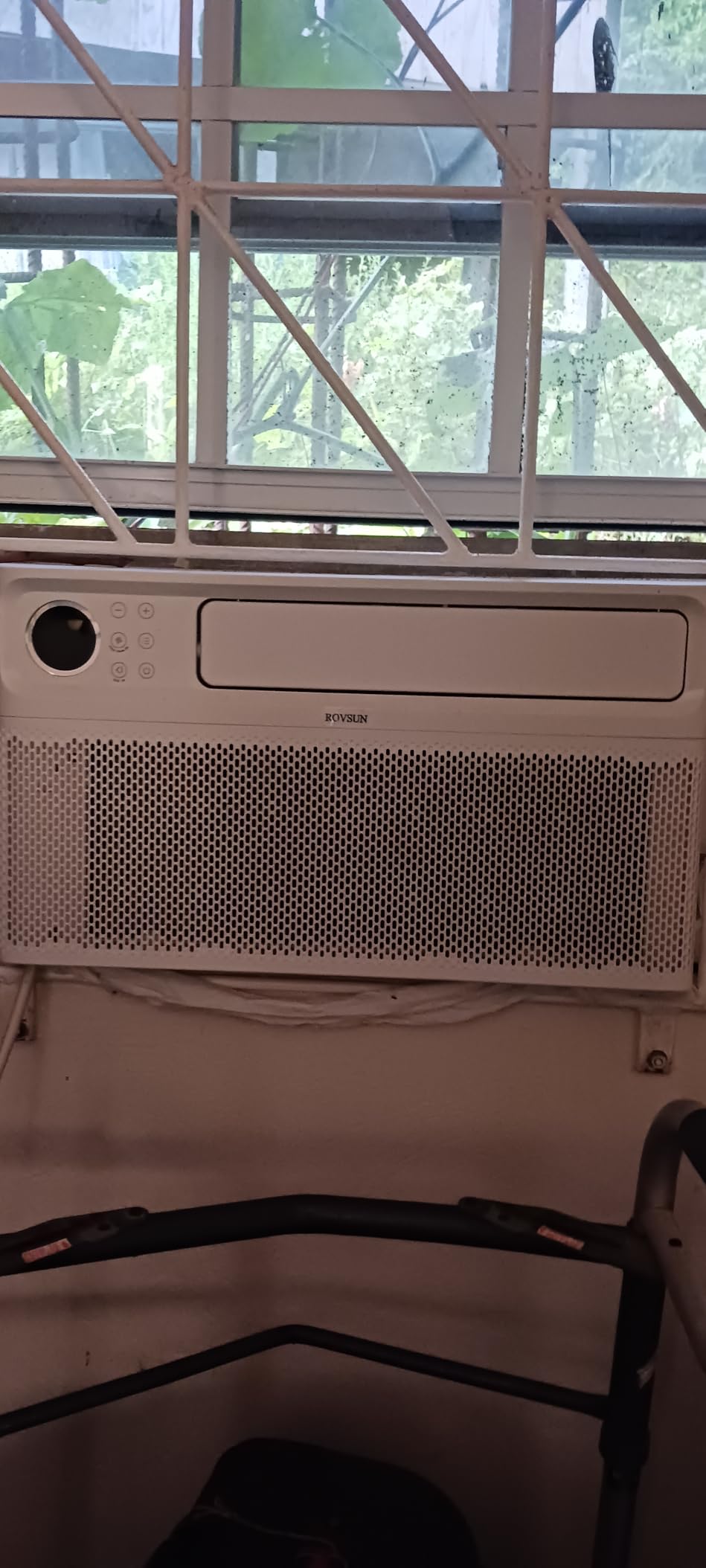
Installation is the other selling point. The side panels come pre-assembled, which owners say shaves roughly 30 percent off the work, and the window range of 23 to 34 inches wide by 14.5 inches tall is easy to measure. Cooling, dehumidifier and fan-only modes cover the usual uses, and a 4-way swing spreads the output.
Two practical notes. The condensate drain elbow is not included, so gravity drainage needs managing, and a small but real group of buyers report units that never cooled at all. Keep the box and check it thoroughly in the first 24 hours. A brief startup buzz from the refrigerant on initial run is reported by some and is not a fault.
What to check before you buy the ROVSUN 10,000
Confirm the window gives you 23 inches of width and 14.5 inches of height, and plan where the condensate goes before install day. Without a drain elbow, the rear drain needs an external route, and that is a five-minute planning step that prevents the water-on-the-sill problem owners complain about most often.
Weight is manageable at 57.8 pounds, but a bracket still belongs on any window above the ground floor. This is one of the quieter units, so a rattly bracket is more noticeable than it would be on a loud conventional box.
Where the ROVSUN 10,000 falls short
The units-that-do-not-cool reports are the main concern, and with 158 ratings the sample is smaller than the models above, so the failure rate is harder to judge. Test cooling thoroughly before the return window closes.
Brand support is thinner than the majors, with a much lower sales rank, which matters if a part is needed years later. And 520 square feet of rated coverage is modest for a genuinely large living room.
9. Windmill 10,000 BTU WhisperTech (10W2Wi) – Best for Upward Airflow Design and Efficiency
Windmill 10,000 BTU Quiet Window Air Conditioner, Cools up to 350-450 sq ft
10000 BTU
450 sq ft
40 dB
115V
SEER 17
71.3 lb
Pros
- SEER of 17 is the highest efficiency figure in the roundup
- Dual intake pulls from the front and bottom and outputs air upward at about 45 degrees
- Installs in roughly 5-20 minutes with the pre-assembled kit and included tools
- Dual filtration with a washable mesh plus an optional carbon filter
- Auto-dimming LED and a design with no visible vents
Cons
- Warranty reportedly requires video documentation of defects
- Some units developed a loud clunk and shut down within weeks
- App has stopped connecting or shown frozen readings for some owners
- Not every size uses true variable-speed compression so noise can exceed 40 dB
The design here is genuinely different from every other unit in this roundup, and it solves a specific large-room problem. Air is drawn in from the front and the bottom, then directed upward at about 45 degrees, so the cold stream travels along the ceiling and descends across the room instead of firing at whatever is directly in front of the window. In a large open space, that is the difference between cooling the room and cooling the seat by the sill.
SEER of 17 is the highest figure in this roundup, and it comes with double-insulating side panels that cut noise transfer as well as energy use. The 40 dB rating is second only to the Midea U-shaped. Filter handling is above average too, with a washable mesh filter plus an optional activated carbon filter for odour and particulate.
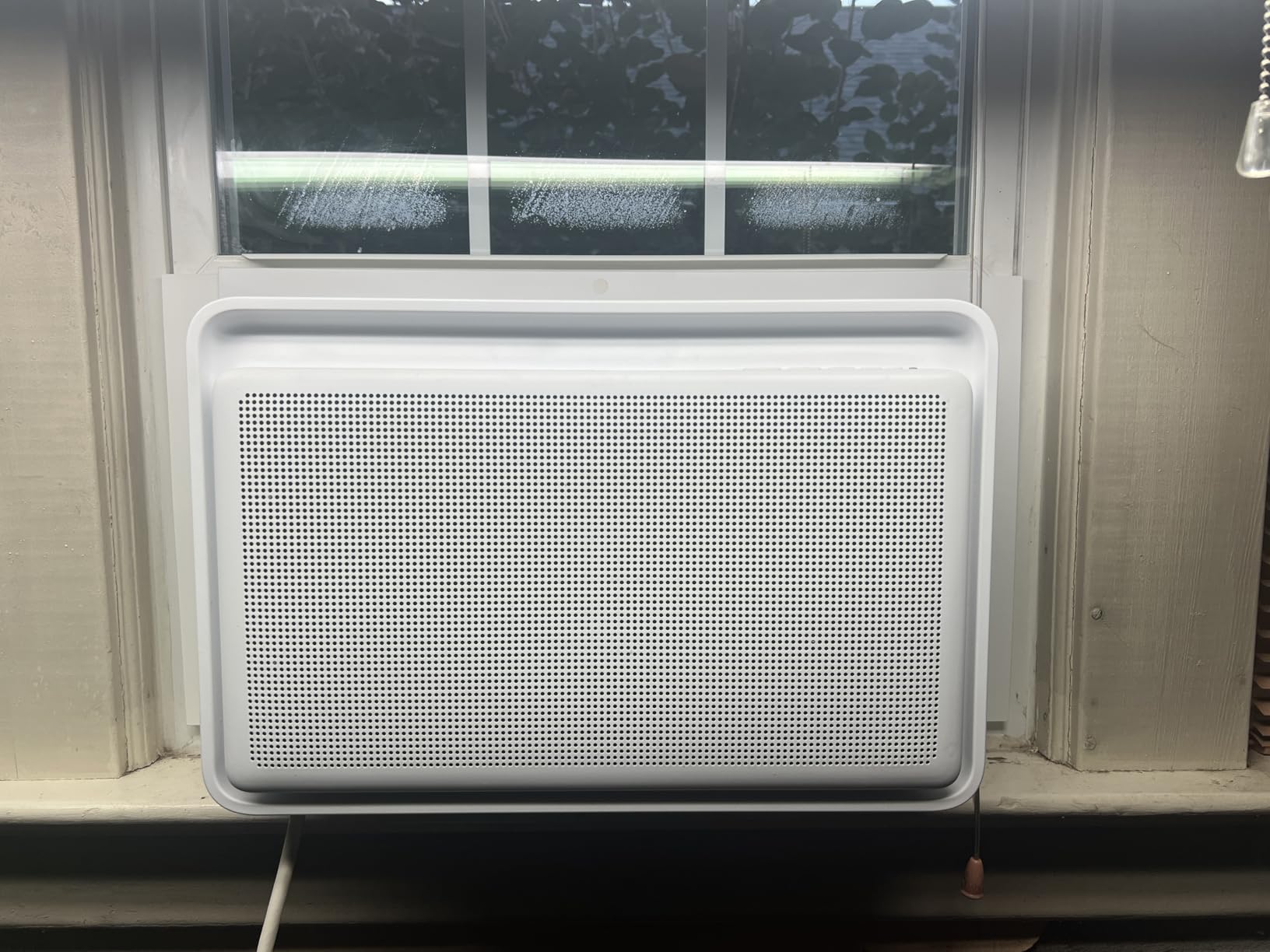
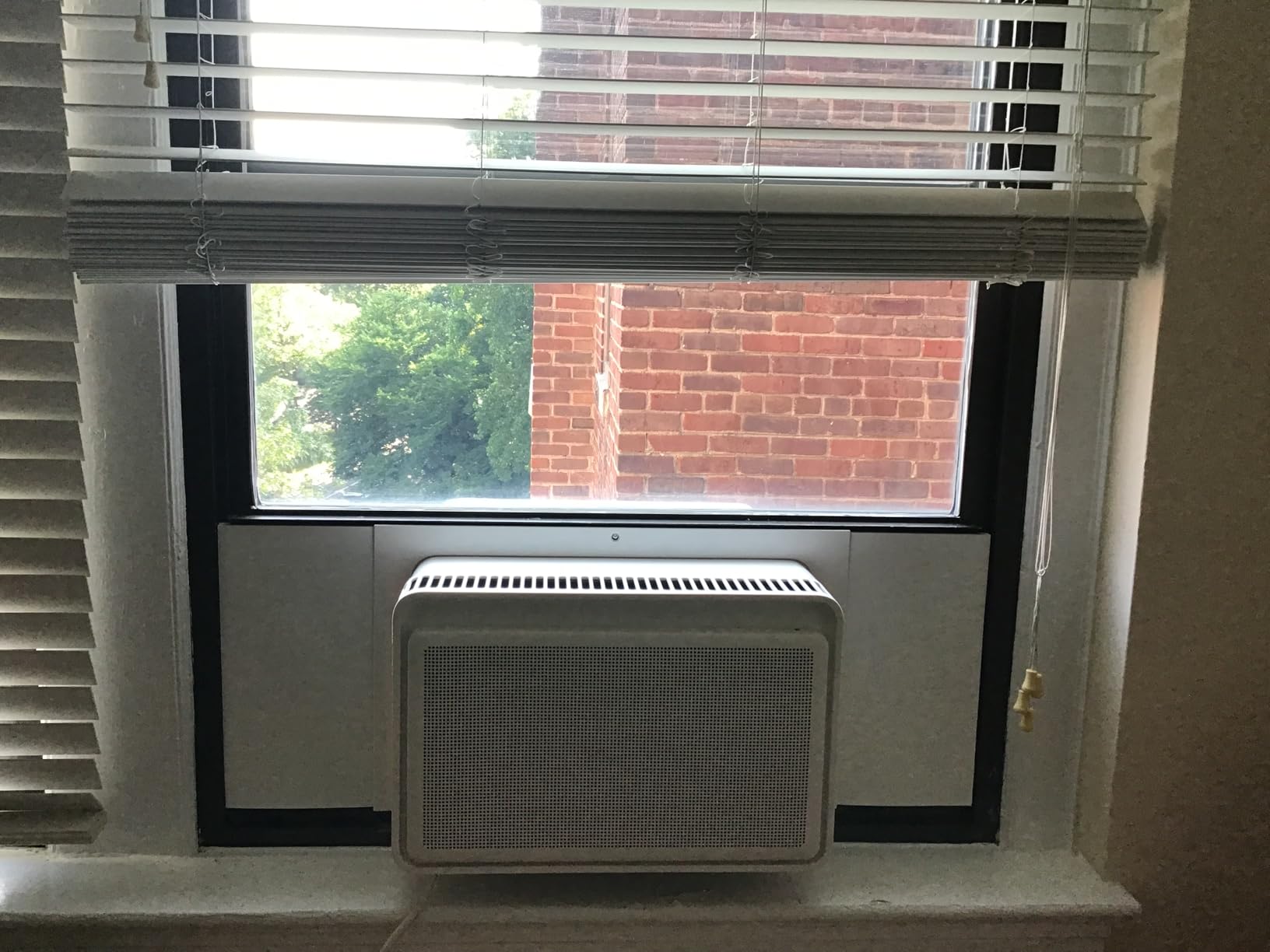
Installation is the easiest of any unit here. The pre-assembled kit and included tools mean most owners finish in five to twenty minutes with no tools of their own, and the product itself has no visible vents, which changes how a window looks from inside a room. Control is a remote, a touch panel with auto-dimming lights, three cooling settings and three fan speeds.
The 3.9 rating reflects real problems, and with 1,725 ratings they are impossible to ignore or explain away. The warranty reportedly requires video documentation of defects, which reviewers consider a serious limitation. Some units developed a loud clunk and shut down within weeks, and the app has stopped connecting or shown frozen room-temperature readings for a number of owners.
What to check before you buy the Windmill 10,000
Read the warranty terms before you buy, not after something fails. A warranty that hinges on video evidence of the defect changes how you should approach any problem with this unit, and that is worth knowing on a front porch rather than in month eight. Keep the original packaging for the same reason.
Check the actual noise in your room rather than trusting the 40 dB figure alone. Not every size in this line uses true variable-speed compression, so on high fan settings the real sound level can exceed the claim, and buyers on r/smarthome threads note the difference is noticeable in a bedroom.
Where the Windmill 10,000 falls short
Reliability is the honest concern. A cluster of units failing with a clunk within weeks, combined with a documentation-heavy warranty, makes this a harder recommendation than its design and efficiency deserve. Service has been reported as responsive in some cases, including goodwill replacements, but that is goodwill rather than contract.
The set temperature can read a few degrees away from actual room temperature, and the app is unreliable for some owners. It also carries the highest price per unit among the 115V models here, and at 71.3 pounds it is a deliberate two-person lift.
10. Midea 24,000 BTU Smart Inverter 230V (MAW24S2VWT-A) – Best for Whole-Floor Cooling up to 1,500 Sq Ft
Midea 24,000 BTU Smart Inverter 230V Window Air Conditioner, Cools up to 1,500 sq ft, with Wi-Fi Control
24000 BTU
1500 sq ft
48.5 dB
230V
SEER 14
98.3 lb
Pros
- Only unit in the roundup rated for whole-floor cooling at 1500 sq ft
- Cools an entire floor in about 20 minutes from a hot start
- Variable-speed inverter with SEER of 14 and 40 percent energy savings claim
- Quiet for its capacity at about 48.5 dBA
- Window bracket included with app remote and voice control
Cons
- Requires a dedicated 20-amp 230V circuit and not a standard 15-amp plug
- Heaviest unit in the roundup at about 98 lb
- Installation is bulky in the window and can take around 40 minutes
- One buyer reported a unit that stopped powering on after six weeks
This is the only window unit here that can cool an entire floor. Its 24,000 BTU rating covers 1,500 square feet, and owners report cooling homes considerably larger than that when the space is open. If your large room is actually a great room, a loft, or a main floor with high ceilings, this is the model that matches the problem.
Efficiency holds up despite the capacity. SEER of 14 from a variable-speed inverter with a claimed 40 percent saving versus the energy conservation standard means the running cost is not what an old 24,000 BTU unit would cost, and owners consistently describe it as quiet for its size at about 48.5 dBA. Four modes, three speeds, a 24-hour timer and ECO mode are all present.
The electrical requirement is the real gate. It needs a 230V dedicated 20-amp circuit, not a standard 15-amp household plug, so you should confirm the panel and the run length before you order. The window needs to be between 28 and 40.5 inches wide with 18.5 to 36 inches of height, which excludes a lot of older housing stock.
At 98.3 pounds this is the heaviest unit in the roundup, and installation is a genuine project that owners put at around forty minutes. The included window bracket is a meaningful part of the package at this weight, and on an upper floor it is not optional.
What to check before you buy the Midea 24,000
Have an electrician confirm a 20-amp 230V circuit is available before you buy anything. This is the single check that decides whether the unit is possible, and retrofitting a circuit can cost more than the equipment. The appliance draws about 3,200 watts, so a shared circuit with other large appliances is not acceptable.
Measure the window twice and check the upper limit. At 40.5 inches wide by 36 inches tall, this unit needs one of the largest windows in residential use, and an over-sill installation on a wide opening may be a better route if the sash is short. Structural support matters more than ever at this weight.
Where the Midea 24,000 falls short
The circuit requirement puts it out of reach for renters, older homes without panel capacity, and anyone who cannot host a small electrical job. That is a real constraint, not a preference.
At nearly 100 pounds with a bulky chassis, install takes planning, a second person and a properly rated bracket. It is also louder than smaller units, as any unit of this capacity would be, and one buyer reported a unit that stopped powering on after about six weeks.
How to Size a Window AC for a Large Room (BTU per Square Foot)?
Start with 20 BTU per square foot, then adjust. That is the number most manufacturers’ charts and most installers use as a baseline, and it is a good one for a normally insulated room with standard 8 foot ceilings. Multiply your room’s length by its width, multiply that by 20, and you have a starting capacity rather than a final answer.
Then adjust for the room itself. Add roughly 10 percent for a sun-facing room with west or afternoon sun, and roughly 10 to 20 percent for ceilings above 8 feet, since the conditioned volume is larger than the floor area suggests. Add 5 to 10 percent for a room with several windows or a top floor. Subtract a little for a shaded, well-insulated, lower-level room, but not much, because undersizing is the more expensive mistake.
Worked example for a common case. A 700 square foot living room at 20 BTU per square foot calls for 14,000 BTU, and with a sun-facing wall that becomes roughly 15,400. Nothing in this roundup sits exactly at 14,000, which is normal. The practical answer is a 12,000 BTU unit for a moderately exposed room or a step up to a 24,000 BTU 230V model if the space is open to the rest of the floor.
The over-sizing trap is real and worth understanding. A unit with far more capacity than the room needs drops the temperature quickly and then cycles off, and a conventional compressor that cycles off does not strip much moisture while it is off. The result is a room that is cool and clammy rather than cool and dry. If a room feels cold but humid, the unit is very likely too big, and the fix is a smaller unit rather than a dehumidifier.
Watch the 12,000 BTU question specifically, since it comes up constantly. Rated at 450 to 550 square feet, a 12,000 BTU unit is the right answer for a large bedroom, a den or a standard living room, and it is the sweet spot in this roundup: 115V power, inverter options, and coverage that most open floor plans can live with. Is 8,000 BTU or 12,000 BTU better? For a large room, 12,000, without much debate.
115V vs 230V: Which Circuit Your Large Room Needs
The rule is straightforward, and getting it wrong stalls the whole project. Units up to about 12,000 BTU in this roundup all run on 115V and plug into a standard household outlet. Above roughly 18,000 BTU, you are in 230V territory with a dedicated circuit, and the two 230V units covered here are the 12,000 BTU ROVSUN and the 24,000 BTU Midea.
Note the exception. A 12,000 BTU unit does not automatically mean 115V, because a heating function at that capacity often pushes the current up. The ROVSUN 4-in-1 is the example here: it cools 550 square feet on a 208/230V circuit, and buyers who assumed a standard plug discovered otherwise at install time. Read the voltage line, not just the BTU.
A 230V unit needs a dedicated 20-amp circuit and, for the 24,000 BTU model, a panel that can carry it. If you are renting, that conversation starts with your landlord. If you own an older home, the panel may need work before the appliance does. The 115V inverter options in this roundup are the safer path for most households for exactly that reason.
Two units on one circuit is a mistake. If you are cooling an open floor plan with two window units, run them on separate circuits, because a single 15-amp line cannot carry two compressors cycling at the same time. This is the strategy that actually works for open plans, and it is more reliable than trying to find one enormous unit for a space that has no window big enough to hold it.
What the Noise Rating Actually Means for a Large Room
Decibels in this category range from about 32 dB to 63 dB, and that spread matters more in a large room than it does in a small one, because a large room holds more of the sound. Below 45 dB is close to background noise in a quiet house. Around 50 dB you will notice it when the room is otherwise silent. Above 60 dB, conversation gets raised and sleep gets interrupted.
Measured against that scale, the differences here are stark. The Midea U-shaped at 32 dBA and the Windmill at 40 dB behave like a fan. The ROVSUN 10,000 at 42 dBA in sleep mode is close behind. The LG at 52 dB and the Della at 56 dB are noticeable in a bedroom. The GE units and the ROVSUN 12,000 at 59 to 63 dB are conversation-changing, which is fine in a garage and wrong next to a bed.
Two further details are worth knowing. Inverter compressors are quieter partly because they never hard-cycle, so a variable-speed unit at the same capacity tends to sit at a lower average level than a conventional one. And airflow design changes the character of the sound: a unit that throws air straight at the nearest surface is louder in practice than its rating suggests, while a unit that directs output upward spreads the same cooling load more quietly.
Compressor placement matters too, and all window units put the compressor outside the room with the evaporator fan inside. The noise people describe in reviews is largely fan noise, gear rattle and the air moving through the chassis, which is why a unit with a bigger grille and a targeted output pattern can sound better than a smaller one pointed at a bare wall.
Window Fit, Weight, Brackets and Condensate Drainage
Window compatibility is a first-order filter, not a footnote. Every unit here has a published window range, and they are not interchangeable. A unit needing 26 inches of width and 16 inches of height will not fit a window that a 13 inch-high unit accepts, and in a row of older houses that difference decides the purchase. Measure the clear opening, not the frame, and check the height as carefully as the width.
Double-hung windows are the easy case, which is why nearly every model here targets them. Casement and hopper windows are harder because of the sash swing and the opening direction, and side-sliding windows in particular cause trouble for U-shaped chassis that need square side panels. Where a window has an exterior grate, a sash lock that fouls the chassis, or a historic-district restriction, the unit choice is made for you. One r/AirConditioners user with an exterior window grate described the search for anything that would physically fit as the hardest part of the whole project.
Weight deserves its own warning, because it is the biggest install risk here. The units in this roundup weigh between 56.9 and 98.3 pounds. Anything above the ground floor should be bracketed before the unit goes in, and the bracket should be rated for the actual weight rather than a generic figure. A unit resting on the sash alone, on an upper floor, is a falling-object risk that costs very little to avoid.
Condensation is the most common installation complaint, and it is nearly always a pitch problem. The unit should be tilted very slightly outward so condensation runs to the back and out, rather than inward to the sill or the floor. If the unit sits dead level, water has nowhere to go. Check that the drain ports are clear and that the drain elbow, where the manufacturer supplies one, is fitted and routed outside.
Sealing the gap around the unit is the efficiency lever most people skip. Foam weatherstripping on the top and bottom edges and a bead of suitable caulk around the chassis reduces the hot-air leak that makes a window unit work overtime. The same seal cuts outside noise, which matters most in a city apartment. And a bubble level during install catches the tilt mistake before water finds it.
Filter maintenance and off-season storage are simple. Most units here use a slide-out or removable washable filter, with cleaning intervals stated around 30 days. Vacuum or rinse it monthly during the season, and for the winter, drain the unit fully, wrap the cord, cover the chassis and leave the sash lockable so moisture does not sit inside the cabinet all winter.
When a Large-Room Window AC Is the Wrong Choice
Past roughly 1,000 square feet of open space, a window unit starts to lose the argument on paper as well as in practice. A mini-split head and outdoor unit moves air across a much larger volume with variable speed, and the indoor head can sit out of the airflow instead of being the airflow. The tradeoff is installation cost and the fact that it needs a wall, a lineset route and a professional install rather than a window and a plug.
Portables are the third option, and the honest reason they lose is the single-hose design. A portable pulls room air in, cools it, and exhausts hot air and moisture through one hose, so the negative pressure pulls uncooled air back in continuously. In a large room, that extra air movement is a permanent tax on efficiency, and no amount of marketing changes the physics.
A window unit is the wrong choice for renters who cannot modify anything, for historic-district properties, and for any home without a window large enough or a circuit adequate enough. It is also the wrong choice for a room where the far side never cools, since a single window unit throws air in a line rather than circulating it, and two smaller units on separate circuits serve an open plan better than one oversized unit.
On the other hand, a window unit is exactly right when you need one room cool, when you cannot alter the property, and when you want cooling that is back on after a power outage with no work. Buyers on r/Costco chasing the largest capacity for the money are making the same trade in the opposite direction, and the inverter units in this roundup are the version of that instinct worth acting on.
Frequently Asked Questions
Which AC window unit is best for large rooms?
For most large rooms, the Midea 10,000 BTU U-shaped smart inverter is the strongest all-round choice because it runs at about 32 dBA, lets the window close, and runs on a 115V plug while cooling 450 sq ft. For rooms above 550 sq ft, step up to a 12,000 BTU unit, and above 1,000 sq ft of open space, use two units on separate circuits or a mini-split.
What size room will a 12000 BTU window air conditioner cool?
A 12,000 BTU window air conditioner is rated for roughly 450 to 550 square feet with standard 8 foot ceilings. Increase that estimate by about 10 percent for a sun-facing room and 10 to 20 percent for ceilings above 8 feet, since the cooled volume grows faster than the floor area.
Which is better, 8000 BTU or 12000 BTU, for a large room?
For a large room, 12,000 BTU is the better choice. An 8,000 BTU unit is sized for rooms around 350 square feet, so in a space above 450 square feet it runs continuously, never catches up and leaves the far side of the room warm. Oversizing in the other direction is also a problem, because a unit that cools too fast cycles off before removing enough moisture.
Do window air conditioners need a dedicated circuit?
Most 10,000 and 12,000 BTU units in this roundup run on a standard 115V household outlet, though some higher-capacity models with a heating function need 208/230V. Units at 18,000 BTU and above, including the 24,000 BTU model here, need a dedicated 20-amp 230V circuit. If you plan to run two window units at once, put them on separate circuits.
What are the downsides of a window air conditioner?
The main drawbacks are installation effort, limited airflow reach, noise, and window fit. Large units weigh 57 to 98 pounds and usually need two people plus a support bracket, especially above the ground floor. Air is thrown in a line rather than circulated, so the far side of a large room stays warmer, and units above about 60 dB interfere with conversation and sleep. Condensation also needs a slight outward tilt to drain properly.
Conclusion: Which Large-Room Window AC to Buy in 2026
Start with the number, not the brand. Measure the room, apply 20 BTU per square foot, add for sun and ceiling height, and you will know whether you need a 10,000, 12,000 or 24,000 BTU unit before you look at a single listing. Then check three things in this order: whether the window opening accepts the unit’s stated width and height, whether your circuit is 115V or 230V, and whether the noise rating suits the room.
With that done, our best window air conditioner for large rooms is the Midea 10,000 BTU U-shaped smart inverter. It is quiet enough for a shared space, efficient enough to run cheaply, and flexible enough to fit more window types than a conventional chassis. For rooms over 550 square feet, the Midea 12,000 BTU with heat is the step up, and for a bedroom where noise decides the purchase, the ROVSUN 10,000 BTU inverter at 42 dBA is the sleeper’s pick.
If your large room is really an entire floor, the Midea 24,000 BTU 230V model is the only window unit here that can take it, provided your panel can support a dedicated 20-amp circuit. If the window cannot host a unit that size, two smaller units on separate circuits or a mini-split will cool an open plan better than one oversized box ever could.
Check the current specification and availability for your exact window and circuit before you buy, since fit and voltage are the two things that cannot be changed later. In 2026, the best window air conditioners for large rooms are still decided by those two numbers, not by the badge on the box.